. 2015;7(5):805-11.
doi: 10.1080/19420862.2015.1073429.

Consistency of quality attributes for the glycosylated monoclonal antibody Humira® (adalimumab)

Affiliations

Consistency of quality attributes for the glycosylated monoclonal antibody Humira® (adalimumab)

Paul W Tebbey et al. MAbs. 2015.

Abstract

Humira® (adalimumab) is a recombinant human IgG1 monoclonal antibody (mAb) glycoprotein consisting of 1330 amino acids that is specific for human tumor necrosis factor (TNF). The biological activity and clinical profile of mAb therapeutics, including adalimumab, is influenced by their protein structure and glycosylation patterns, which can be affected by the expression system, cell culture conditions and purification process methodology. While clinical outcome cannot yet be attributed to many of the individual structural features that constitute a mAb, it is evident that detailed structural attribute analysis is necessary if structural contributions to function are to be comprehensively defined. Adalimumab product quality data generated from over a decade of manufacturing across multiple production sites and through a series of manufacturing scale changes are presented here. These data reveal a consistent and tightly controlled profile for the product.

Keywords: adalimumab; biosimilars; manufacturing; oligosaccharides; quality attributes.


Figures
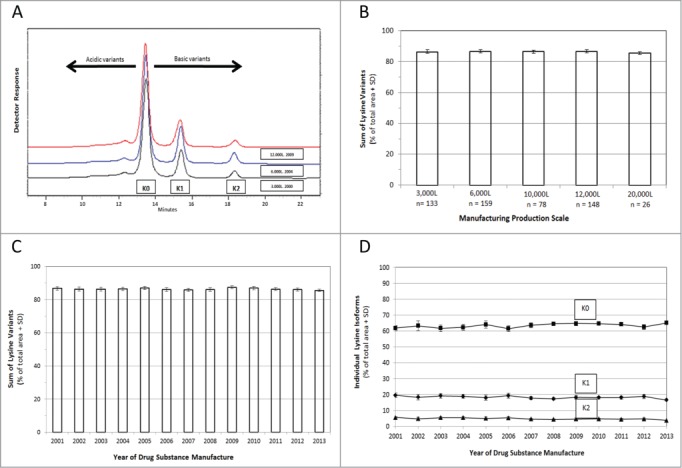
Figure 1.
Figure 1.
Lysine Profiles of Humira®. Chromatograms of representative batches are displayed in A; 3,000L (Black; 2000), 6,000L (Blue; 2004), 12,000L (Red; 2009). WCX-HPLC was performed on batches of Humira that derived from scale-up production (3,000 to 20,000 liters, B) and through each year 2001 to 2013 (C & D). The chromatograms illustrate the relative retention time and relative peak areas. The relative amount of the 3 C-terminal lysine isoforms (K0, K1, K2) was calculated from the chromatograms as a percent of total area. The mean sum of lysines of multiple batches per data point is presented with standard deviation (n = 544 batches for B and 525 total batches included for C and D). The number of drug substance batches evaluated per data point is displayed in B. For each year 2001 to 2013 (C and D), the number of batches included in each data point is 13, 38, 50, 44, 54, 40, 37, 34, 24, 34, 57, 52, 48, respectively. The mean of individual lysine species (K0 [square], K1 [diamond] & K2 [triangle]) is presented with standard deviation (D).
Figure 2.
Figure 2.
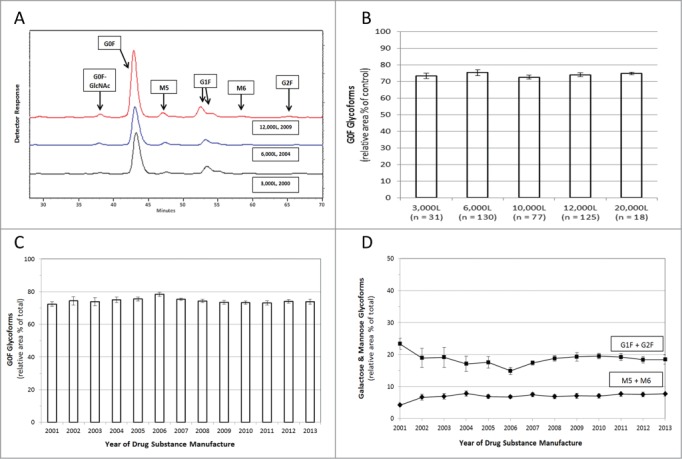
Glycan Mapping of Humira®. Assessment of oligosaccharides was performed using NP-HPLC to separate fluorescent-labeled glycan species. (A) Representative chromatograms of Humira® reference standards from different scale / years displaying glycan elution patterns (3,000L (Black; 2000), 6,000L (Blue; 2004), 12,000L (Red; 2009). The chromatograms illustrate the relative retention time and relative peak areas. The relative amount of each glycan species was calculated from the chromatograms as a percent of total area. (B) Agalactosyl fucosylated biantennary oligosaccharides (G0F) are displayed by scale-up production (3,000 to 20,000 liters; mean ± standard deviation, total n = 381). (C) Agalactosyl fucosylated biantennary oligosaccharides (G0F) were analyzed through time (mean plus standard deviation). The number of drug substance batches (total n = 381) evaluated per data point for each year 2001 to 2013 is 4, 6, 8, 15, 45, 18, 29, 34, 30, 43, 55, 46, 48, respectively (C and D). (D) Galactose-containing fucosylated biantennary oligosaccharides (G1F + G2F) are plotted (squares) with detectable oligomannose species (M5 + M6) (diamonds) with each data point displaying 1 SD of the mean.
Figure 3.
Figure 3.
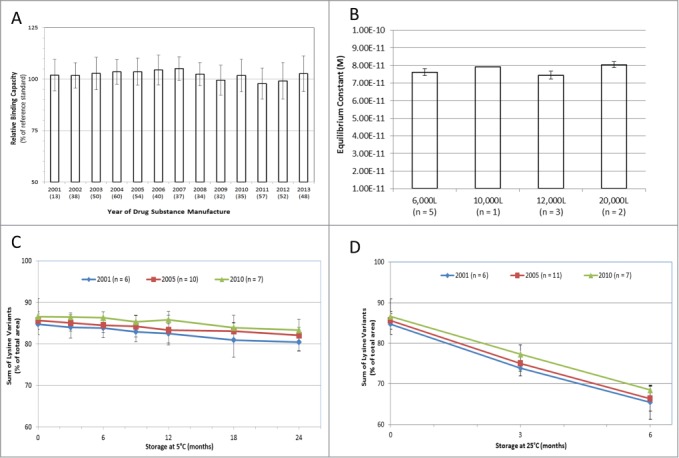
Binding Affinity and Stability Profiles of Humira®. The binding capacity of Humira® drug substance to recombinant human TNF was assessed by anti-TNF ELISA (A) and by surface plasmon resonance (B). For anti-TNF ELISA, test batches are represented from each year of manufacture from 2001 to 2013 (n = number of batches per data point). Results are presented as the percent binding capacity of the test sample relative to that of the reference standard (black bars) plus standard deviation. Intrinsic binding affinities of adalimumab were determined by surface plasmon resonance via measurement of the rates at which soluble TNF bound to and dissociated from single antigen-binding sites of surface-bound adalimumab. The graph displays the molar equilibrium constant for batches of adalimumab by manufacturing scale (total n = 11) (B). Sum of lysine variants of adalimumab drug product stored at 5°C for up to 24 months as measured by WCX-HPLC (C). Samples derive from 2001 (diamond, n = 6), 2005 (square, n = 10) and 2010 (triangle, n = 7). The mean sum of lysines is presented with standard deviation. Sum of lysine variants of Humira® drug product stored at 25°C for up to 6 months as measured by WCX-HPLC (D). Samples (Mean ± SD) derive from 2001 (diamond, n = 6), 2005 (square, n = 11) and 2010 (triangle, n = 7).

References

    1. Abbvie Inc. Humira® [package insert] North Chicago, IL: 2014.
    1. Burmester GR, Panaccione R, Gordon KB, McIlraith MJ, Lacerda AP. Adalimumab: long-term safety in 23 458 patients from global clinical trials in rheumatoid arthritis, juvenile idiopathic arthritis, ankylosing spondylitis, psoriatic arthritis, psoriasis and Crohn's disease. Ann Rheum Dis 2013; 72:517-24; PMID:22562972; http://dx.doi.org/10.1136/annrheumdis-2011-201244 - DOI - PMC - PubMed
    1. Gordon K, Papp K, Poulin Y, Gu Y, Rozzo S, Sasso EH. Long-term efficacy and safety of adalimumab in patients with moderate to severe psoriasis treated continuously over 3 years: results from an open-label extension study for patients from REVEAL. J Am Acad Dermatol 2012; 66:241-51; PMID:21752491; http://dx.doi.org/10.1016/j.jaad.2010.12.005 - DOI - PubMed
    1. Keystone EC, van der Heijde D, Kavanaugh A, Kupper H, Liu S, Guerette B, Mozaffarian N. Clinical, functional, and radiographic benefits of longterm adalimumab plus methotrexate: final 10-year data in longstanding rheumatoid arthritis. J Rheumatol 2013; 40:1487-97; PMID:23818718; http://dx.doi.org/10.3899/jrheum.120964 - DOI - PubMed
    1. Schiestl M, Stangler T, Torella C, Cepeljnik T, Toll H, Grau R. Acceptable changes in quality attributes of glycosylated biopharmaceuticals. Nat Biotechnol 2011; 29:310-2; PMID:21478841; http://dx.doi.org/10.1038/nbt.1839 - DOI - PubMed

Publication types

MeSH terms