


Extinction learning is slower, weaker and less context specific after alcohol
- PMID: 26234587
- PMCID: PMC4655873
- DOI: 10.1016/j.nlm.2015.07.014
Extinction learning is slower, weaker and less context specific after alcohol
Abstract
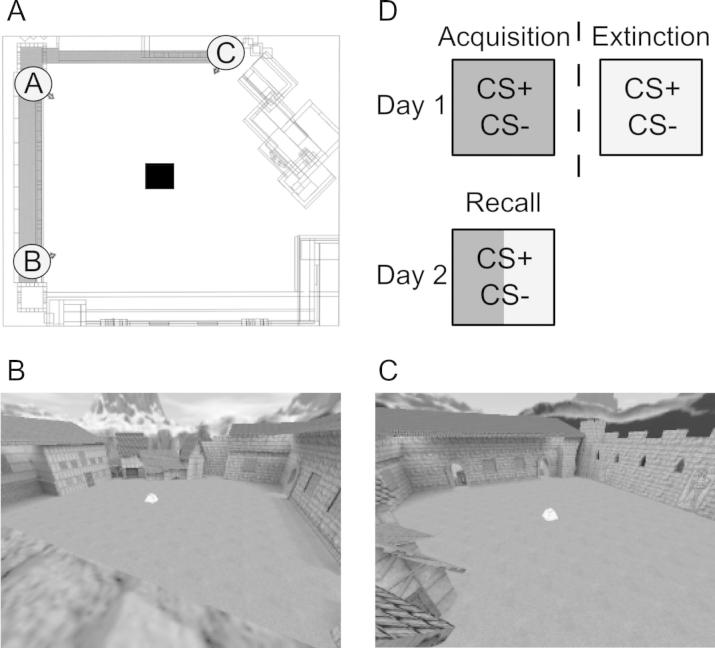
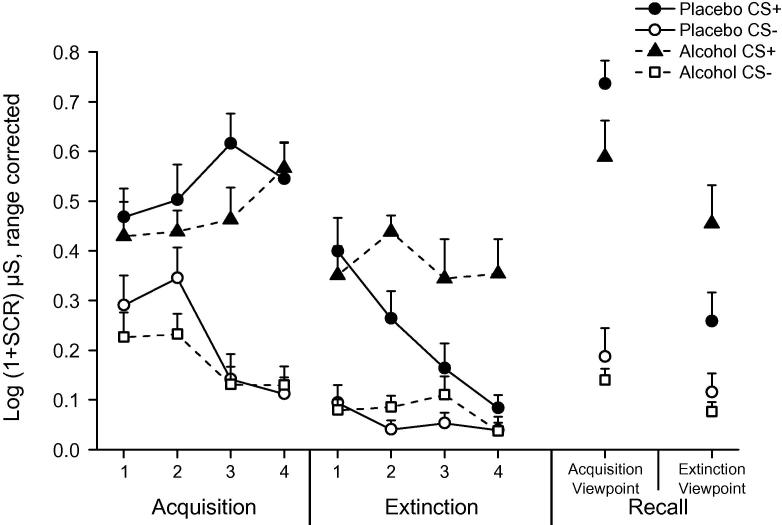
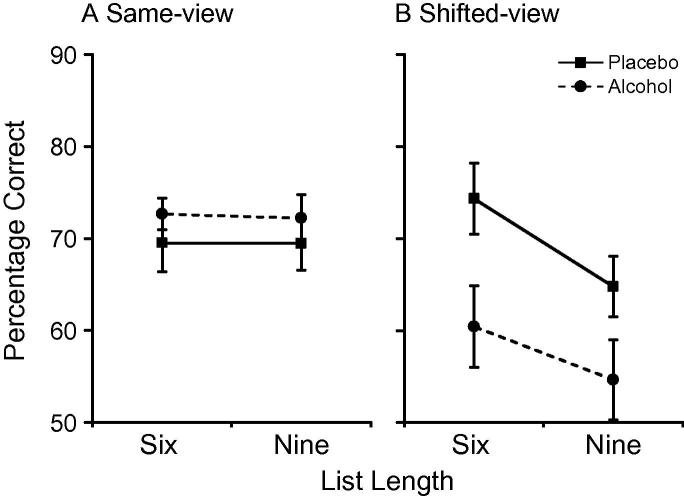
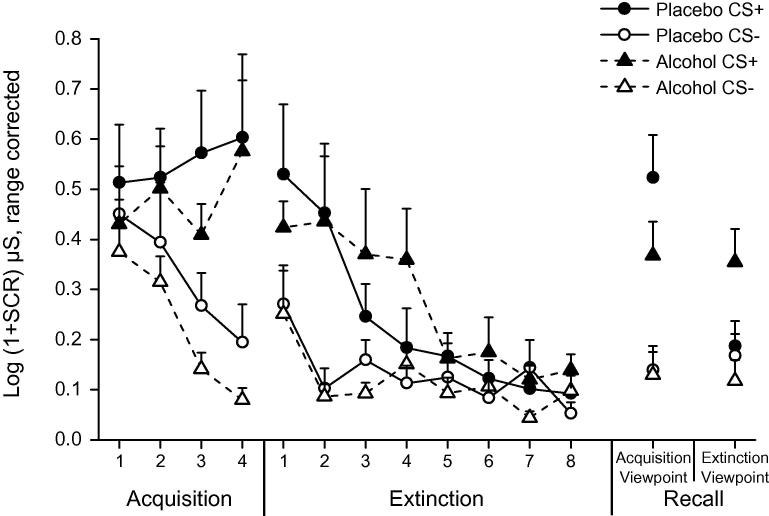
Alcohol is frequently involved in psychological trauma and often used by individuals to reduce fear and anxiety. We examined the effects of alcohol on fear acquisition and extinction within a virtual environment. Healthy volunteers were administered alcohol (0.4g/kg) or placebo and underwent acquisition and extinction from different viewpoints of a virtual courtyard, in which the conditioned stimulus, paired with a mild electric shock, was centrally located. Participants returned the following day to test fear recall from both viewpoints of the courtyard. Skin conductance responses were recorded as an index of conditioned fear. Successful fear acquisition under alcohol contrasted with impaired extinction learning evidenced by persistent conditioned responses (Experiment 1). Participants' impairments in extinction under alcohol correlated with impairments in remembering object-locations in the courtyard seen from one viewpoint when tested from the other viewpoint. Alcohol-induced extinction impairments were overcome by increasing the number of extinction trials (Experiment 2). However, a test of fear recall the next day showed persistent fear in the alcohol group across both viewpoints. Thus, alcohol impaired extinction rather than acquisition of fear, suggesting that extinction is more dependent than acquisition on alcohol-sensitive representations of spatial context. Overall, extinction learning under alcohol was slower, weaker and less context-specific, resulting in persistent fear at test that generalized to the extinction viewpoint. The selective effect on extinction suggests an effect of alcohol on prefrontal involvement, while the reduced context-specificity implicates the hippocampus. These findings have important implications for the use of alcohol by individuals with clinical anxiety disorders.
Keywords: Alcohol; Extinction; Fear memory.
Copyright © 2015 The Authors. Published by Elsevier Inc. All rights reserved.
Figures
References
-
- Bisby J.A., Brewin C.R., Leitz J.R., Valerie Curran H. Acute effects of alcohol on the development of intrusive memories. Psychopharmacology. 2009;204:655–666. - PubMed
-
- Bisby J., King J., Brewin C., Burgess N., Curran H. Acute effects of alcohol on intrusive memory development and viewpoint dependence in spatial memory support a dual representation model. Biological Psychiatry. 2010;68:280–286. - PubMed
-
- Bond A., Lader M. The use of analogue scales in rating subjective feelings. British Journal of Medical Psychology. 1974;47:211–218.
Publication types
MeSH terms
Substances
Grants and funding
LinkOut - more resources
Full Text Sources
Other Literature Sources
