


REDUCING AMBIGUITY IN THE FUNCTIONAL ASSESSMENT OF PROBLEM BEHAVIOR
- PMID: 26236145
- PMCID: PMC4521420
- DOI: 10.1002/bin.1400
REDUCING AMBIGUITY IN THE FUNCTIONAL ASSESSMENT OF PROBLEM BEHAVIOR
Abstract
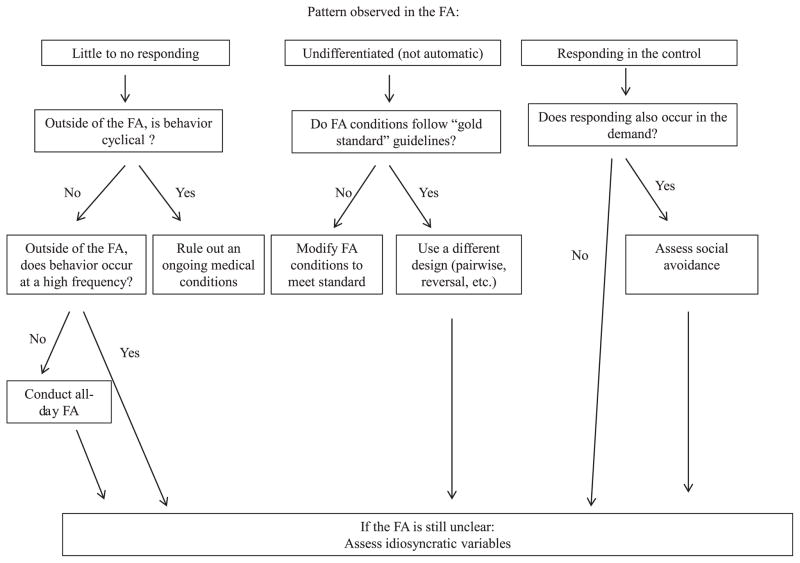
Severe problem behavior (e.g., self-injury and aggression) remains among the most serious challenges for the habilitation of persons with intellectual disabilities and is a significant obstacle to community integration. The current standard of behavior analytic treatment for problem behavior in this population consists of a functional assessment and treatment model. Within that model, the first step is to assess the behavior-environment relations that give rise to and maintain problem behavior, a functional behavioral assessment. Conventional methods of assessing behavioral function include indirect, descriptive, and experimental assessments of problem behavior. Clinical investigators have produced a rich literature demonstrating the relative effectiveness for each method, but in clinical practice, each can produce ambiguous or difficult-to-interpret outcomes that may impede treatment development. This paper outlines potential sources of variability in assessment outcomes and then reviews the evidence on strategies for avoiding ambiguous outcomes and/or clarifying initially ambiguous results. The end result for each assessment method is a set of best practice guidelines, given the available evidence, for conducting the initial assessment.
Figures
References
-
- Asmus JM, Franzese JC, Conroy MA, Dozier CL. Clarifying functional analysis outcomes for disruptive behaviors by controlling consequence delivery for stereotypy. School Psychology Review. 2003;32:624–630. Retrieved from http://www.nasponline.org/publications/spr/index-list.aspx.
Grants and funding
LinkOut - more resources
Full Text Sources
Other Literature Sources