


doi: 10.1016/j.nmni.2015.04.006.
eCollection 2015 Sep.
Sphingobacterium multivorum: case report and literature review
Affiliations
- PMID: 26236492
- PMCID: PMC4501434
- DOI: 10.1016/j.nmni.2015.04.006
Item in Clipboard
Sphingobacterium multivorum: case report and literature review
New Microbes New Infect.
.
Abstract
We describe the case of a 67-year-old African American woman with multiple medical problems who presented with septic shock resulting from Sphingobacterium multivorum bacteraemia. S. multivorum, a Gram-negative bacillus, is ubiquitous in nature and is rarely involved in human infections. However, it is intrinsically resistant to many commonly administered antibiotics and can be a life-threatening microorganism.
Keywords: Extended-spectrum β-lactamase; Gram-negative bacilli; metallo-β-lactamase; moist hospital environments; septic shock; sphingophospholipids.
Figures
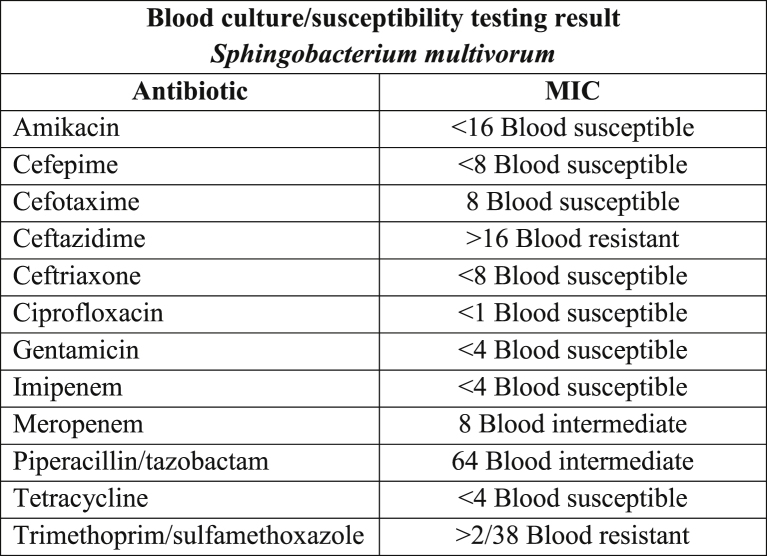
Sphingobacterium multivorum blood culture susceptibility testing results.
References
-
- Forbes B., Sahm D., Weissfeld A. 12th ed. Elsevier; Philadelphia: 2007. Diagnostic microbiology; pp. 358–362.
-
- Mandell G., Bennett J., Dolin R. 7th ed. Elsevier; Philadelphia: 2010. Principles and practice of infectious diseases. 3016–3017, 3027.
-
- Manfredi R., Nanetti A., Ferri M., Mastroianni A., Coronado O.V., Chiodo F. Flavobacterium spp. organisms as opportunistic bacterial pathogens during advanced HIV disease. J Infect. 1999;39:146–152. - PubMed
LinkOut - more resources
Full Text Sources
Other Literature Sources