Review
. 2014 Jul 24;3(3):809-37.
doi: 10.3390/jcm3030809.

Chromosomal Mosaicism in Human Feto-Placental Development: Implications for Prenatal Diagnosis

Affiliations
Review

Chromosomal Mosaicism in Human Feto-Placental Development: Implications for Prenatal Diagnosis

Francesca Romana Grati. J Clin Med. .

Abstract

Chromosomal mosaicism is one of the primary interpretative issues in prenatal diagnosis. In this review, the mechanisms underlying feto-placental chromosomal mosaicism are presented. Based on the substantial retrospective diagnostic experience with chorionic villi samples (CVS) of a prenatal diagnosis laboratory the following items are discussed: (i) The frequency of the different types of mosaicism (confined placental, CPM, and true fetal mosaicisms, TFM); (ii) The risk of fetal confirmation after the detection of a mosaic in CVS stratified by chromosome abnormality and placental tissue involvement; (iii) The frequency of uniparental disomy for imprinted chromosomes associated with CPM; (iv) The incidence of false-positive and false-negative results in CVS samples analyzed by only (semi-)direct preparation or long term culture; and (v) The implications of the presence of a feto-placental mosaicism for microarray analysis of CVS and non-invasive prenatal screening (NIPS).

Keywords: amniocentesis; chorionic villi; chromosome mosaicism; confined placental mosaicism; cytotrophoblast; mesenchyme; non-invasive prenatal screening; true fetal mosaicism; uniparental disomy.


Figures
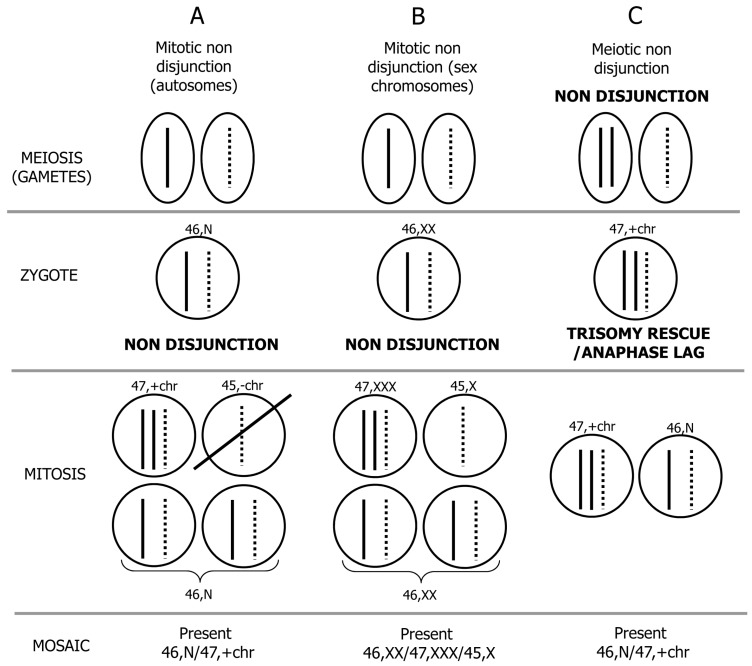
Figure 1
Figure 1
Schematic representation of mechanisms leading to chromosome mosaicism. (A) Mitotic non disjunction error involving an autosome: A mosaic 46,N/47,+chr is recovered in cytogenetic prenatal diagnosis; (B) Mitotic non-disjunction error involving a sex chromosome (X chromosome in the example): A mosaic 46,XX/47,XXX/45,X is present; (C) Meiotic non-disjunction error followed by trisomy rescue/anaphase lag: A mosaic 46,N/47,+chr is detectable.
Figure 2
Figure 2
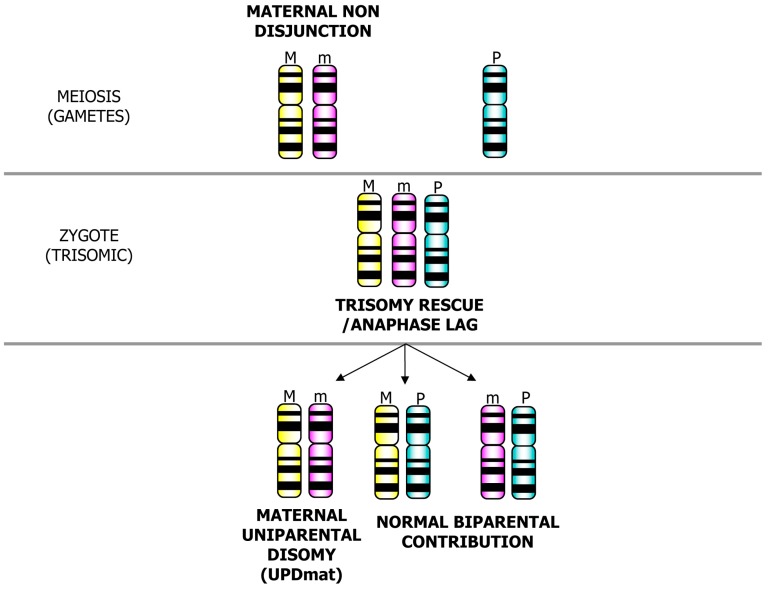
Uniparental disomy (UPD) formation after the rescue of a trisomic zygote: Trisomy rescue/anaphase lag mechanism can result in the formation of a UPD or a biparental condition.
Figure 3
Figure 3
Schematic representation of the use of short tandem repeats (STRs) to determine the mechanism of formation of UPD. (A) Normal biparental STR profile: one paternal and one maternal allele at each informative locus is present; (B) Complete isodisomy due to post-zygotic reduplication of an homolog: homozygosity of all STRs markers is present; (C) Partial heterodisomy consequent to a non-disjunction error during meiosis II followed by trisomy rescue: homozygosity at pericentromeric STRs and heterozygosity interjected with homozygosity along chromosome arms are present; (D) Complete heterodisomy consequent to a non-disjunction error during meiosis I followed by trisomy rescue: informative STRs, pericentromeric and the p- and q-arms are all heterozygous and derived from only one parent.
Figure 4
Figure 4
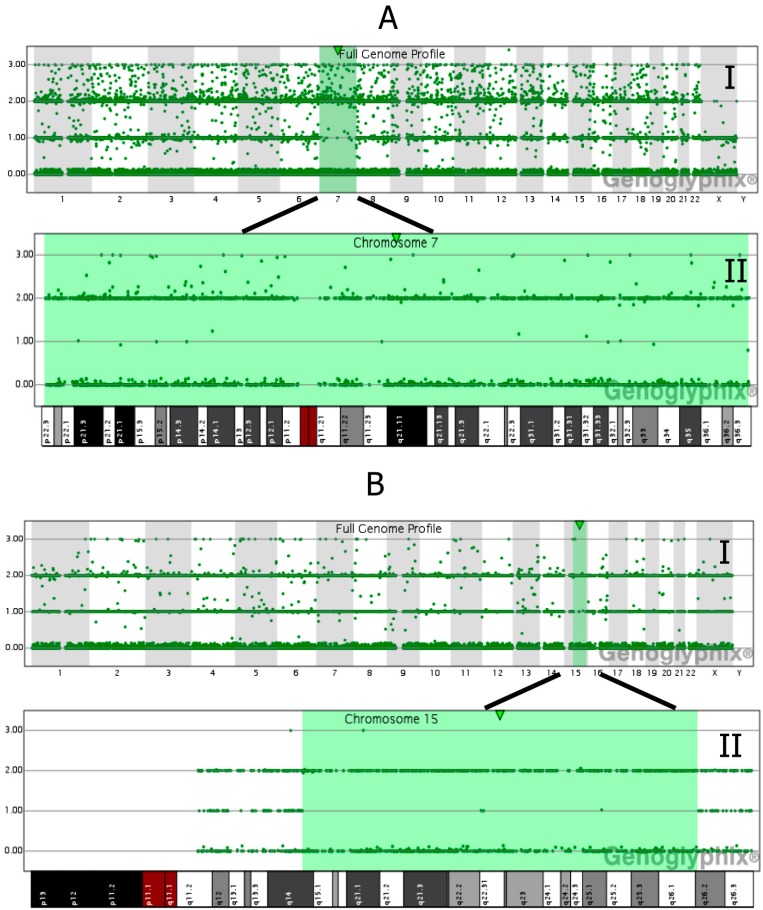
Examples of UPD detected by SNP array; (AI) and (BI): full genome profile: chromosome 7 and 15 are highlighted as regions of homozygosity (ROH) by Genoglyphix software; (AII) and (BII): complete isodisomy of chromosome 7 (AII) consequent to post-zygotic reduplication of an homolog and (BII) partial isodisomy of chromosome 15 (from q14 to q26.2) between two regions of heterodisomy consequent of a non-disjunction error during meiosis II followed by trisomy rescue are depicted (courtesy of Signature Genomic Laboratories, a subsidiary of PerkinElmer, Wallac, Turku, Finland).

References

    1. Brambati B., Simoni G. Diagnosis of fetal trisomy 21 in first trimester. Lancet. 1983;1:586. - PubMed
    1. Simoni G., Fraccaro M., Gimelli G., Maggi F., Dagna Bricarelli F. False-positive and false-negative findings on chorionic villus sampling. Prenat. Diagn. 1987;7:671–672. doi: 10.1002/pd.1970070911. - DOI - PubMed
    1. Miny P., Basaran S., Holzgreve W., Horst J., Pawlowitzki I.H., Ngo T.K. False negative cytogenetic result in direct preparations after CVS. Prenat. Diagn. 1988;8:633. doi: 10.1002/pd.1970080812. - DOI - PubMed
    1. Tomkins D.J., Vekemans M.J. False-positive and false-negative cytogenetic findings on chorionic villus sampling. Prenat. Diagn. 1989;9:139–140. doi: 10.1002/pd.1970090210. - DOI - PubMed
    1. Simoni G., Sirchia S.M. Confined placental mosaicism. Prenat. Diagn. 1994;14:1185–1189. doi: 10.1002/pd.1970141304. - DOI - PubMed