Review
. 2015 Aug 4:10:35.
doi: 10.1186/s13024-015-0031-x.

CRISPR/Cas9: a powerful genetic engineering tool for establishing large animal models of neurodegenerative diseases

Affiliations
Review

CRISPR/Cas9: a powerful genetic engineering tool for establishing large animal models of neurodegenerative diseases

Zhuchi Tu et al. Mol Neurodegener. .

Abstract

Animal models are extremely valuable to help us understand the pathogenesis of neurodegenerative disorders and to find treatments for them. Since large animals are more like humans than rodents, they make good models to identify the important pathological events that may be seen in humans but not in small animals; large animals are also very important for validating effective treatments or confirming therapeutic targets. Due to the lack of embryonic stem cell lines from large animals, it has been difficult to use traditional gene targeting technology to establish large animal models of neurodegenerative diseases. Recently, CRISPR/Cas9 was used successfully to genetically modify genomes in various species. Here we discuss the use of CRISPR/Cas9 technology to establish large animal models that can more faithfully mimic human neurodegenerative diseases.


Figures
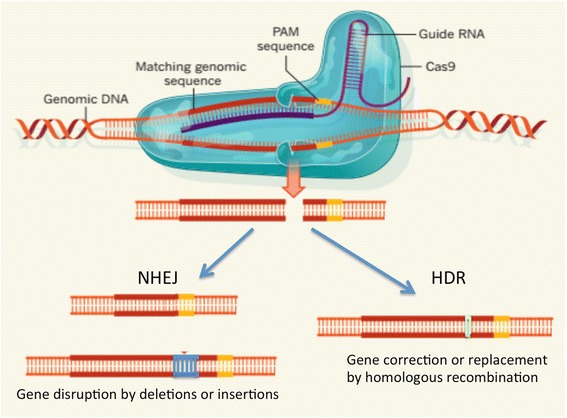
Fig. 1
Fig. 1
CRISPR-Cas9 targeting system. In the CRISPR/Cas9 system, a guide RNA hybridizes a 20-nt DNA sequence immediately preceding an NGG DNA motif (protospacer-associated motif or PAM), resulting in a double-strand break (DSB) 3 bp upstream of the NGG. The double-stranded DNA breaks become substrates for endogenous cellular DNA repair machinery that catalyze nonhomologous end joining (NHEJ) or homology-directed repair (HDR). Adopted from Charpentier & Doudna, Nature, 2013,495:50–1
Fig. 2
Fig. 2
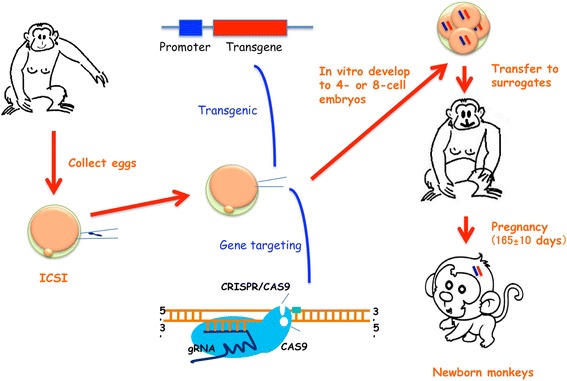
Establishment of non-human primate models of neurodegenerative diseases. In non-human primates, female monkeys are superovulated for collection of eggs, which are subject to intracytoplasmic sperm injection (ICSI) for in vitro fertilization. The fertilized eggs are injected with either lentiviral vectors into perivitelline space to express exogenous transgenes or gRNAs/Cas9 into cytoplasm to target the endogenous genes. The injected eggs then developed to 4- or 8-cell embryos in vitro before being transferred to the surrogate monkeys. After full-term gestational development, the newborn monkeys are examined to verify the presence of transgenes of mutations in the targeted DNAs, which are known to cause neurodegenerative diseases in humans

References

    1. Chen Y, Neve RL, Liu H. Neddylation dysfunction in Alzheimer's disease. J Cell Mol Med. 2012;16(11):2583–91. doi: 10.1111/j.1582-4934.2012.01604.x. - DOI - PMC - PubMed
    1. Cookson MR. The biochemistry of Parkinson's disease. Annu Rev Biochem. 2005;74:29–52. doi: 10.1146/annurev.biochem.74.082803.133400. - DOI - PubMed
    1. Kiernan MC, Vucic S, Cheah BC, Turner MR, Eisen A, Hardiman O, et al. Amyotrophic lateral sclerosis. The Lancet. 2011;377(9769):942–955. doi: 10.1016/S0140-6736(10)61156-7. - DOI - PubMed
    1. Ribeiro FM, Camargos ER, Souza LC, Teixeira AL. Animal models of neurodegenerative diseases. Rev Bras Psiquiatr. 2013;35(Suppl 2):S82–91. doi: 10.1590/1516-4446-2013-1157. - DOI - PubMed
    1. Lee Y, Dawson VL, Dawson TM. Animal models of Parkinson's disease: vertebrate genetics. Cold Spring Harb Perspect Med. 2012;2(10): doi:10.1101/cshperspect.a009324. - PMC - PubMed

Publication types

MeSH terms