


A genome-wide analysis of putative functional and exonic variation associated with extremely high intelligence
- PMID: 26239293
- PMCID: PMC4650257
- DOI: 10.1038/mp.2015.108
A genome-wide analysis of putative functional and exonic variation associated with extremely high intelligence
Erratum in
-
A genome-wide analysis of putative functional and exonic variation associated with extremely high intelligence.Mol Psychiatry. 2016 Aug;21(8):1152. doi: 10.1038/mp.2015.145. Epub 2015 Sep 1. Mol Psychiatry. 2016. PMID: 26324102 Free PMC article. No abstract available.
Abstract
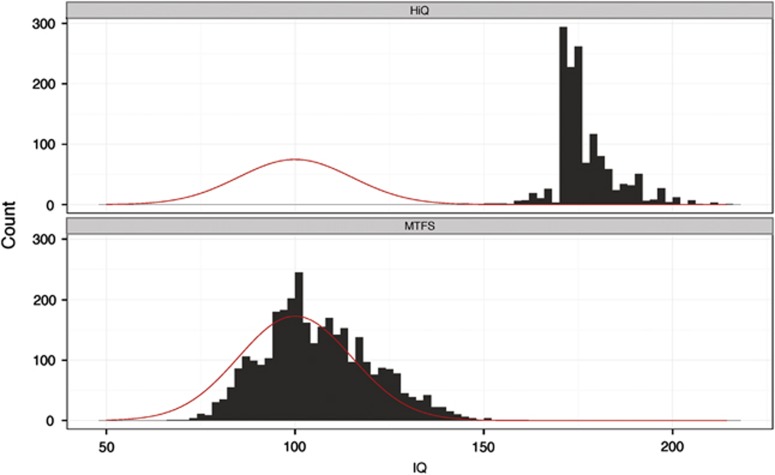
Although individual differences in intelligence (general cognitive ability) are highly heritable, molecular genetic analyses to date have had limited success in identifying specific loci responsible for its heritability. This study is the first to investigate exome variation in individuals of extremely high intelligence. Under the quantitative genetic model, sampling from the high extreme of the distribution should provide increased power to detect associations. We therefore performed a case-control association analysis with 1409 individuals drawn from the top 0.0003 (IQ >170) of the population distribution of intelligence and 3253 unselected population-based controls. Our analysis focused on putative functional exonic variants assayed on the Illumina HumanExome BeadChip. We did not observe any individual protein-altering variants that are reproducibly associated with extremely high intelligence and within the entire distribution of intelligence. Moreover, no significant associations were found for multiple rare alleles within individual genes. However, analyses using genome-wide similarity between unrelated individuals (genome-wide complex trait analysis) indicate that the genotyped functional protein-altering variation yields a heritability estimate of 17.4% (s.e. 1.7%) based on a liability model. In addition, investigation of nominally significant associations revealed fewer rare alleles associated with extremely high intelligence than would be expected under the null hypothesis. This observation is consistent with the hypothesis that rare functional alleles are more frequently detrimental than beneficial to intelligence.
Figures
References
-
- Hunt EB. Human Intelligence. Cambridge University Press: : Cambridge, 2011.
-
- Lubinski D, Benbow CP, Kell HJ. Life paths and accomplishments of mathematically precocious males and females four decades later. Psychol Sci 2014; 25: 2217–2232. - PubMed
-
- Deary IJ, Johnson W, Houlihan LM. Genetic foundations of human intelligence. Hum Genet 2009; 126: 215–232. - PubMed
-
- Plomin R, DeFries JC, Knopik VS, Neiderhiser JM. Behavioral genetics 6th edn. Worth Publishers: New York, 2013.
Publication types
MeSH terms
Grants and funding
- R37 AA009367/AA/NIAAA NIH HHS/United States
- R01 AA009367/AA/NIAAA NIH HHS/United States
- R01 AA011886/AA/NIAAA NIH HHS/United States
- MC_PC_15018/MRC_/Medical Research Council/United Kingdom
- R01 DA024417/DA/NIDA NIH HHS/United States
- G19/2/MRC_/Medical Research Council/United Kingdom
- R01 MH066140/MH/NIMH NIH HHS/United States
- G0500079/MRC_/Medical Research Council/United Kingdom
- R37 DA005147/DA/NIDA NIH HHS/United States
- 092731/MRC_/Medical Research Council/United Kingdom
- R01 DA013240/DA/NIDA NIH HHS/United States
- R01 DA005147/DA/NIDA NIH HHS/United States
- R01 DA036216/DA/NIDA NIH HHS/United States
- U01 DA024417/DA/NIDA NIH HHS/United States
- G0901245/MRC_/Medical Research Council/United Kingdom
- 102215/WT_/Wellcome Trust/United Kingdom
- MC_UU_12013/1/MRC_/Medical Research Council/United Kingdom
- 295366/ERC_/European Research Council/International
LinkOut - more resources
Full Text Sources
Other Literature Sources
