


Genetic analysis of Verticillium wilt resistance in a backcross inbred line population and a meta-analysis of quantitative trait loci for disease resistance in cotton
- PMID: 26239843
- PMCID: PMC4524102
- DOI: 10.1186/s12864-015-1682-2
Genetic analysis of Verticillium wilt resistance in a backcross inbred line population and a meta-analysis of quantitative trait loci for disease resistance in cotton
Abstract
Background: Verticillium wilt (VW) and Fusarium wilt (FW), caused by the soil-borne fungi Verticillium dahliae and Fusarium oxysporum f. sp. vasinfectum, respectively, are two most destructive diseases in cotton production worldwide. Root-knot nematodes (Meloidogyne incognita, RKN) and reniform nematodes (Rotylenchulus reniformis, RN) cause the highest yield loss in the U.S. Planting disease resistant cultivars is the most cost effective control method. Numerous studies have reported mapping of quantitative trait loci (QTLs) for disease resistance in cotton; however, very few reliable QTLs were identified for use in genomic research and breeding.
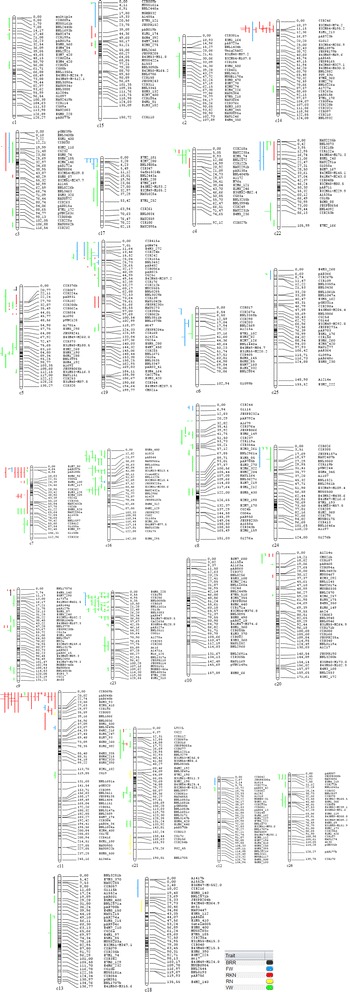
Results: This study first performed a 4-year replicated test of a backcross inbred line (BIL) population for VW resistance, and 10 resistance QTLs were mapped based on a 2895 cM linkage map with 392 SSR markers. The 10 VW QTLs were then placed to a consensus linkage map with other 182 VW QTLs, 75 RKN QTLs, 27 FW QTLs, and 7 RN QTLs reported from 32 publications. A meta-analysis of QTLs identified 28 QTL clusters including 13, 8 and 3 QTL hotspots for resistance to VW, RKN and FW, respectively. The number of QTLs and QTL clusters on chromosomes especially in the A-subgenome was significantly correlated with the number of nucleotide-binding site (NBS) genes, and the distribution of QTLs between homeologous A- and D- subgenome chromosomes was also significantly correlated.
Conclusions: Ten VW resistance QTL identified in a 4-year replicated study have added useful information to the understanding of the genetic basis of VW resistance in cotton. Twenty-eight disease resistance QTL clusters and 24 hotspots identified from a total of 306 QTLs and linked SSR markers provide important information for marker-assisted selection and high resolution mapping of resistance QTLs and genes. The non-overlapping of most resistance QTL hotspots for different diseases indicates that their resistances are controlled by different genes.
Figures
References
-
- Hillocks RJ. Cotton diseases. Wallingford, UK: CAB International; 1992.
-
- Kirkpatrick TL, Rothrock CS. Compendium of cotton diseases. St. Paul, MN: Amer. Phytopath. Soc; 2001.
-
- Blasingame D, Patel MV . Cotton disease loss estimate committee report. San Antonio, TX: Proc, Beltwide Cotton Conf; 2013. pp. 1242–1245.
-
- Zhang JF, Fang H, Zhou HP, Sanogo S, Ma ZY. Genetics, breeding, and marker-assisted selection for Verticillium wilt resistance in cotton. Crop Sci. 2014;54:1289–1303. doi: 10.2135/cropsci2013.08.0550. - DOI
-
- Sanogo S, Zhang JF. Resistance sources, resistance screening techniques and disease management for Fusarium wilt in cotton. Euphytica. 2015 (Accepted)
Publication types
MeSH terms
Substances
LinkOut - more resources
Full Text Sources
Other Literature Sources
Research Materials
Miscellaneous
