


Towards Predicting Patient-Specific Flow-Diverter Treatment Outcomes for Bifurcation Aneurysms: From Implantation Rehearsal to Virtual Angiograms
- PMID: 26240061
- PMCID: PMC4690836
- DOI: 10.1007/s10439-015-1395-3
Towards Predicting Patient-Specific Flow-Diverter Treatment Outcomes for Bifurcation Aneurysms: From Implantation Rehearsal to Virtual Angiograms
Abstract
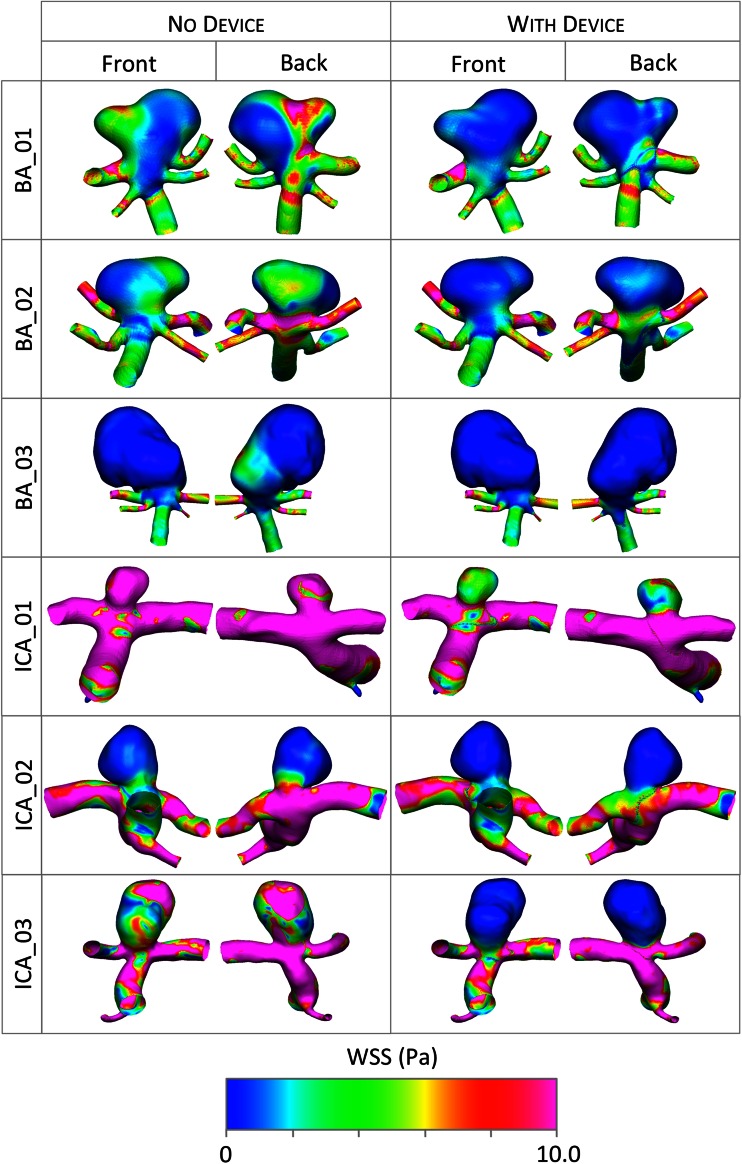
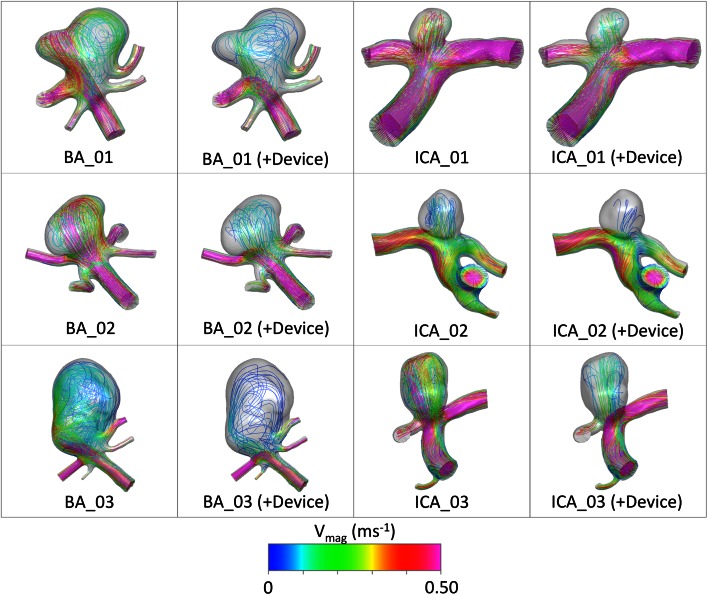
Despite accounting for the majority of all cerebral aneurysm cases, bifurcation aneurysms present many challenges to standard endovascular treatment techniques. This study examines the treatment of bifurcation aneurysms endovascularly with flow-diverting stents and presents an integrative computational modeling suite allowing for rehearsing all aspects of the treatment. Six bifurcation aneurysms are virtually treated with 70% porosity flow-diverters. Substantial reduction (>50%) in aneurysm inflow due to device deployment is predicted in addition to reductions in peak and average aneurysm wall shear stress to values considered physiologically normal. The subsequent impact of flow-diverter deployment on daughter vessels that are jailed by the device is investigated further, with a number of simulations conducted with increased outlet pressure conditions at jailed vessels. Increased outlet pressures at jailed daughter vessels are found to have little effect on device-induced aneurysm inflow reduction, but large variation (13-86%) is seen in the resulting reduction in daughter vessel flow rate. Finally, we propose a potentially powerful approach for validation of such models, by introducing an angiographic contrast model, with contrast transport modeled both before and after virtual treatment. Virtual angiograms and contrast residence curves are created, which offer unique clinical relevance and the potential for future in vivo verification of simulated results.
Keywords: Bifurcation aneurysm; Computational fluid dynamics; Flow-diverter; Stent; Virtual contrast; Virtual deployment.
Figures



References
-
- Alfano J, Kolgega J, Natarajan SK, Xiang J, Paluch R, Levy E, Siddiqui AH, Meng H. Intracranial aneurysms occur more frequently at bifurcation sites that typically experience higher hemodynamic stresses. Neurosurgery. 2013 - PubMed
-
- Brinjikji, W., H. J. Cloft, D. Fiorella, G. Lanzino, and D. F. Kallmes. Estimating the proportion of intracranial aneurysms likely to be amenable to treatment with the pipeline embolization device. J. Neurointerv. Surg. 3–6, 2011. doi:10.1136/neurintsurg-2011-010165. - PubMed
-
- Byrne, J. V., and I. Szikora. Flow diverters in the management of intracranial aneurysms: a review. EJMINT, 2012:1225000057, 2012.
Publication types
MeSH terms
LinkOut - more resources
Full Text Sources
Other Literature Sources
