


Suicide Attempts and Childhood Maltreatment Among Street Youth: A Prospective Cohort Study
- PMID: 26240210
- PMCID: PMC4552091
- DOI: 10.1542/peds.2015-1108
Suicide Attempts and Childhood Maltreatment Among Street Youth: A Prospective Cohort Study
Abstract
Background: Although suicide is a known leading cause of death among street youth, few prospective studies have explored childhood experiences as risk factors for future suicide attempt in this population. We examined the risk of attempted suicide in relation to childhood maltreatment among street youth.
Methods: From September 2005 to November 2013, data were collected from the At Risk Youth Study (ARYS), a prospective cohort of street youth in Vancouver, Canada. Inclusion criteria were age 14 to 26 years, past-month illicit drug use, and street involvement. Participants completed the Childhood Trauma Questionnaire, an instrument measuring self-reported sexual, physical, and emotional abuse and physical and emotional neglect. Suicide attempts were assessed semiannually. Using Cox regression, we examined the association between the 5 types of maltreatment and suicide attempts.
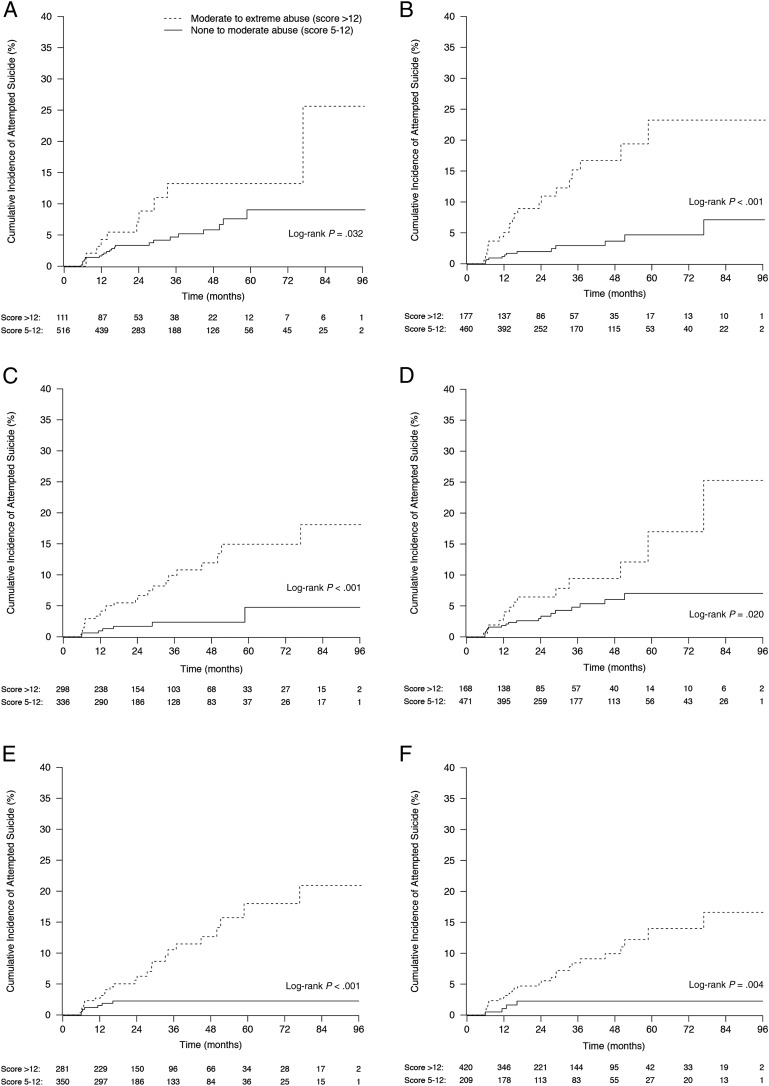
Results: Of 660 participants, 68.2% were male and 24.6% were Aboriginal. Median age was 21.5 years. The prevalence of moderate to extreme childhood maltreatment ranged from 16.8% (sexual abuse) to 45.2% (emotional abuse). Participants contributed 1841 person-years, with suicide attempts reported by 35 (5.3%) individuals (crude incidence density: 1.9 per 100 person-years; 95% confidence interval [CI]: 1.4-2.6 per 100 person-years). In adjusted analyses, types of maltreatment associated with suicide attempts included physical abuse (adjusted hazard ratio [HR]: 4.47; 95% CI: 2.12-9.42), emotional abuse (adjusted HR: 4.92; 95% CI: 2.11-11.5), and emotional neglect (adjusted HR: 3.08; 95% CI: 1.05-9.03).
Conclusions: Childhood maltreatment is associated with subsequent risk of suicidal behavior among street youth. Suicide prevention efforts should be targeted toward this marginalized population and delivered from a trauma-informed perspective.
Copyright © 2015 by the American Academy of Pediatrics.
Figures
Similar articles
-
Suicide and history of childhood trauma among street youth.J Affect Disord. 2012 Feb;136(3):377-80. doi: 10.1016/j.jad.2011.11.019. Epub 2011 Dec 6. J Affect Disord. 2012. PMID: 22153920 Free PMC article.
-
High school incompletion and childhood maltreatment among street-involved young people in Vancouver, Canada.Health Soc Care Community. 2017 Mar;25(2):378-384. doi: 10.1111/hsc.12314. Epub 2015 Dec 28. Health Soc Care Community. 2017. PMID: 26709010 Free PMC article.
-
Suicidal behavior and sexual/physical abuse among street youth.Child Abuse Negl. 1998 Mar;22(3):213-22. doi: 10.1016/s0145-2134(97)00137-3. Child Abuse Negl. 1998. PMID: 9589175
-
Childhood maltreatment and adult suicidality: a comprehensive systematic review with meta-analysis.Psychol Med. 2019 May;49(7):1057-1078. doi: 10.1017/S0033291718003823. Epub 2019 Jan 4. Psychol Med. 2019. PMID: 30608046 Free PMC article.
-
Association of Childhood Maltreatment With Suicide Behaviors Among Young People: A Systematic Review and Meta-analysis.JAMA Netw Open. 2020 Aug 3;3(8):e2012563. doi: 10.1001/jamanetworkopen.2020.12563. JAMA Netw Open. 2020. PMID: 32756929 Free PMC article.
Cited by
-
Youth Experiencing Homelessness with Suicidal Ideation: Understanding Risk Associated with Peer and Family Social Networks.Community Ment Health J. 2021 Jan;57(1):128-135. doi: 10.1007/s10597-020-00622-7. Epub 2020 Apr 17. Community Ment Health J. 2021. PMID: 32303933 Free PMC article.
-
The Global Prevalence of Non-suicidal Self-injury, Suicide Behaviors, and Associated Risk Factors Among Runaway and Homeless Youth: A Meta-analysis.Community Ment Health J. 2024 Jul;60(5):919-944. doi: 10.1007/s10597-024-01245-y. Epub 2024 Mar 7. Community Ment Health J. 2024. PMID: 38451378
-
Are there sensitive periods when child maltreatment substantially elevates suicide risk? Results from a nationally representative sample of adolescents.Depress Anxiety. 2017 Aug;34(8):734-741. doi: 10.1002/da.22650. Epub 2017 May 23. Depress Anxiety. 2017. PMID: 28544045 Free PMC article.
-
Youth experiencing homelessness at risk for suicide: psychosocial risk factors and service use patterns.BMC Public Health. 2025 Feb 4;25(1):444. doi: 10.1186/s12889-024-21212-2. BMC Public Health. 2025. PMID: 39905400 Free PMC article. Clinical Trial.
-
Associations of Childhood Maltreatment With Suicidal Behavior Among Chinese Adolescents: Does It Differ Based on Gender and Biological Rhythm?Front Psychiatry. 2022 Jul 8;13:885713. doi: 10.3389/fpsyt.2022.885713. eCollection 2022. Front Psychiatry. 2022. PMID: 35898623 Free PMC article.
References
-
- Johnson NB, Hayes LD, Brown K, Hoo EC, Ethier KA, Centers for Disease Control and Prevention CDC National Health Report: leading causes of morbidity and mortality and associated behavioral risk and protective factors—United States, 2005-2013. MMWR Surveill Summ. 2014;63(suppl 4):3–27 - PubMed
-
- Statistics Canada. The 10 leading causes of death, 2011. Available at: www.statcan.gc.ca/pub/82-625-x/2014001/article/11896-eng.htm. Accessed December 3, 2014
-
- Public Health Agency of Canada. Street youth in Canada: findings from the enhanced surveillance of Canadian street youth, 1999-2003. 2006. Available at: www.phac-aspc.gc.ca/std-mts/reports_06/pdf/street_youth_e.pdf. Accessed December 3, 2014
-
- Roy E, Haley N, Leclerc P, Sochanski B, Boudreau JF, Boivin JF. Mortality in a cohort of street youth in Montreal. JAMA. 2004;292(5):569–574 - PubMed
Publication types
MeSH terms
Grants and funding
LinkOut - more resources
Full Text Sources
Other Literature Sources
Miscellaneous
