


Accuracy of Continuous Glucose Monitoring During Three Closed-Loop Home Studies Under Free-Living Conditions
- PMID: 26241693
- PMCID: PMC4649721
- DOI: 10.1089/dia.2015.0062
Accuracy of Continuous Glucose Monitoring During Three Closed-Loop Home Studies Under Free-Living Conditions
Abstract
Objectives: Closed-loop (CL) systems modulate insulin delivery based on glucose levels measured by a continuous glucose monitor (CGM). Accuracy of the CGM affects CL performance and safety. We evaluated the accuracy of the Freestyle Navigator(®) II CGM (Abbott Diabetes Care, Alameda, CA) during three unsupervised, randomized, open-label, crossover home CL studies.
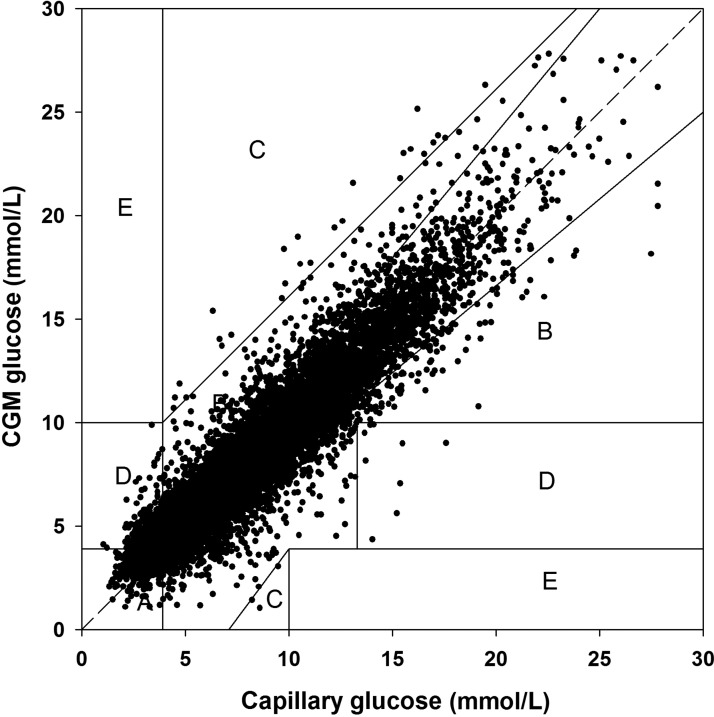
Materials and methods: Paired CGM and capillary glucose values (10,597 pairs) were collected from 57 participants with type 1 diabetes (41 adults [mean±SD age, 39±12 years; mean±SD hemoglobin A1c, 7.9±0.8%] recruited at five centers and 16 adolescents [mean±SD age, 15.6±3.6 years; mean±SD hemoglobin A1c, 8.1±0.8%] recruited at two centers). Numerical accuracy was assessed by absolute relative difference (ARD) and International Organization for Standardization (ISO) 15197:2013 15/15% limits, and clinical accuracy was assessed by Clarke error grid analysis.
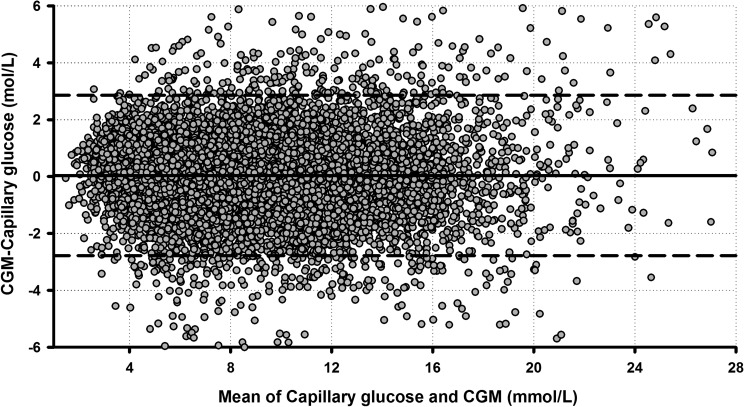
Results: Total duration of sensor use was 2,002 days (48,052 h). Overall sensor accuracy for the capillary glucose range (1.1-27.8 mmol/L) showed mean±SD and median (interquartile range) ARD of 14.2±15.5% and 10.0% (4.5%, 18.4%), respectively. Lowest mean ARD was observed in the hyperglycemic range (9.8±8.8%). Over 95% of pairs were in combined Clarke error grid Zones A and B (A, 80.1%, B, 16.2%). Overall, 70.0% of the sensor readings satisfied ISO criteria. Mean ARD was consistent (12.3%; 95% of the values fall within ±3.7%) and not different between participants (P=0.06) within the euglycemic and hyperglycemic range, when CL is actively modulating insulin delivery.
Conclusions: Consistent accuracy of the CGM within the euglycemic-hyperglycemic range using the Freestyle Navigator II was observed and supports its use in home CL studies. Our results may contribute toward establishing normative CGM performance criteria for unsupervised home use of CL.
Trial registration: ClinicalTrials.gov NCT01221467 NCT01440140 NCT01666028.
Figures
Comment in
-
Accuracy of CGM During Closed-Loop Home Studies.Diabetes Technol Ther. 2015 Nov;17(11):770-2. doi: 10.1089/dia.2015.0331. Diabetes Technol Ther. 2015. PMID: 26535928 No abstract available.
References
-
- The DCCT Research Group: Epidemiology of severe hypoglycemia in the Diabetes Control and Complications Trial. Am J Med 1991;90:450–459 - PubMed
-
- Hovorka R: Closed-loop insulin delivery: from bench to clinical practice. Nat Rev Endocrinol 2011;7:385–395 - PubMed
-
- Hovorka R, Allen JM, Elleri D, et al. : Manual closed-loop insulin delivery in children and adolescents with type 1 diabetes: a phase 2 randomised crossover trial. Lancet 2010;375:743–751 - PubMed
-
- Phillip M, Battelino T, Atlas E, et al. : Nocturnal glucose control with an artificial pancreas at a diabetes camp. N Engl J Med 2013;368:824–833 - PubMed
Publication types
MeSH terms
Substances
Associated data
Grants and funding
LinkOut - more resources
Full Text Sources
Other Literature Sources
Medical
