


Use of vitamin K antagonists for secondary stroke prevention depends on the treating healthcare provider in Germany - results from the German AFNET registry
- PMID: 26242880
- PMCID: PMC4524411
- DOI: 10.1186/s12883-015-0371-8
Use of vitamin K antagonists for secondary stroke prevention depends on the treating healthcare provider in Germany - results from the German AFNET registry
Abstract
Background: Anticoagulation using vitamin K antagonists (VKAs) significantly reduces the risk of recurrent stroke in stroke patients with atrial fibrillation (AF) and is recommended by guidelines.
Methods: The German Competence NETwork on Atrial Fibrillation established a nationwide prospective registry including 9,574 AF patients, providing the opportunity to analyse AF management according to German healthcare providers.
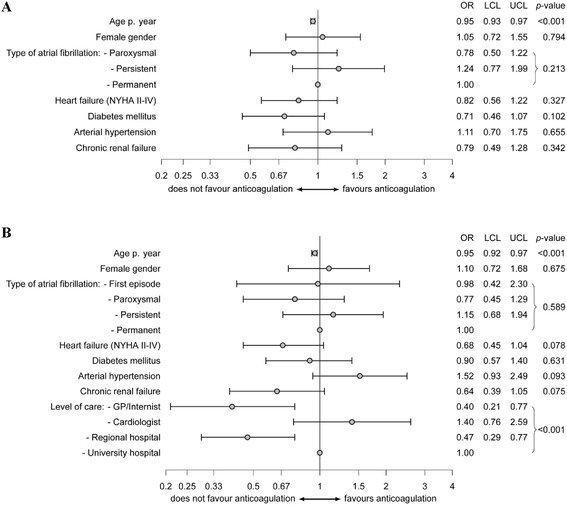
Results: On enrolment, 896 (9.4 %) patients reported a prior ischaemic stroke or transient ischaemic attack. Stroke patients were significantly older, more likely to be female, had a higher rate of cardiovascular risk factors, and more frequently received anticoagulation (almost exclusively VKA) than patients without prior stroke history. Following enrolment, 76.4 % of all stroke patients without VKA contraindications received anticoagulation, which inversely associated with age (OR 0.95 per year; 95 % CI 0.92-0.97). General practitioners/internists (OR 0.40; 95 % CI 0.21-0.77) and physicians working in regional hospitals (OR 0.47; 95 % CI 0.29-0.77) prescribed anticoagulation for secondary stroke prevention less frequently than physicians working at university hospitals (reference) and office-based cardiologists (OR 1.40; 95 % CI 0.76-2.60). The impact of the treating healthcare provider was less evident in registry patients without prior stroke.
Conclusions: In the AFNET registry, anticoagulation for secondary stroke prevention was prescribed in roughly three-quarters of AF patients, a significantly higher rate than in primary prevention. We identified two factors associated with withholding oral anticoagulation in stroke survivors, namely higher age and-most prominently-treatment by a general practitioner/internist or physicians working at regional hospitals.
Figures
References
-
- Camm AJ, Lip GYH, De Caterina R, Savelieva I, Atar D, Hohnloser SH, et al. 2012 focused update of the ESC Guidelines for the management of atrial fibrillation: an update of the 2010 ESC Guidelines for the management of atrial fibrillation–developed with the special contribution of the European Heart Rhythm Association. Europace. 2012;14:1385–413. doi: 10.1093/europace/eur416. - DOI - PubMed
-
- Kirchhof P, Curtis AB, Skanes AC, Gillis AM, Samuel Wann L, John CA. Atrial fibrillation guidelines across the Atlantic: a comparison of the current recommendations of the European Society of Cardiology/European Heart Rhythm Association/European Association of Cardiothoracic Surgeons, the American College of Cardiology Fou. Eur Hear J. 2013;34:1471–4. doi: 10.1093/eurheartj/ehs446. - DOI - PubMed
Publication types
MeSH terms
Substances
LinkOut - more resources
Full Text Sources
Other Literature Sources
Medical
