


Pregnancy-Related Mortality Resulting From Influenza in the United States During the 2009-2010 Pandemic
- PMID: 26244541
- PMCID: PMC4557717
- DOI: 10.1097/AOG.0000000000000996
Pregnancy-Related Mortality Resulting From Influenza in the United States During the 2009-2010 Pandemic
Abstract
Objective: To estimate the burden of pregnancy-related mortality resulting from influenza A (H1N1)pdm09 virus infection during the 2009-2010 pandemic influenza season.
Methods: Data from the Centers for Disease Control and Prevention's Pregnancy Mortality Surveillance System were used to identify women whose death during or shortly after pregnancy was attributed or likely attributed to the influenza A (H1N1)pdm09 virus from April 15, 2009, through June 30, 2010. We report the characteristics of these women and enumerate cases resulting in death as the pandemic began, peaked, and resolved.
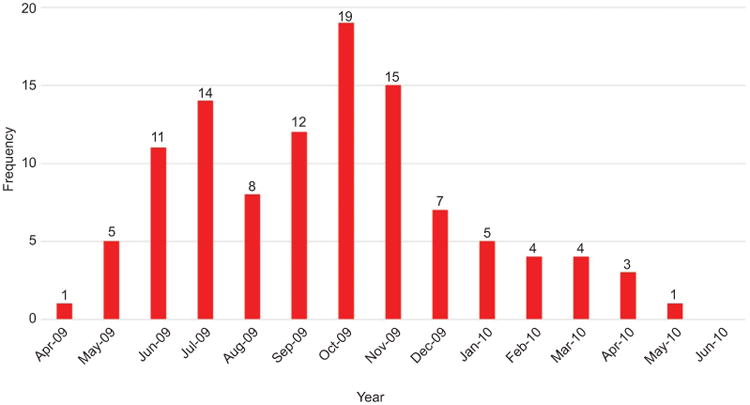
Results: During the pandemic season, we identified 915 pregnancy-related deaths and 4,911,297 live births. Seventy-five (8.2%) women died as a result of confirmed influenza A (H1N1)pdm09 infection deaths and 34 (3.7%) women as a result of possible influenza A (H1N1)pdm09 infection deaths. The pregnancy-related mortality ratio for confirmed and possible (combined) influenza A (H1N1)pdm09 infection deaths was 2.2 per 100,000 live births. Most deaths occurred during the 2009 calendar year with the peak of the distribution of deaths over time occurring in October 2009.
Conclusion: Twelve percent of pregnancy-related deaths were attributed to confirmed or possible influenza A (H1N1)pdm09 infection during the 2009-2010 pandemic season. Because prediction of pandemics is difficult, planning for prevention of influenza and care for those women affected are critical for preventing associated severe maternal morbidity and mortality.
Level of evidence: III.
Figures
References
-
- Novel SwineOrigin Influenza A (H1N1) Virus Investigation Team. Dawood FS, Jain S, Finelli L, Shaw MW, Lindstrom S, et al. Emergence of a novel swine-origin influenza a (H1N1) virus in humans. N Engl J Med. 2009;360:2605–15. - PubMed
-
- Centers for Disease Control and Prevention. The 2009 H1N1 pandemic: summary highlights, April 2009 – April 2010. Available at: http://www.cdc.gov/h1n1flu/cdcresponse.htm. Retrieved February 20, 2015.
-
- Jamieson DJ, Honein MA, Rasmussen SA, Williams JL, Swerdlow DL, Biggerstaff MS, et al. H1N1 2009 influenza virus infection during pregnancy in the USA. Lancet. 2009;374:451–8. - PubMed
-
- Centers for Disease Control and Prevention (CDC) Novel influenza A (H1N1) virus infections in three pregnant women– United States, April–May, 2009. MMWR Morb Mortal Wkly Rep. 2009;58:497–500. - PubMed
-
- Louie JK, Acosta M, Jamieson DJ, Honein MA California Pandemic (H1N1) Working Group . Severe 2009 H1N1 influenza in pregnant and postpartum women in California. N Engl J Med. 2010;362:27–35. - PubMed
MeSH terms
Grants and funding
LinkOut - more resources
Full Text Sources
Medical
Research Materials
Miscellaneous
