


The Effectiveness of Cognitive Behavioural Treatment for Non-Specific Low Back Pain: A Systematic Review and Meta-Analysis
- PMID: 26244668
- PMCID: PMC4526658
- DOI: 10.1371/journal.pone.0134192
The Effectiveness of Cognitive Behavioural Treatment for Non-Specific Low Back Pain: A Systematic Review and Meta-Analysis
Abstract
Objectives: To assess whether cognitive behavioural (CB) approaches improve disability, pain, quality of life and/or work disability for patients with low back pain (LBP) of any duration and of any age.
Methods: Nine databases were searched for randomised controlled trials (RCTs) from inception to November 2014. Two independent reviewers rated trial quality and extracted trial data. Standardised mean differences (SMD) and 95% confidence intervals were calculated for individual trials. Pooled effect sizes were calculated using a random-effects model for two contrasts: CB versus no treatment (including wait-list and usual care (WL/UC)), and CB versus other guideline-based active treatment (GAT).
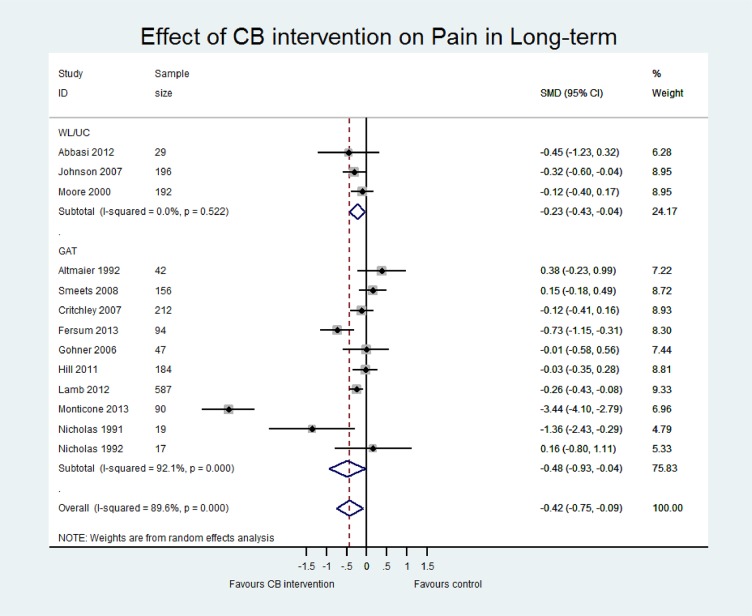
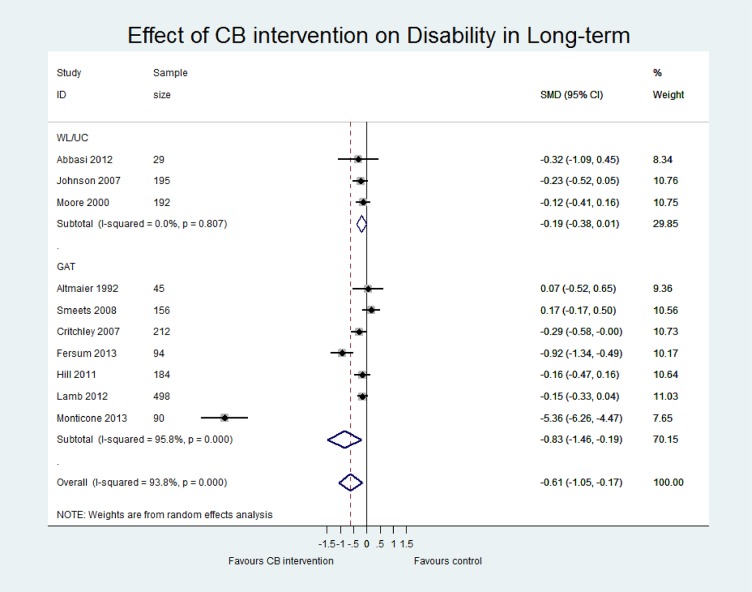
Results: The review included 23 studies with a total of 3359 participants. Of these, the majority studied patients with persistent LBP (>6 weeks; n=20). At long term follow-up, the pooled SMD for the WL/UC comparison was -0.19 (-0.38, 0.01) for disability, and -0.23 (-0.43, -0.04) for pain, in favour of CB. For the GAT comparison, at long term the pooled SMD was -0.83 (-1.46, -0.19) for disability and -0.48 (-0.93, -0.04) for pain, in favour of CB. While trials varied considerably in methodological quality, and in intervention factors such as provider, mode of delivery, dose, duration, and pragmatism, there were several examples of lower intensity, low cost interventions that were effective.
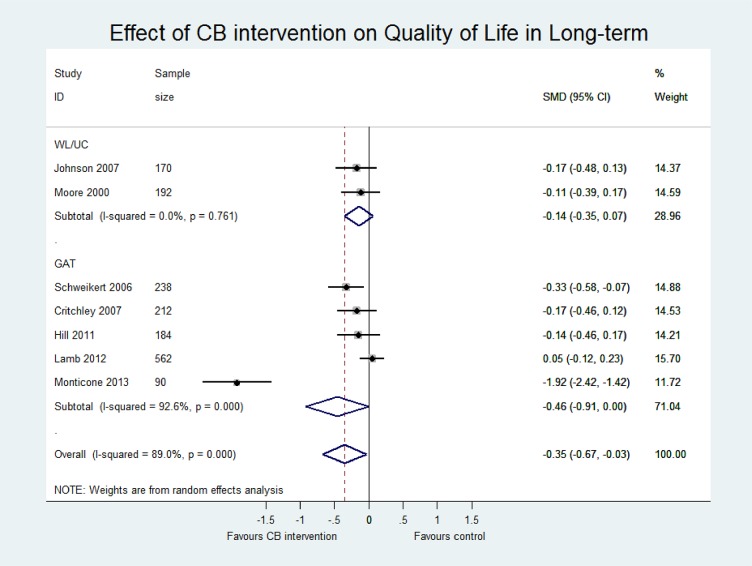
Conclusion: CB interventions yield long-term improvements in pain, disability and quality of life in comparison to no treatment and other guideline-based active treatments for patients with LBP of any duration and of any age.
Systematic review registration: PROSPERO protocol registration number: CRD42014010536.
Conflict of interest statement
Figures
References
-
- NICE (2009) Low back pain: early management of persistent non-specific low back pain. Full guideline. Available: http://wwwniceorguk/nicemedia/live/11887/44334/44334pdf [Accessed on: 08.04.2014].
-
- NICE (2009) Low back pain. Costing report. Implementing NICE guidance. Avaiilable: http://wwwniceorguk/nicemedia/pdf/CG88CostReportpdf [Accessed on: 08.04.2014].
-
- Chou R, Qaseem A, Snow V, Casey D, Cross JJT, et al. (2007) Diagnosis and Treatment of Low Back Pain: A Joint Clinical Practice Guideline from the American College of Physicians and the American Pain Society. Annals of Internal Medicine 147: 478–491. - PubMed
Publication types
MeSH terms
Grants and funding
LinkOut - more resources
Full Text Sources
Other Literature Sources
Miscellaneous
