Evaluation of the Specificity of Two Enzyme Immunoassays for Coccidioidomycosis by Using Sera from a Region of Endemicity and a Region of Nonendemicity
- PMID: 26245352
- PMCID: PMC4580743
- DOI: 10.1128/CVI.00375-15
Evaluation of the Specificity of Two Enzyme Immunoassays for Coccidioidomycosis by Using Sera from a Region of Endemicity and a Region of Nonendemicity
Abstract
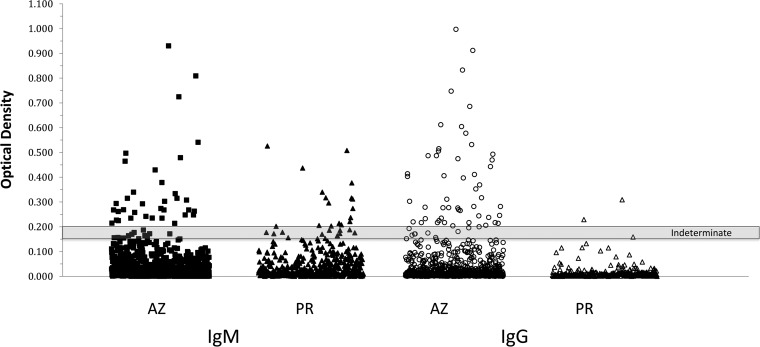
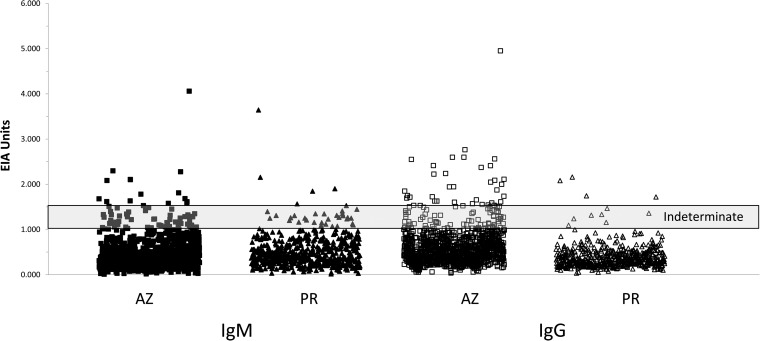
Coccidioidomycosis (CM), a serious life-threatening fungal infection endemic to arid regions of the western United States and Mexico, can be challenging to diagnose in a timely manner. Commercially developed enzyme immunoassays (EIAs) (from Meridian Biosciences and Immuno-Mycologics [IMMY]) have provided faster, simpler means for serodiagnosis; however, independent evaluations have questioned EIA specificity, particularly IgM-positive/IgG-negative results. This study was conducted to evaluate EIA specificity among persons residing in Puerto Rico (n = 534), where CM is not endemic (who were not likely to have been exposed to Coccidioides spp.), compared to blood bank donors residing in Arizona (n = 1,218), where CM is endemic. Upon comparing serum reactivity between Puerto Rico and Arizona, the Meridian EIA showed a significant difference in IgG reactivity (0.37% versus 3.6%; P < 0.001) but not IgM reactivity (3.4% versus 2.4%; P = 0.31). No IgM-/IgG-reactive sera were detected among sera from Puerto Rico, compared to 7 (0.57%) sera from Arizona. Similar results were observed using the IMMY EIA, although significantly (P = 0.03) fewer IgM-reactive sera from Arizona were observed, compared to the Meridian EIA. EIA-reactive sera were also evaluated by immunodiffusion before and after 3- to 4-fold concentration of the sera. These results demonstrate that elevated IgG EIA reactivity is present in sera from healthy individuals in regions of endemicity and that IgM EIA reactivity observed in sera from individuals residing outside regions of endemicity is most likely nonspecific. Other criteria, including clinical and microbiological evaluations, should be taken into account when interpreting results from surveillance studies and other reporting measures.
Copyright © 2015, American Society for Microbiology. All Rights Reserved.
Figures
References
-
- Nguyen C, Barker BM, Hoover S, Nix DE, Ampel NM, Frelinger JA, Orbach MJ, Galgiani JN. 2013. Recent advances in our understanding of the environmental, epidemiological, immunological, and clinical dimensions of coccidioidomycosis. Clin Microbiol Rev 26:505–525. doi: 10.1128/CMR.00005-13. - DOI - PMC - PubMed
-
- Thompson G III, Stevens D, Clemons K, Fierer J, Johnson R, Sykes J, Rutherford G, Peterson M, Taylor J, Chaturvedi V. 2015. Call for a California coccidioidomycosis consortium to face the top ten challenges posed by a recalcitrant regional disease. Mycopathologia 179:1–9. doi: 10.1007/s11046-014-9816-7. - DOI - PubMed
-
- Zartarian M, Peterson EM, de la Maza LM. 1997. Detection of antibodies to Coccidioides immitis by enzyme immunoassay. Am J Clin Pathol 107:148–153. - PubMed
Publication types
MeSH terms
Substances
LinkOut - more resources
Full Text Sources
Medical
Miscellaneous