


Higher Total Protein Intake and Change in Total Protein Intake Affect Body Composition but Not Metabolic Syndrome Indexes in Middle-Aged Overweight and Obese Adults Who Perform Resistance and Aerobic Exercise for 36 Weeks
- PMID: 26246322
- PMCID: PMC4548166
- DOI: 10.3945/jn.115.213595
Higher Total Protein Intake and Change in Total Protein Intake Affect Body Composition but Not Metabolic Syndrome Indexes in Middle-Aged Overweight and Obese Adults Who Perform Resistance and Aerobic Exercise for 36 Weeks
Abstract
Background: Studies assessing the effects of protein supplementation on changes in body composition (BC) and health rarely consider the impact of total protein intake (TPro) or the change in TPro (CTPro) from participants' usual diets.
Objective: This secondary data analysis assessed the impact of TPro and CTPro on changes in BC and metabolic syndrome (MetS) indexes in overweight and obese middle-aged adults who participated in an exercise training program.
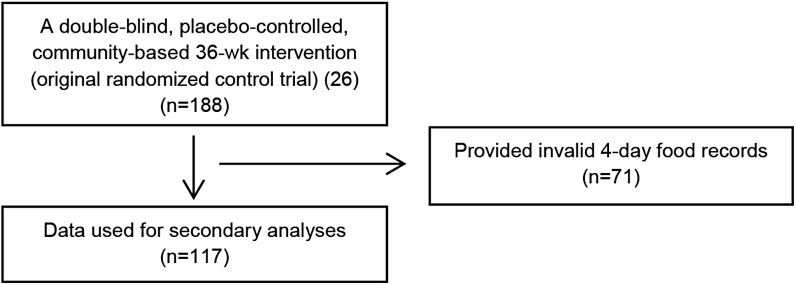
Methods: Men and women [n = 117; age: 50 ± 0.7 y, body mass index (BMI; in kg/m(2)): 30.1 ± 0.3; means ± SEs] performed resistance exercise 2 d/wk and aerobic exercise 1 d/wk and consumed an unrestricted diet along with 200-kcal supplements (0, 10, 20, or 30 g whey protein) twice daily for 36 wk. Protein intake was assessed via 4-d food records. Multiple linear regression model and stratified analysis were applied for data analyses.
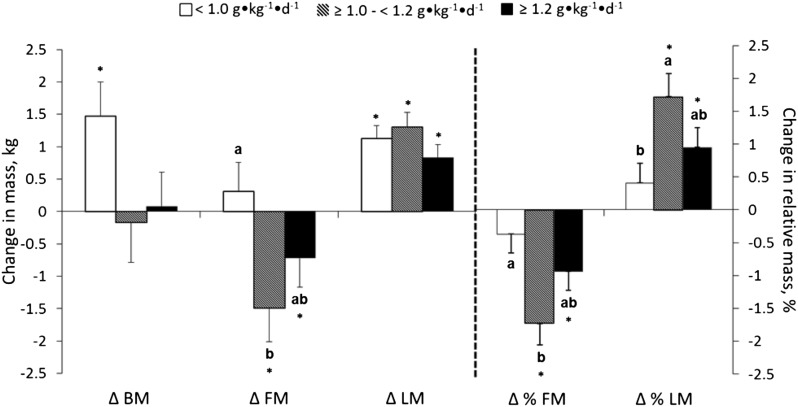
Results: Among all subjects, TPro and CTPro were inversely associated (P < 0.05) with changes in body mass, fat mass (FM), and BMI. Changes in BC were different (P < 0.05) among groups that consumed <1.0 (n = 43) vs. ≥1.0 to <1.2 (n = 29) vs. ≥1.2 g · kg(-1) · d(-1) (n = 45). The TPro group with ≥1.0 to <1.2 g ·: kg(-1) ·: d(-1) reduced FM and %FM and increased percentage of LM (%LM) compared with the lowest TPro group, whereas the TPro group with ≥1.2 g ·: kg(-1) ·: d(-1) presented intermediate responses on changes in FM, %FM, and %LM. The gain in LM was not different among groups. In addition, MetS indexes were not influenced by TPro and CTPro.
Conclusions: In conjunction with exercise training, higher TPro promoted positive changes in BC but not in MetS indexes in overweight and obese middle-aged adults. Changes in TPro from before to during the intervention also influenced BC responses and should be considered in future research when different TPro is achieved via diet or supplements. This trial was registered at clinicaltrials.gov as NCT00812409.
Keywords: aerobic and resistance exercise training; body composition; dietary protein intake; metabolic syndrome; overweight and obese middle-aged adults.
© 2015 American Society for Nutrition.
Conflict of interest statement
Author disclosures: JE Kim, AF Amankwaah, SL Gordon, and EM Weinheimer-Haus, no conflicts of interest. WW Campbell was a member of the National Dairy Council Whey Protein Advisory Panel while the research was being conducted.
Figures

References
-
- Flegal KM, Carroll MD, Ogden CL, Curtin LR. Prevalence and trends in obesity among US adults, 1999–2008. JAMA 2010;303:235–41. - PubMed
-
- Villareal DT, Apovian CM, Kushner RF, Klein S. Obesity in older adults: technical review and position statement of the American Society for Nutrition and NAASO, The Obesity Society. Am J Clin Nutr 2005;82:923–34. - PubMed
-
- Malnick SD, Knobler H. The medical complications of obesity. QJM 2006;99:565–79. - PubMed
-
- Rhéaume C, Leblanc MÉ, Poirier P. Adiposity assessment: explaining the association between obesity, hypertension and stroke. Expert Rev Cardiovasc Ther 2011;9:1557–64. - PubMed
-
- Church T. Exercise in obesity, metabolic syndrome, and diabetes. Prog Cardiovasc Dis 2011;53:412–8. - PubMed
Publication types
MeSH terms
Substances
Associated data
Grants and funding
LinkOut - more resources
Full Text Sources
Other Literature Sources
Medical
