


doi: 10.1128/JVI.01446-15.
Epub 2015 Aug 5.
Importation and Recombination Are Responsible for the Latest Emergence of Highly Pathogenic Porcine Reproductive and Respiratory Syndrome Virus in China
Affiliations
- PMID: 26246582
- PMCID: PMC4580157
- DOI: 10.1128/JVI.01446-15
Item in Clipboard
Importation and Recombination Are Responsible for the Latest Emergence of Highly Pathogenic Porcine Reproductive and Respiratory Syndrome Virus in China
J Virol.
2015 Oct.
Abstract
In China, a majority of the highly pathogenic porcine reproductive and respiratory syndrome (HP-PRRSV) strains were seeded by the 2006 outbreak. However, the most recently emerged (2013-2014) HP-PRRSV strain has a very different genetic background. It is a NADC30-like PRRSV strain recently introduced from North America that has undergone genetic exchange with the classic HP-PRRSV strains in China. Subsequent isolation and characterization of this variant suggest high pathogenicity, so it merits special attention in control and vaccine strategies.
Copyright © 2015, American Society for Microbiology. All Rights Reserved.
Figures
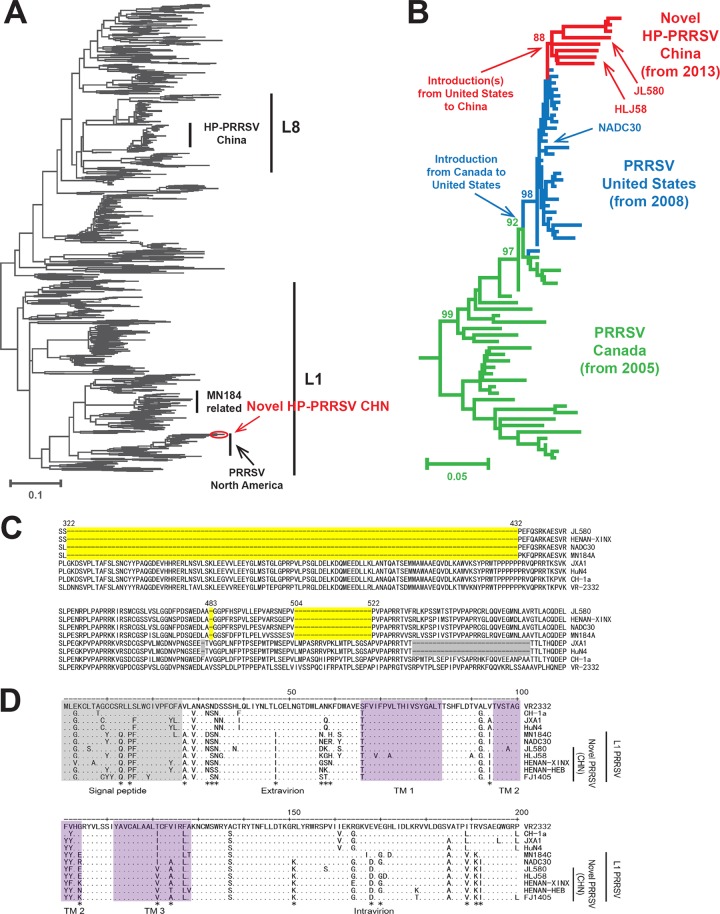
Genotyping of the HP-PRRSV strain that has newly emerged in China. The phylogenetic positions of all representative type 2 PRRSV strains (A) and the most closely related viruses (B) are shown on a tree based on their ORF5 nucleotide sequences. HP-PRRSV strains newly emerged in China are shown in red, and related viruses from the United States and Canada are shown in blue and green, respectively. Only the important viral groups and strains are labeled to the right of the tree. The genetic relatedness of these strains is also supported by the distribution of the gaps in the nsp2 protein alignment (C). Deletions in JL580 and related virus strains are shaded yellow, and deletions in the classic HP-PRRSV strains are shaded gray. Alignment and comparison of amino acid mutations of GP5 (D). The signal peptide and transmembrane (TM) domains are demarcated and shaded. Important amino acid sequence differences between L1 PRRSV and classical HP-PRRSV are indicated by asterisks.
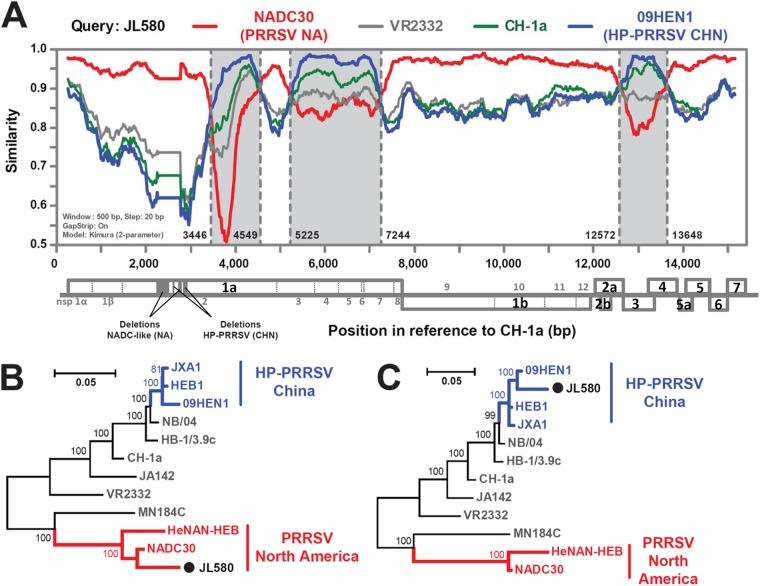
Recombination analysis of strain JL580. (A) Genome scale similarity comparisons of JL580 (query) with NADC30 (red), 09HEN1 (blue), CH-1a (green), and VR2332 (gray). Recombination breakpoints are shown as black dotted lines, with the locations indicated at the bottom. The background color of the major parental regions (parental region A) is white, whereas that of the minor parental regions (parental region B) is gray. Below the similarity plot is a full genome structure, with reference to CH-1a, in which the positions and boundaries of the major ORFs, nsp-encoding genes within ORF1a and ORF2b, and gaps are shown. Phylogenies of parental regions A (B) and B (C) are shown below the similarity plot. The major parental group (NADC30-like viruses) is shown in red; the minor parental group (classic HP-PRRSV in China) is shown in blue.
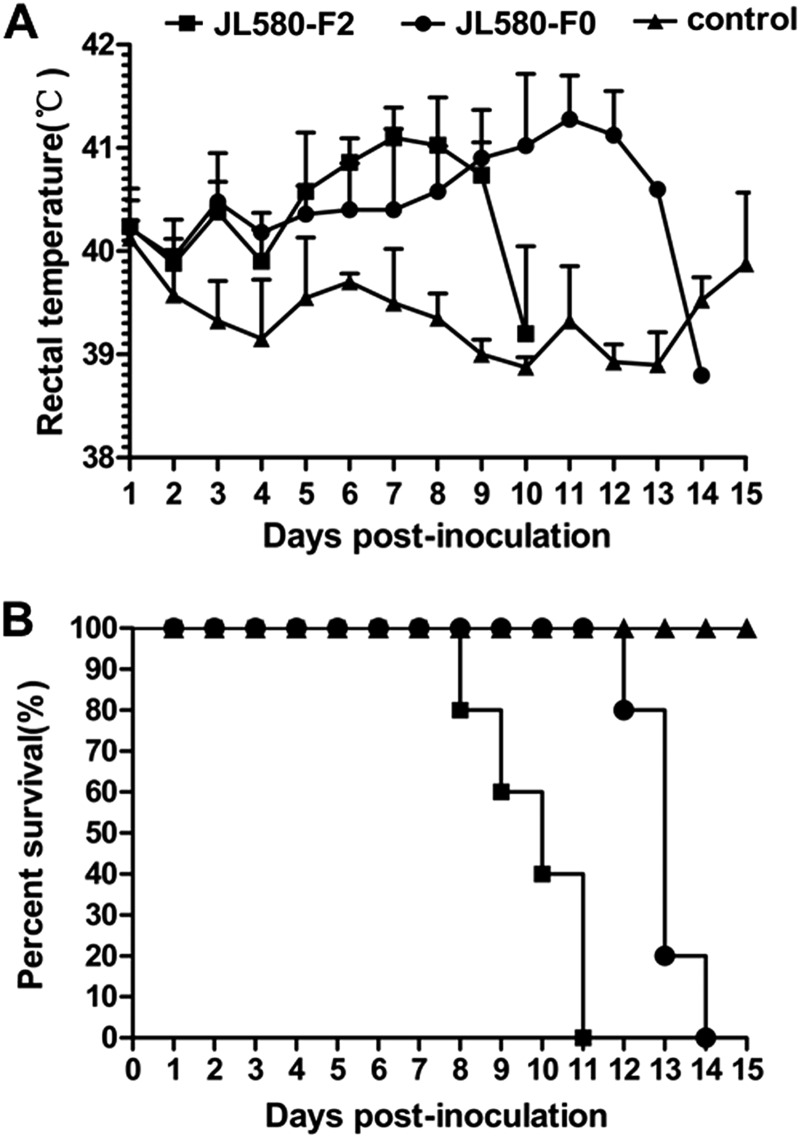
Rectal temperatures and mortality rates of piglets inoculated with JL580. (A) Rectal temperatures of piglets inoculated with JL580 F0 (homogenate supernatant) or JL580 F2 (second passage of JL580 in Marc-145 cells). Mean temperatures ± standard deviations (error bars) are shown (groups A and B, n = 5; group C, n = 4). A rectal temperature of >40.5°C was defined as fever. (B) Mortality rates of piglets infected with JL580 F0 or F2.
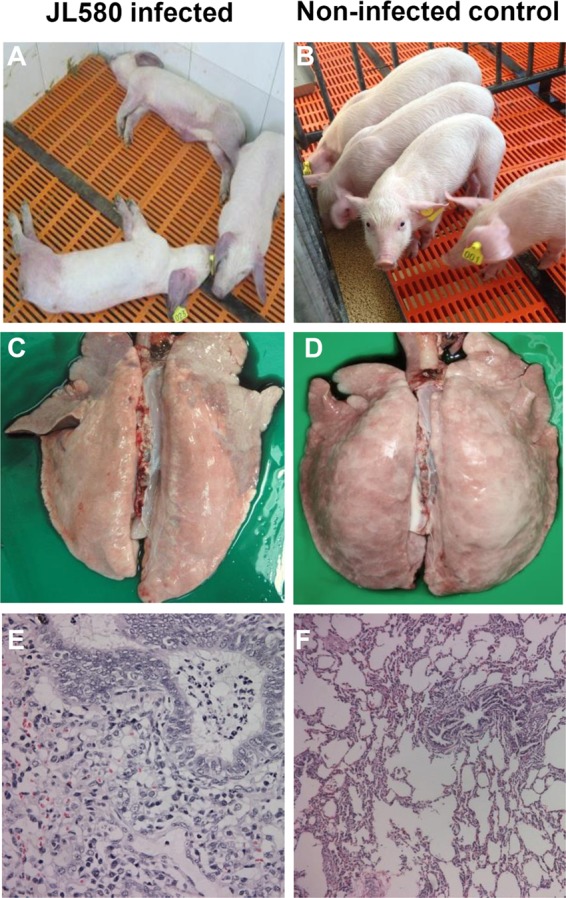
HP-PRRSV syndrome in piglets infected with JL580, including red discoloration of the body and ears (A), consolidation in the lungs (C), and massive lymphomononuclear cell infiltration of the lungs (E), compared with controls (B, D, and F, respectively).
References
-
- Keffaber KK. 1989. Reproductive failure of unknown etiology. Am Assoc Swine Pract Newsl 2:1–9.
-
- Tian K, Yu X, Zhao T, Feng Y, Cao Z, Wang C, Hu Y, Chen X, Hu D, Tian X, Liu D, Zhang S, Deng X, Ding Y, Yang L, Zhang Y, Xiao H, Qiao M, Wang B, Hou L, Wang X, Yang X, Kang L, Sun M, Jin P, Wang S, Kitamura Y, Yan J, Gao GF. 2007. Emergence of fatal PRRSV variants: unparalleled outbreaks of atypical PRRS in China and molecular dissection of the unique hallmark. PLoS One 2:e526. doi: 10.1371/journal.pone.0000526. - DOI - PMC - PubMed
Publication types
MeSH terms
Associated data
- Actions
- Actions
LinkOut - more resources
Full Text Sources
Research Materials
Miscellaneous
