


Development and Validation of a Mortality Prediction Model for Patients Receiving 14 Days of Mechanical Ventilation
- PMID: 26247337
- PMCID: PMC4788381
- DOI: 10.1097/CCM.0000000000001205
Development and Validation of a Mortality Prediction Model for Patients Receiving 14 Days of Mechanical Ventilation
Abstract
Objectives: The existing risk prediction model for patients requiring prolonged mechanical ventilation is not applicable until after 21 days of mechanical ventilation. We sought to develop and validate a mortality prediction model for patients earlier in the ICU course using data from day 14 of mechanical ventilation.
Design: Multicenter retrospective cohort study.
Setting: Forty medical centers across the United States.
Patients: Adult patients receiving at least 14 days of mechanical ventilation.
Interventions: None.
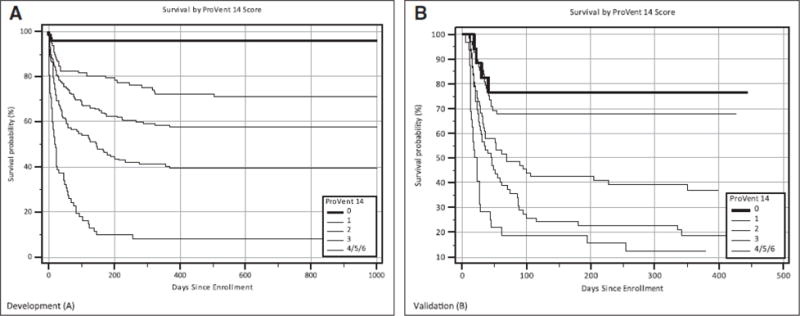
Measurements and main results: Predictor variables were measured on day 14 of mechanical ventilation in the development cohort and included in a logistic regression model with 1-year mortality as the outcome. Variables were sequentially eliminated to develop the ProVent 14 model. This model was then generated in the validation cohort. A simplified prognostic scoring rule (ProVent 14 Score) using categorical variables was created in the development cohort and then tested in the validation cohort. Model discrimination was assessed by the area under the receiver operator characteristic curve. Four hundred ninety-one patients and 245 patients were included in the development and validation cohorts, respectively. The most parsimonious model included age, platelet count, requirement for vasopressors, requirement for hemodialysis, and nontrauma admission. The area under the receiver operator characteristic curve for the ProVent 14 model using continuous variables was 0.80 (95% CI, 0.76-0.83) in the development cohort and 0.78 (95% CI, 0.72-0.83) in the validation cohort. The ProVent 14 Score categorized age at 50 and 65 years old and platelet count at 100×10(9)/L and had similar discrimination as the ProVent 14 model in both cohorts.
Conclusion: Using clinical variables available on day 14 of mechanical ventilation, the ProVent 14 model can identify patients receiving prolonged mechanical ventilation with a high risk of mortality within 1 year.
Figures
References
-
- Chelluri L, Im KA, Belle SH, et al. Long-term mortality and quality of life after prolonged mechanical ventilation. Crit Care Med. 2004;32:61–69. - PubMed
-
- Combes A, Costa MA, Trouillet JL, et al. Morbidity, mortality, and quality-of-life outcomes of patients requiring >or=14 days of mechanical ventilation. Crit Care Med. 2003;31:1373–1381. - PubMed
