


doi: 10.1371/journal.ppat.1004992.
eCollection 2015 Aug.
Interdisciplinarity and Infectious Diseases: An Ebola Case Study
Affiliations
- PMID: 26247831
- PMCID: PMC4527690
- DOI: 10.1371/journal.ppat.1004992
Item in Clipboard
Interdisciplinarity and Infectious Diseases: An Ebola Case Study
PLoS Pathog.
.
No abstract available
Conflict of interest statement
The authors have declared that no competing interests exist.
Figures
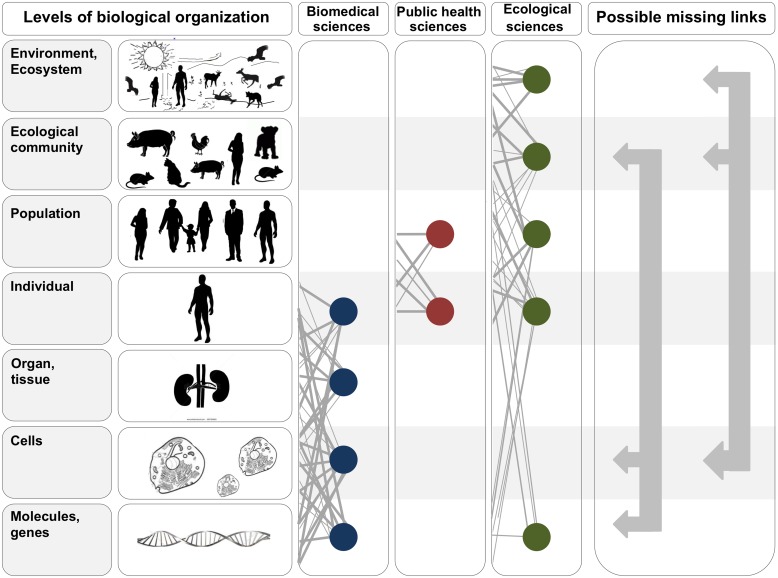
Each level of the hierarchy reflects an increase in organizational complexity, with each level being primarily composed of the previous level’s basic units. Middle panels illustrate how the study of interactions between infectious disease agents and their hosts differs across the biomedical, public health, and ecological sciences. Specifically, biomedical sciences typically focus on lower- and medium-scale levels of biological organization (e.g., molecules, genes, and organs). In contrast, public health and ecological sciences typically focus on medium- and higher-scale levels of organization (individual, population, community, ecosystem, and environment). The filled circles and solid lines connecting the circles illustrate key cross scale biological interactions studied within each field. The right panel shows example knowledge gaps that can emerge from the “typical” segregation of research activities across the three fields. To better integrate our understanding of the causes and consequences of zoonotic infectious diseases, researchers must begin focusing on these types of missing links.
References
-
- Parkes MW, Bienen L, Breilh J, Hsu L-N, McDonald M, et al. (2005) All Hands on Deck: Transdisciplinary Approaches to Emerging Infectious Disease. EcoHealth 2: 258–272.
Publication types
MeSH terms
LinkOut - more resources
Full Text Sources
Other Literature Sources
Medical
