


Experimental superposition of orders of quantum gates
- PMID: 26250107
- PMCID: PMC4918346
- DOI: 10.1038/ncomms8913
Experimental superposition of orders of quantum gates
Abstract
Quantum computers achieve a speed-up by placing quantum bits (qubits) in superpositions of different states. However, it has recently been appreciated that quantum mechanics also allows one to 'superimpose different operations'. Furthermore, it has been shown that using a qubit to coherently control the gate order allows one to accomplish a task--determining if two gates commute or anti-commute--with fewer gate uses than any known quantum algorithm. Here we experimentally demonstrate this advantage, in a photonic context, using a second qubit to control the order in which two gates are applied to a first qubit. We create the required superposition of gate orders by using additional degrees of freedom of the photons encoding our qubits. The new resource we exploit can be interpreted as a superposition of causal orders, and could allow quantum algorithms to be implemented with an efficiency unlikely to be achieved on a fixed-gate-order quantum computer.
Figures
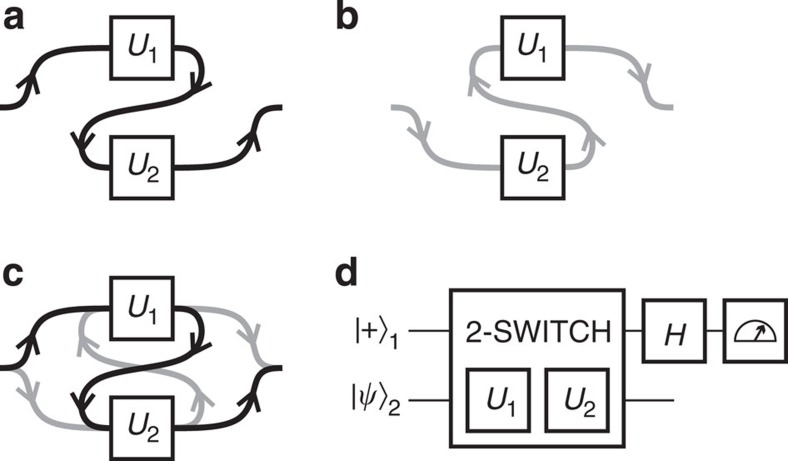
 (the lower qubit) if the upper qubit is in
  , and U2U1 to
  if the upper qubit is in
  . Measuring the state of qubit 1 in the
  basis allows one to unambiguously decide if U1 and U2 commute or anti-commute with only a single use of each gate. In this circuit, H is the Hadamard gate, and
  .
.

 , is the identity, X=σx, Y=σy, and Z=σz. The average success rate (probability to exit the ‘correct port') of these data is 0.973±0.016.
References
-
- Deutsch D. Quantum computational networks. Proc. R. Soc. Lond A Math. Phys. Sci. 425, 73–90 (1989).
-
- Nielsen M. A. & Chuang I. L. Quantum Computation and Quantum Information 1st ed. Cambridge University Press (2000).
-
- Aharonov Y. et al. Superpositions of time evolutions of a quantum system and a quantum time-translation machine. Phys. Rev. Lett. 64, 2965–2968 (1990). - PubMed
-
- Chiribella G. et al. Quantum computations without definite causal structure. Phys. Rev. A. 88, 022318 (2013).
Publication types
LinkOut - more resources
Full Text Sources
Other Literature Sources
