. 2015 Oct 15;593(20):4631-48.
doi: 10.1113/JP270487. Epub 2015 Sep 14.

What limits performance during whole-body incremental exercise to exhaustion in humans?

Affiliations

What limits performance during whole-body incremental exercise to exhaustion in humans?

David Morales-Alamo et al. J Physiol. .

Abstract

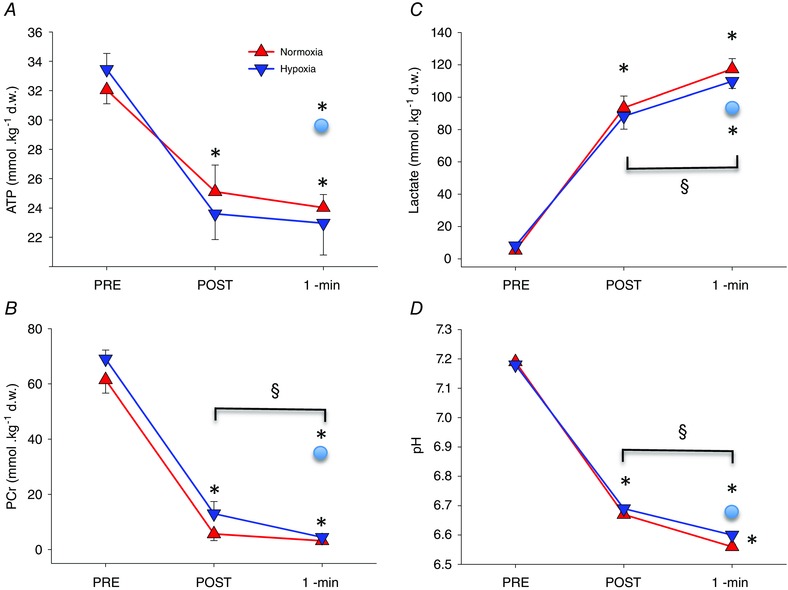
To determine the mechanisms causing task failure during incremental exercise to exhaustion (IE), sprint performance (10 s all-out isokinetic) and muscle metabolites were measured before (control) and immediately after IE in normoxia (P(IO2) 143 mmHg) and hypoxia (P(IO2): 73 mmHg) in 22 men (22 ± 3 years). After IE, subjects recovered for either 10 or 60 s, with open circulation or bilateral leg occlusion (300 mmHg) in random order. This was followed by a 10 s sprint with open circulation. Post-IE peak power output (W(peak)) was higher than the power output reached at exhaustion during IE (P < 0.05). After 10 and 60 s recovery in normoxia, W(peak) was reduced by 38 ± 9 and 22 ± 10% without occlusion, and 61 ± 8 and 47 ± 10% with occlusion (P < 0.05). Following 10 s occlusion, W(peak) was 20% higher in hypoxia than normoxia (P < 0.05), despite similar muscle lactate accumulation ([La]) and phosphocreatine and ATP reduction. Sprint performance and anaerobic ATP resynthesis were greater after 60 s compared with 10 s occlusions, despite the higher [La] and [H(+)] after 60 s compared with 10 s occlusion recovery (P < 0.05). The mean rate of ATP turnover during the 60 s occlusion was 0.180 ± 0.133 mmol (kg wet wt)(-1) s(-1), i.e. equivalent to 32% of leg peak O2 uptake (the energy expended by the ion pumps). A greater degree of recovery is achieved, however, without occlusion. In conclusion, during incremental exercise task failure is not due to metabolite accumulation or lack of energy resources. Anaerobic metabolism, despite the accumulation of lactate and H(+), facilitates early recovery even in anoxia. This points to central mechanisms as the principal determinants of task failure both in normoxia and hypoxia, with lower peripheral contribution in hypoxia.


Figures

Figure 1
Figure 1. Experimental protocol
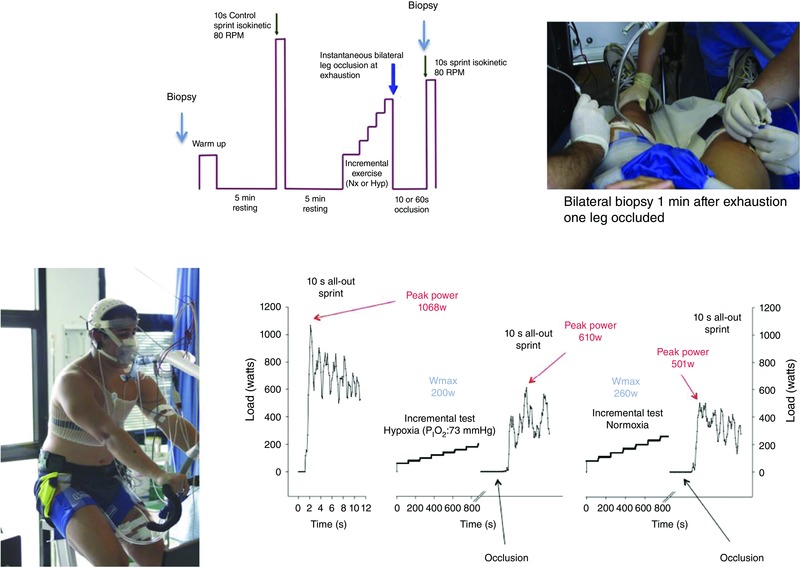
Following a standardized warm‐up subjects performed a control sprint, which was followed by an incremental exercise to exhaustion either in normoxia (PIO2 = ∼143 mmHg) or hypoxia (PIO2 = ∼73 mmHg) performed in random order. At exhaustion, a cuff was instantaneously inflated at 300 mmHg to impede recovery. After either 10 or 60 s of occlusion the cuff was released and the subjects requested to sprint maximally. In another set of experiments, the same protocol was repeated but only one leg was cuffed. Prior to warm‐up a muscle biopsy was obtained in resting conditions. From the cuffed leg additional muscle biopsies were obtained after 10 and 60 s of occlusion, while from the non‐cuffed leg only one biopsy was obtained at 60 s. The sprints were always performed in isokinetic mode at 80 rpm and in normoxia.
Figure 2
Figure 2. Muscle metabolites
Muscle ATP (A), phosphocreatine (PCr) (B), lactate (C) and pH (D) under resting conditions before (PRE) exercise, and 10 s (POST) and 60 s (1‐min) after the end of an incremental exercise to exhaustion either in normoxia (PIO2 = ∼143 mmHg) or hypoxia (PIO2 = ∼73 mmHg) performed in random order. At exhaustion, a cuff was instantaneously inflated at 300 mmHg around the thigh of one leg to impede recovery. A muscle biopsy was obtained 10 and 60 s after the end of the sprint, while the occlusion was maintained, from the musculus vastus lateralis of the occluded leg. A 60 s biopsy was also obtained simultaneously from the non‐cuffed leg (circles in the graphs). *P < 0.05, compared with PRE; §ANOVA time effect POST vs. 1‐min occlusion P < 0.05.
Figure 3
Figure 3. Muscle oxygenation during 10 s sprints
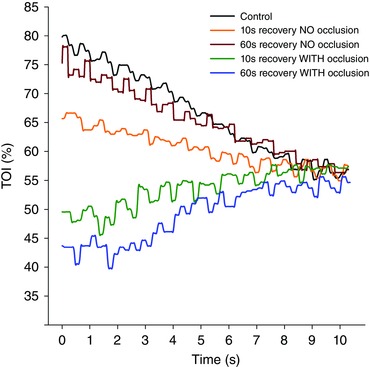
The muscle oxygenation index (TOI) was determined in the musculus vastus lateralis during 10 s isokinetic sprints (80 rpm) after a standardized warm‐up (Control) and 10 or 60 s after an incremental exercise to exhaustion with free or occluded circulation during the recovery periods. TOI followed an increasing pattern for sprints preceded by vascular occlusion, while the pattern was always decreasing for the sprints that were not preceded by vascular occlusion. After 8 s, TOI values converge, indicating similar fractional O2 extraction values, which indirectly imply that the marked differences in pulmonary V˙O2 observed between sprints are probably due to differences in O2 delivery.
Figure 4
Figure 4. Muscle oxygenation
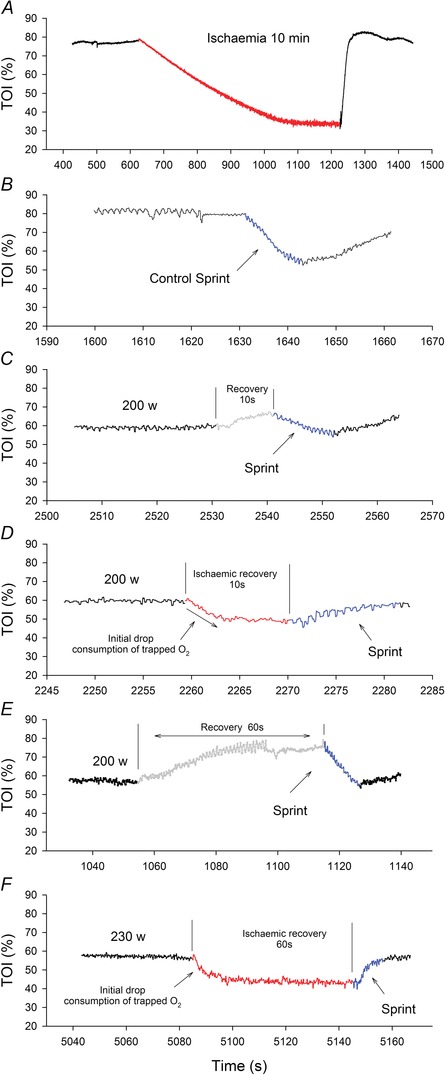
The tissue oxygenation index (TOI) was determined in the musculus vastus lateralis during incremental exercise to exhaustion continued by 10 or 60 s recovery periods with free circulation or ischaemia, which were followed by 10 s isokinetic sprints. Vastus lateralis TOI responses to 10 min of ischaemia (red line, A); a control sprint preceded by a standardized warm‐up (B); sprint performed 10 s after exhaustion (blue line) with open circulation during recovery (grey line) (C); sprint performed 10 s after exhaustion (blue line) with vascular occlusion during recovery (red line) (D); sprint performed 60 s after exhaustion (blue line) with open circulation during recovery (grey line) (E); sprint performed 60 s after exhaustion (blue line) with vascular occlusion during recovery (red line) (F). All graphs are from data obtained in a single representative subject.

References

    1. Allen D & Westerblad H (2004). Physiology. Lactic acid–the latest performance‐enhancing drug. Science 305, 1112–1113. - PubMed
    1. Allen DG, Lamb GD & Westerblad H (2008). Skeletal muscle fatigue: cellular mechanisms. Physiol Rev 88, 287–332. - PubMed
    1. Amann M & Calbet JA (2008). Convective oxygen transport and fatigue. J Appl Physiol (1985) 104, 861–870. - PubMed
    1. Amann M & Dempsey JA (2008). Locomotor muscle fatigue modifies central motor drive in healthy humans and imposes a limitation to exercise performance. J Physiol 586, 161–173. - PMC - PubMed
    1. Amann M, Romer LM, Subudhi AW, Pegelow DF & Dempsey JA (2007). Severity of arterial hypoxaemia affects the relative contributions of peripheral muscle fatigue to exercise performance in healthy humans. J Physiol 581, 389–403. - PMC - PubMed

Publication types