


Validation of 64Cu-ATSM damaging DNA via high-LET Auger electron emission
- PMID: 26251463
- PMCID: PMC4577009
- DOI: 10.1093/jrr/rrv042
Validation of 64Cu-ATSM damaging DNA via high-LET Auger electron emission
Abstract
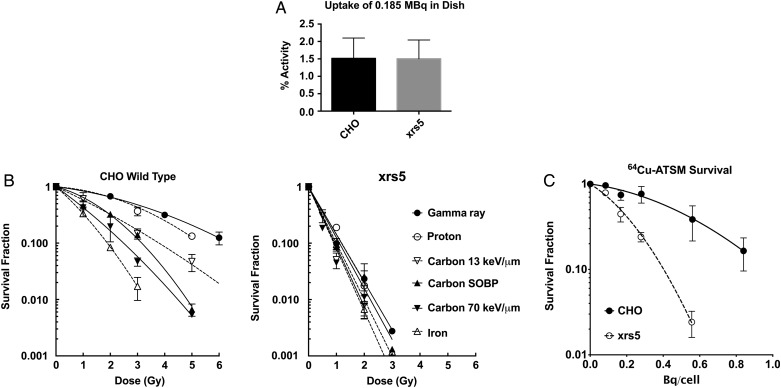
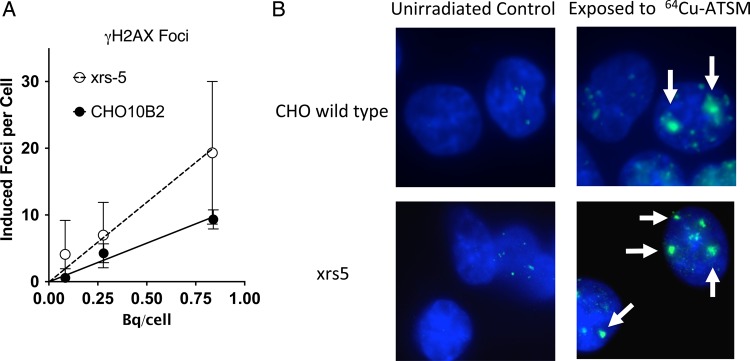
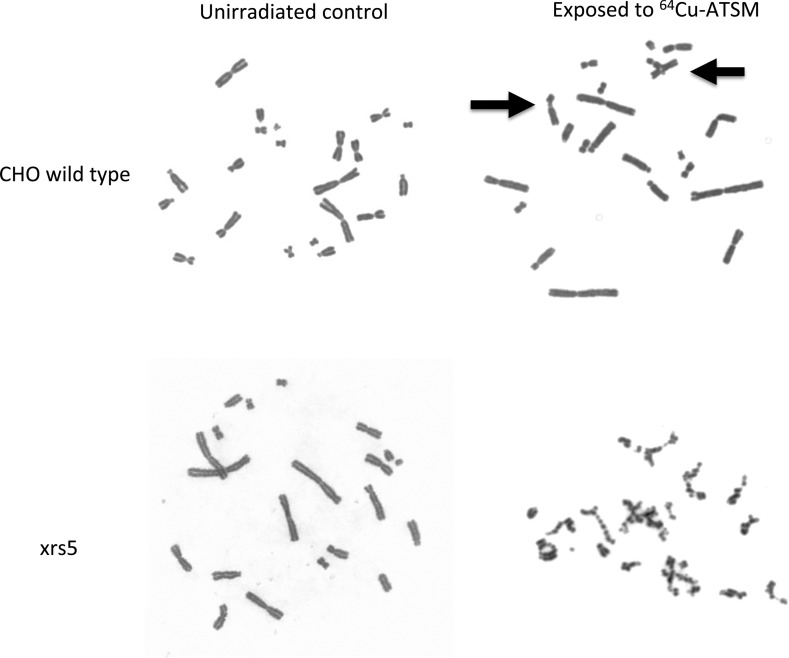
Radioactive copper (II) (diacetyl-bis N4-methylthiosemicarbazone) (Cu-ATSM) isotopes were originally developed for the imaging of hypoxia in tumors. Because the decay of a (64)Cu atom is emitting not only positrons but also Auger electrons, this radionuclide has great potential as a theranostic agent. However, the success of (64)Cu-ATSM internal radiation therapy would depend on the contribution of Auger electrons to tumor cell killing. Therefore, we designed a cell culture system to define the contributions to cell death from Auger electrons to support or refute our hypothesis that the majority of cell death from (64)Cu-ATSM is a result of high-LET Auger electrons and not positrons or other low-LET radiation. Chinese hamster ovary (CHO) wild type and DNA repair-deficient xrs5 cells were exposed to (64)Cu-ATSM during hypoxic conditions. Surviving fractions were compared with those surviving gamma-radiation, low-LET hadron radiation, and high-LET heavy ion exposure. The ratio of the D(10) values (doses required to achieve 10% cell survival) between CHO wild type and xrs5 cells suggested that (64)Cu-ATSM toxicity is similar to that of high-LET Carbon ion radiation (70 keV/μm). γH2AX foci assays confirmed DNA double-strand breaks and cluster damage by high-LET Auger electrons from (64)Cu decay, and complex types of chromosomal aberrations typical of high-LET radiation were observed after (64)Cu-ATSM exposure. The majority of cell death was caused by high-LET radiation. This work provides strong evidence that (64)Cu-ATSM damages DNA via high-LET Auger electrons, supporting further study and consideration of (64)Cu-ATSM as a cancer treatment modality for hypoxic tumors.
Keywords: 64Cu-ATSM; CHO; DNA double strand break; auger electron; high LET.
© The Author 2015. Published by Oxford University Press on behalf of The Japan Radiation Research Society and Japanese Society for Radiation Oncology.
Figures
References
-
- Fujibayashi Y, Taniuchi H, Yonekura Y, et al. Copper-62-ATSM: a new hypoxia imaging agent with high membrane permeability and low redox potential. J Nucl Med 1997;38:1155–60. - PubMed
-
- Lewis JS, McCarthy DW, McCarthy TJ, et al. Evaluation of 64Cu-ATSM in vitro and in vivo in a hypoxic tumor model. J Nucl Med 1999;40:177–83. - PubMed
-
- Yoshii Y, Furukawa T, Kiyono Y, et al. Copper-64-diacetyl-bis (N4-methylthiosemicarbazone) accumulates in rich regions of CD133+ highly tumorigenic cells in mouse colon carcinoma. Nucl Med Biol 2010;37:395–404. - PubMed
-
- Zweit J. Radionuclides and carrier molecules for therapy. Phys Med Biol 1996;41:1905–14. - PubMed
-
- Johnson TE, Birky BK. Health Physics and Radiological Health. 4th edn. Lippincott Williams & Wilkins, 2011.
Publication types
MeSH terms
Substances
LinkOut - more resources
Full Text Sources
Other Literature Sources
Miscellaneous
