. 2015 Aug 7;10(8):e0135340.
doi: 10.1371/journal.pone.0135340. eCollection 2015.

Anti-Retroviral Lectins Have Modest Effects on Adherence of Trichomonas vaginalis to Epithelial Cells In Vitro and on Recovery of Tritrichomonas foetus in a Mouse Vaginal Model

Affiliations

Anti-Retroviral Lectins Have Modest Effects on Adherence of Trichomonas vaginalis to Epithelial Cells In Vitro and on Recovery of Tritrichomonas foetus in a Mouse Vaginal Model

Aparajita Chatterjee et al. PLoS One. .

Abstract

Trichomonas vaginalis causes vaginitis and increases the risk of HIV transmission by heterosexual sex, while Tritrichomonas foetus causes premature abortion in cattle. Our goals were to determine the effects, if any, of anti-retroviral lectins, which are designed to prevent heterosexual transmission of HIV, on adherence of Trichomonas to ectocervical cells and on Tritrichomonas infections in a mouse model. We show that Trichomonas Asn-linked glycans (N-glycans), like those of HIV, bind the mannose-binding lectin (MBL) that is part of the innate immune system. N-glycans of Trichomonas and Tritrichomonas bind anti-retroviral lectins (cyanovirin-N and griffithsin) and the 2G12 monoclonal antibody, each of which binds HIV N-glycans. Binding of cyanovirin-N appears to be independent of susceptibility to metronidazole, the major drug used to treat Trichomonas. Anti-retroviral lectins, MBL, and galectin-1 cause Trichomonas to self-aggregate and precipitate. The anti-retroviral lectins also increase adherence of ricin-resistant mutants, which are less adherent than parent cells, to ectocervical cell monolayers and to organotypic EpiVaginal tissue cells. Topical application of either anti-retroviral lectins or yeast N-glycans decreases by 40 to 70% the recovery of Tritrichomonas from the mouse vagina. These results, which are explained by a few simple models, suggest that the anti-retroviral lectins have a modest potential for preventing or treating human infections with Trichomonas.


Conflict of interest statement

Competing Interests: The authors have declared that no competing interests exist.

Figures

Fig 1
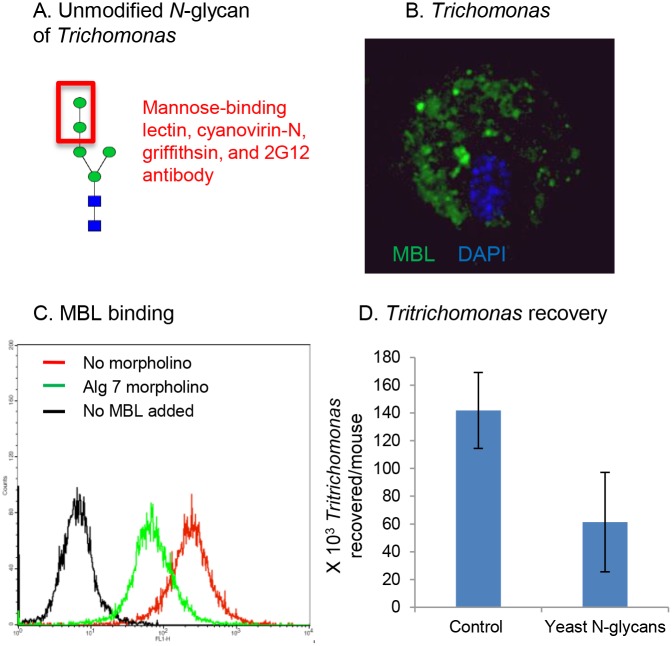
Fig 1. Mannose-binding lectin (MBL) binds to unprocessed N-glycans on the surface of Trichomonas.
A. MBL, as well as anti-retroviral lectins (cyanovirin-N and griffithsin) and 2G12 monoclonal antibody, binds to the single mannose arm (red box) of an unprocessed N-glycan of Trichomonas. B. MBL (green) labels the surface of Trichomonas. The nucleus is labeled with DAPI. C. Flow cytometry shows that labeling with the MBL (red) is decreased when Trichomonas is treated with an Alg7 morpholino (green) that decreases synthesis of the N-glycan precursor. Unlabeled parasites are shown in black. D. N-glycans from the Saccharomyces mnn1/mmn4 double-knockout decrease by 40% the recovery after two days of Tritrichomonas in the vagina of mice (average of three experiments with five mice each).
Fig 2
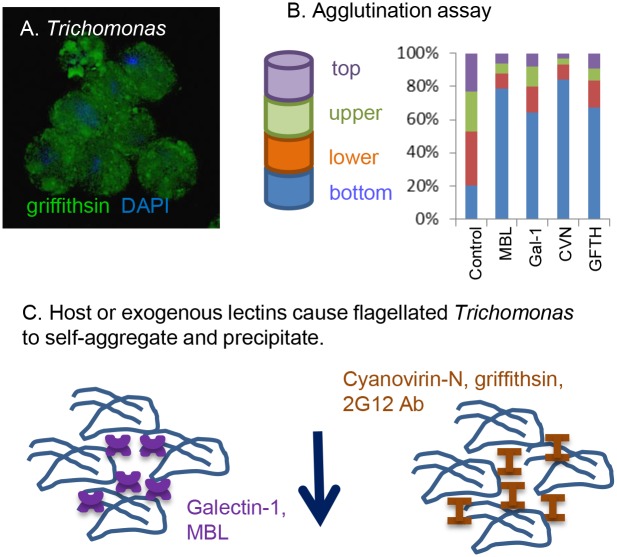
Fig 2. Host lectins (galectin-1 and MBL), as well as anti-retroviral lectins (cyanovirin-N and griffithsin) and 2G12 monoclonal antibody, agglutinate flagellated Trichomonas and cause them to precipitate.
A. Fluorescence micrograph of Trichomonas aggregated by griffithsin (green). Nuclei are labeled with DAPI. B. In the absence of host or exogenous lectins added to TYM medium (control group), flagellated Trichomonas parasites swim and remain in roughly equal numbers in the top (purple), middle (green and rust), and bottom (blue) 50 μl fractions of a 200 μl suspension. In contrast, host MBL and galectin-1 (Gal-1), as well as exogenous cyanovirin-N (CVN) and griffithsin (GFTH), agglutinate swimming Trichomonas and cause them to precipitate, so that the vast majority of the parasites are in the bottom 50 μl fraction (blue). The average of two experiments, each performed in duplicate, with very similar results is shown. C. Model shows that host or exogenous lectins agglutinate flagellated Trichomonas and cause them to precipitate (blue arrow).
Fig 3
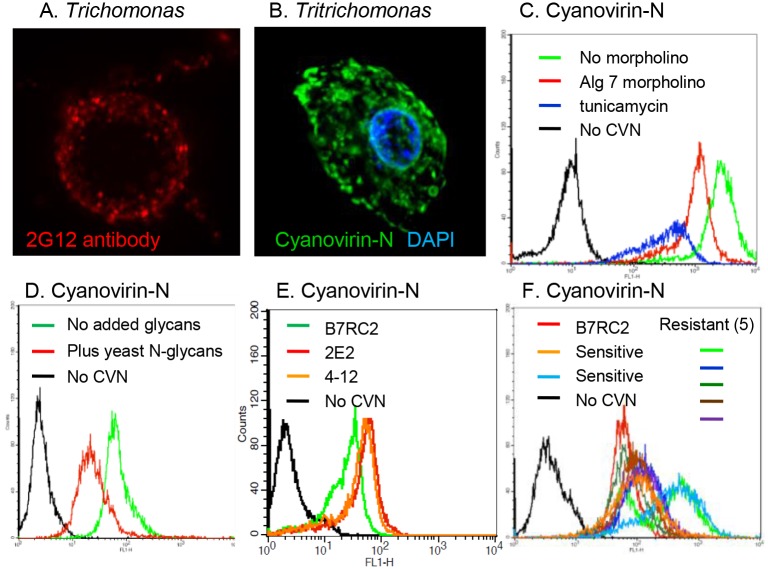
Fig 3. Anti-retroviral lectins and the 2G12 monoclonal antibody bind N-glycans of Trichomonas.
A. Fluorescence micrographs show binding of griffithsin 2G12 antibody (red) to the surface of Trichomonas. B. Fluorescence micrograph shows binding of cyanovirin-N to the surface of Tritrichomonas. C. Flow cytometry shows that labeling with cyanovirin-N (green) is decreased when Trichomonas is treated with an Alg7 morpholino (red) or treated with tunicamycin (blue), both of which inhibit the first step in synthesis of the N-glycan precursor. D. Flow cytometry shows decreased binding of cyanovirin-N to Trichomonas (green) in the presence of N-glycans from the Saccharomyces mnn1/mmn4 double-knockout (red). E. Flow cytometry shows binding of cyanovirin-N to ricin resistant mutants (2E2 and 4–12) is slightly greater than binding to parent strain (B7RC2). F. Flow cytometry shows that binding of cyanovirin-N to two metronidazole-sensitive clinical isolates (bright blue and tan) and five metronidazole-resistant clinical isolates (green, dark blue, light blue, brown, and purple) from the CDC is as great or greater than binding of cyanovirin-N to B7RC2 (red), the parent strain for the ricin-resistant mutants.
Fig 4
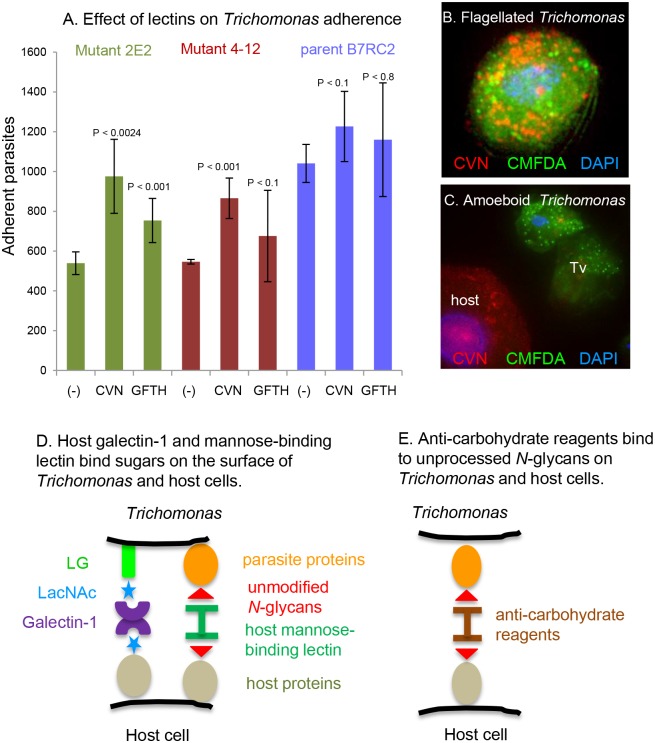
Fig 4. Anti-retroviral lectins increase the adherence of ricin-resistant Trichomonas mutants to ectocervical cells, while cyanovirin-N is lost from the parasite surface when Trichomonas binds to EpiVaginal tissue cells and converts into an ameboid form.
A. Cyanovirin-N (CVN) increases the adherence of ricin-resistant mutant Trichomonas (2E2 and 4–12) to ectocervical cells in vitro, while griffithsin (GRFT) has less effect. Neither lectin has much effect on the parent B7RC2 strain, which is much more adherent to ectocervical cells in the absence of lectin. Data is average of three experiments. B. A flagellated Trichomonas labeled green with CMFDA (green), which concentrates in secretory vesicles, has cyanovirin-N (red) on its surface. C. When CMFDA-labeled Trichomonas adhere to organotypic EpiVaginal tissue cells, most of the cyanovirin-N is lost. Note that the host EpiVaginal cell (lower left) binds cyanovirin-N. D. A model for how host lectins affect adherence of Trichomonas to host cells is based upon experiments here and previously published experiments [24]. Galectin-1 (purple) secreted by the host epithelial cells cross-links LacNAc residues (bright blue) present on glycans of host proteins (grey) and on parasite LG (bright green). Similarly, host mannose-binding lectin (deep green) cross-links unmodified N-glycans (red) present on host and parasite proteins. E. Exogenous anti-retroviral lectins (brown) cross-link N-glycans on the surface of Trichomonas and host cells.
Fig 5
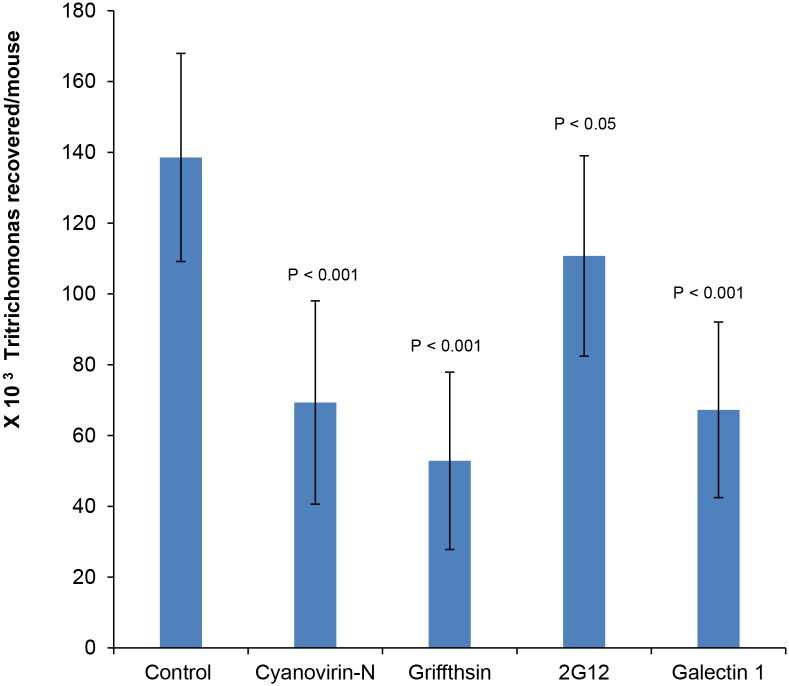
Fig 5. Anti-retroviral lectins decrease recovery of Tritrichomonas in a mouse vaginal model.
Recovery of Tritrichomonas after two days in the vagina of mice shows a modest but statistically significant decrease by co-infection with cyanovirin-N (63% decrease), griffithsin (70% decrease), or galectin-1 (51% decrease). In contrast, there is little effect of the 2G12 monoclonal antibody. Data is the average of three experiments each containing five mice per treatment.

References

    1. Johnston VJ, Mabey DC (2008) Global epidemiology and control of Trichomonas vaginalis . Curr Opin Infect Dis 21: 56–64. 10.1097/QCO.0b013e3282f3d999 - DOI - PubMed
    1. Corbeil LB, Munson L, Campero C, BonDurant RH (2001) Bovine trichomoniasis as a model for development of vaccines against sexually-transmitted disease. Am J Reprod Immunol 45: 310–319. - PubMed
    1. Cobo ER, Eckmann L, Corbeil LB (2011) Murine models of vaginal trichomonad infections. Am J Trop Med Hyg 85: 667–673. 10.4269/ajtmh.2011.11-0123 - DOI - PMC - PubMed
    1. Conrad MD, Gorman AW, Schillinger JA, Fiori PL, Arroyo R, Malla N, et al. (2012) Extensive genetic diversity, unique population structure and evidence of genetic exchange in the sexually transmitted parasite Trichomonas vaginalis . PLoS Negl Trop Dis 6: e1573 10.1371/journal.pntd.0001573 - DOI - PMC - PubMed
    1. Van Der Pol B, Kwok C, Pierre-Louis B, Rinaldi A, Salata RA, Chen PL, et al. (2008) Trichomonas vaginalis infection and human immunodeficiency virus acquisition in African women. J Infect Dis 197: 548–554. 10.1086/526496 - DOI - PubMed

Publication types

MeSH terms