


Six minute walk distance is a predictor of survival in patients with chronic obstructive pulmonary disease undergoing pulmonary rehabilitation
- PMID: 26252533
- PMCID: PMC4530856
- DOI: 10.1155/2015/280187
Six minute walk distance is a predictor of survival in patients with chronic obstructive pulmonary disease undergoing pulmonary rehabilitation
Abstract
Background: Chronic obstructive pulmonary disease (COPD) is a progressive and distressing disease with a trajectory that is often difficult to predict.
Objective: To determine whether initial 6 min walk distance (6MWD) or change in 6MWD following inpatient pulmonary rehabilitation (PR) predicted survival.
Methods: Patients referred for PR in 2010 were studied in a retrospective chart review. Measures of 6MWD before and following PR were recorded. Initial 6MWD was categorized as ≥250 m, 150 m to 249 m and ≤149 m. Government databases provided survival status up until December 2013 and survival analyses were performed. Initial 6MWD and a minimally important difference (MID) of ≥30 m were used for survival analysis.
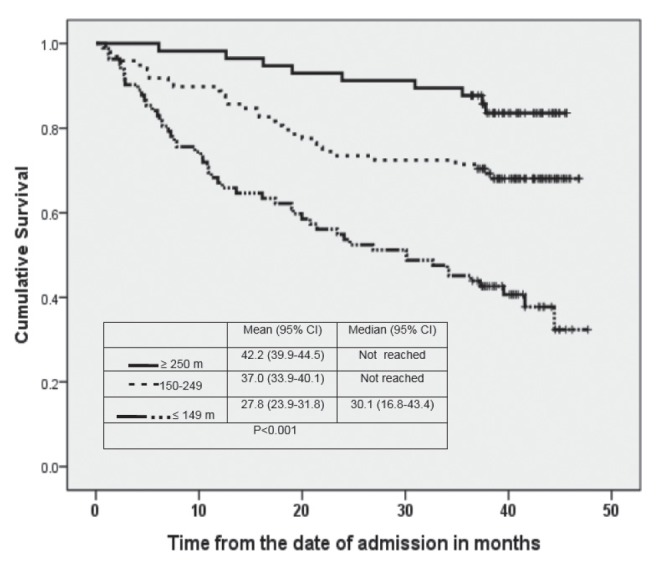
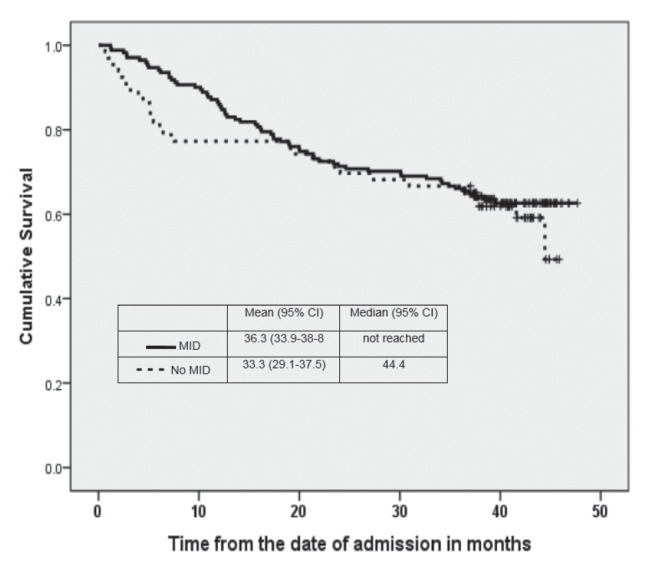
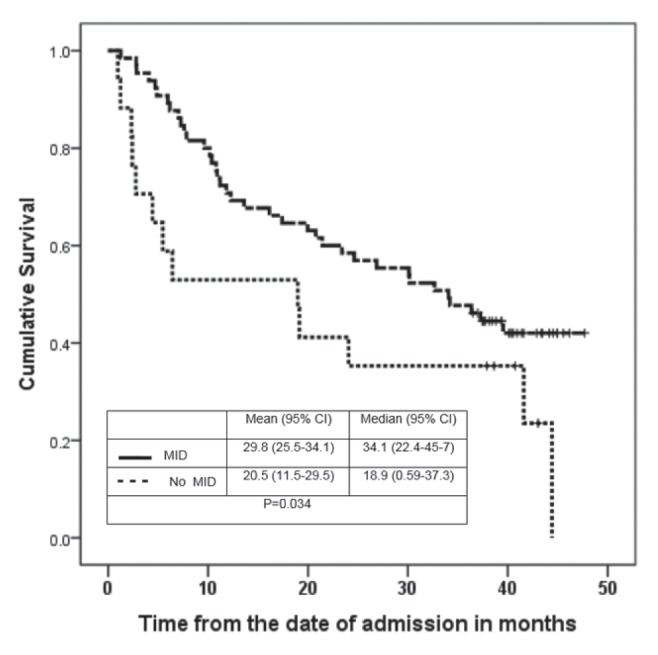
Results: The cohort consisted of 237 patients (92 men, 145 women) with severe COPD. Mean (± SD) forced expiratory volume in 1 s (FEV1) was 0.75±0.36 L, with a mean FEV1/forced vital capacity (FVC) ratio of 0.57±0.16. Overall three-year survival was 58%. Mean survival for the study period as per predefined categories of 6MWD of ≥250 m, 150 m to 249 m and ≤149 m was 42.2, 37.0 and 27.8 months (P<0.001), respectively, with a three-year survival of 81%, 66% and 34% observed, respectively. Overall mean change in 6MWD was 62±57 m, and a minimal improvement of ≥30 m was observed in 72% of patients. In the lowest walking group, early mortality was significantly higher among those who did not achieve minimal improvement. Older age, male sex and shorter initial 6MWD were negative predictors of survival.
Conclusion: In patients with severe COPD, initial 6MWD was predictive of survival. Overall survival at three years was only 58% and was especially poor (34%) in patients with low (<150 m) initial walk distance.
HISTORIQUE :: La maladie pulmonaire obstructive chronique (MPOC) est une maladie évolutive et pénible, à la trajectoire souvent difficile à prévoir.
OBJECTIF :: Déterminer si le test de marche de six minutes (TMSM) initial ou un changement au TMSM après la réadaptation pulmonaire (RP) des patients hospitalisés sont indicateurs de la survie.
MÉTHODOLOGIE :: Les chercheurs ont procédé à l’analyse rétrospective des dossiers des patients orientés vers une RP en 2010. Les chercheurs ont mesuré le TMSM avant et après la RP. Le TMSM était classé à plus de 250 m, entre 150 m et 249 m et à moins de 149 m. Les bases de données gouvernementales ont fourni le statut de survie jusqu’en décembre 2013, et les chercheurs ont effectué les analyses de survie. Un TMSM initial à l’importance d’amplitude minimale (IAM) de plus de 30 m était été utilisé pour l’analyse de survie.
RÉSULTATS :: La cohorte était composée de 237 patients (92 hommes, 145 femmes) atteints d’une grave MPOC. Le volume expiratoire maximal par seconde (VEMS) moyen (± ÉT) était de 0,75±0,36 L, pour un ratio entre le VEMS moyen et la capacité vitale forcée (CVF) de 0,57±0,16. La survie globale au bout de trois ans s’élevait à 58 %. La survie moyenne pendant la période de l’étude, conformément aux catégories prédéfinies de TMSM d’au moins 250 m, de 150 m à 249 m et de 149 m ou moins étaient de 42,2 mois, de 37,0 mois et de 27,8 mois (P<0,001), respectivement, pour une survie de 81 %, de 66 % et de 34 % au bout de trois ans, respectivement. Le changement global moyen du TMSM était de 62±57 m, et les chercheurs ont observé une amélioration minimale d’au moins 30 m chez 72 % des patients. Dans le groupe qui franchissait la plus courte distance, la mortalité précoce était considérablement plus élevée chez ceux qui n’obtenaient pas une amélioration minimale. Un âge plus avancé, le sexe masculin et un TMSM initial plus court étaient des indicateurs de survie négatifs.
CONCLUSION :: Chez les patients atteints d’une grave MOPD, le TMSM initial était indicateur de survie. La survie globale au bout de trois ans n’atteignait que 58 % et était particulièrement basse (34 %) chez les patients dont la distance de marche initiale était faible (moins de 150 m).
Figures
References
-
- World Health Organization . Ten leading causes of death in the world, 2010–2012. Geneva: World Health Organization; < http://www.who.int/mediacentre/factsheets/fs310/en/> (Accessed August 4, 2014).
-
- Hoyert DL, Xu J. Deaths: Preliminary Data for 2011. National Vital Statistics Report 2012. Natl Vital Stat Rep. 2012;61:1–51. - PubMed
-
- Global Strategy for the Diagnosis, Management and Prevention of COPD, Global Initiative for Chronic Obstructive Lung Disease (GOLD) 2010. < www.goldcopd.org/> (Accessed August 2014).
-
- Celli BR. Predictors of mortality in COPD. Respir Med. 2010;104:773–9. - PubMed
-
- Cote CG, Pinto-Plata VM, Marin JM, Nekach H, Dordelly LJ, Celli BR. The modified BODE index: Validation with mortality in COPD. Eur Respir J. 2008;32:1269–74. - PubMed
Publication types
MeSH terms
LinkOut - more resources
Full Text Sources
Other Literature Sources
Medical
Research Materials
