. 2015 Oct;81(20):7187-200.
doi: 10.1128/AEM.02028-15. Epub 2015 Aug 7.

Alcohol Selectivity in a Synthetic Thermophilic n-Butanol Pathway Is Driven by Biocatalytic and Thermostability Characteristics of Constituent Enzymes

Affiliations

Alcohol Selectivity in a Synthetic Thermophilic n-Butanol Pathway Is Driven by Biocatalytic and Thermostability Characteristics of Constituent Enzymes

Andrew J Loder et al. Appl Environ Microbiol. 2015 Oct.

Abstract

n-Butanol is generated as a natural product of metabolism by several microorganisms, but almost all grow at mesophilic temperatures. A synthetic pathway for n-butanol production from acetyl coenzyme A (acetyl-CoA) that functioned at 70°C was assembled in vitro from enzymes recruited from thermophilic bacteria to inform efforts for engineering butanol production into thermophilic hosts. Recombinant versions of eight thermophilic enzymes (β-ketothiolase [Thl], 3-hydroxybutyryl-CoA dehydrogenase [Hbd], and 3-hydroxybutyryl-CoA dehydratase [Crt] from Caldanaerobacter subterraneus subsp. tengcongensis; trans-2-enoyl-CoA reductase [Ter] from Spirochaeta thermophila; bifunctional acetaldehyde dehydrogenase/alcohol dehydrogenase [AdhE] from Clostridium thermocellum; and AdhE, aldehyde dehydrogenase [Bad], and butanol dehydrogenase [Bdh] from Thermoanaerobacter sp. strain X514) were utilized to examine three possible pathways for n-butanol. These pathways differed in the two steps required to convert butyryl-CoA to n-butanol: Thl-Hbd-Crt-Ter-AdhE (C. thermocellum), Thl-Hbd-Crt-Ter-AdhE (Thermoanaerobacter X514), and Thl-Hbd-Crt-Ter-Bad-Bdh. n-Butanol was produced at 70°C, but with different amounts of ethanol as a coproduct, because of the broad substrate specificities of AdhE, Bad, and Bdh. A reaction kinetics model, validated via comparison to in vitro experiments, was used to determine relative enzyme ratios needed to maximize n-butanol production. By using large relative amounts of Thl and Hbd and small amounts of Bad and Bdh, >70% conversion to n-butanol was observed in vitro, but with a 60% decrease in the predicted pathway flux. With more-selective hypothetical versions of Bad and Bdh, >70% conversion to n-butanol is predicted, with a 19% increase in pathway flux. Thus, more-selective thermophilic versions of Bad, Bdh, and AdhE are needed to fully exploit biocatalytic n-butanol production at elevated temperatures.


Figures

FIG 1
FIG 1
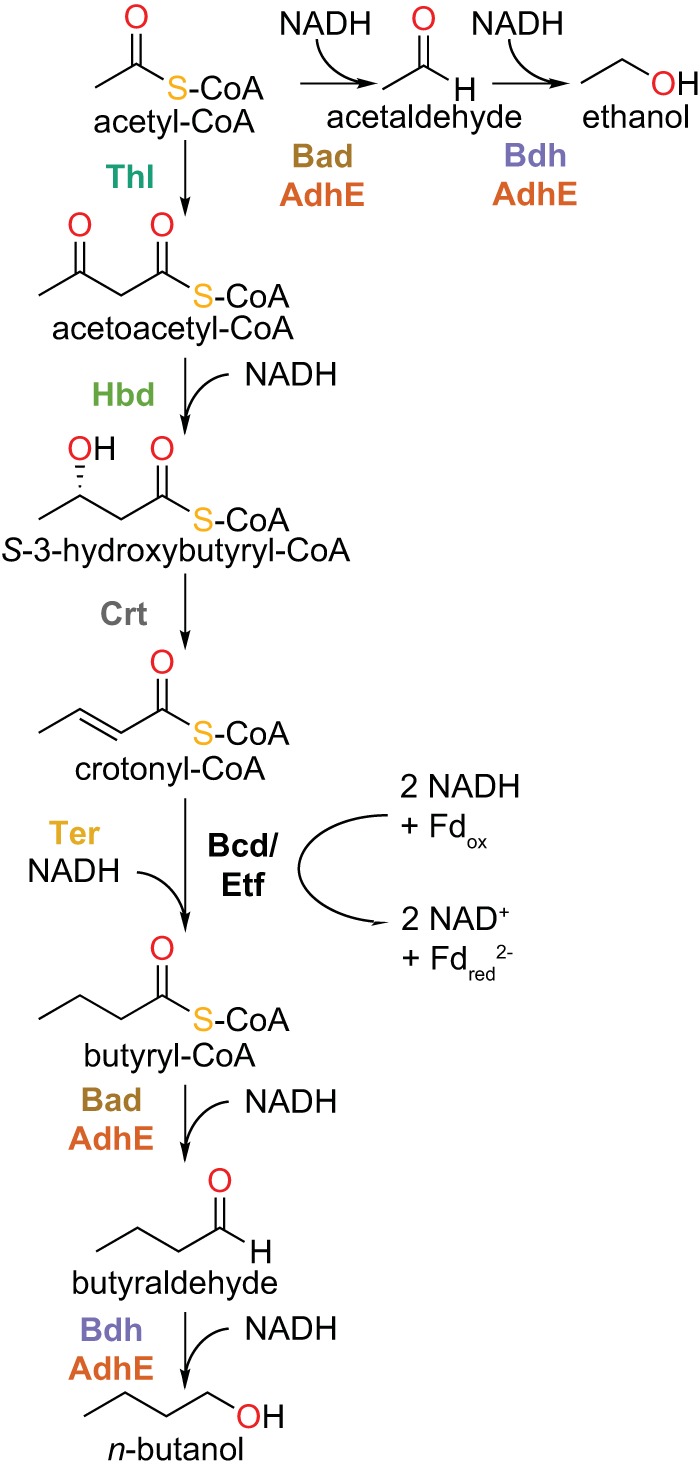
Enzymatic pathway for n-butanol formation. Abbreviations: Thl, β-ketothiolase (EC 2.3.1.16); Hbd, 3-hydroxybutyryl-CoA dehydrogenase (EC 1.1.1.35); Crt, 3-hydroxybutyryl-CoA dehydratase (EC 4.2.1.55); Bcd/Etf, butyryl-CoA dehydrogenase/electron transfer protein; Ter, trans-2-enoyl-CoA reductase (EC 1.3.1.44); Bad, aldehyde dehydrogenase (EC 1.2.1.10); Bdh, alcohol dehydrogenase (EC 1.1.1.1); AdhE, bifunctional acetaldehyde dehydrogenase/alcohol dehydrogenase; Fdox, oxidized ferredoxin; Fdred, reduced ferredoxin.
FIG 2
FIG 2
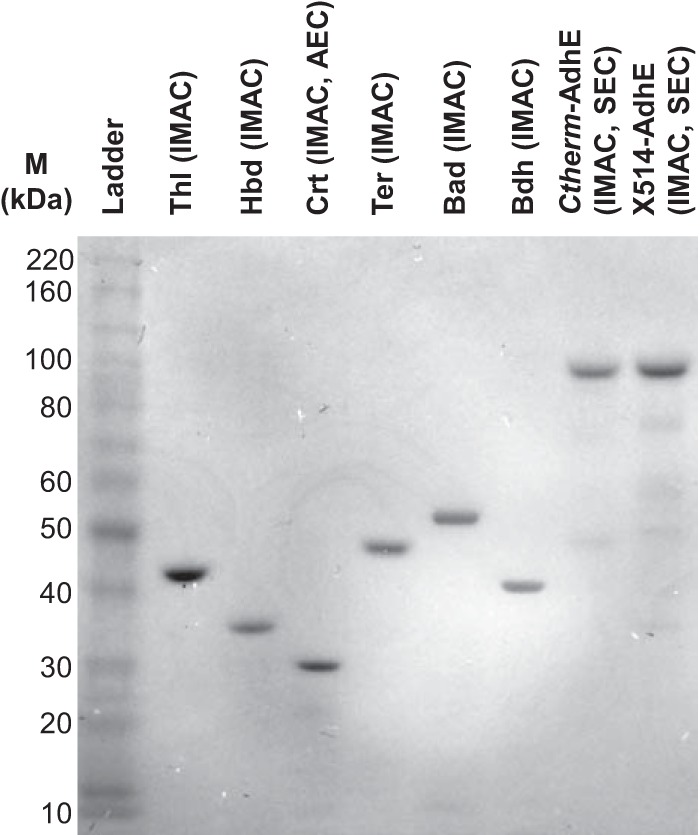
SDS-PAGE analysis of purified enzymes. The positions of molecular mass markers (M) (in kilodaltons) are shown to the left of the gel. Abbreviations: IMAC, immobilized metal affinity chromatography; AEC, anion-exchange chromatography; SEC, size exclusion chromatography.
FIG 3
FIG 3
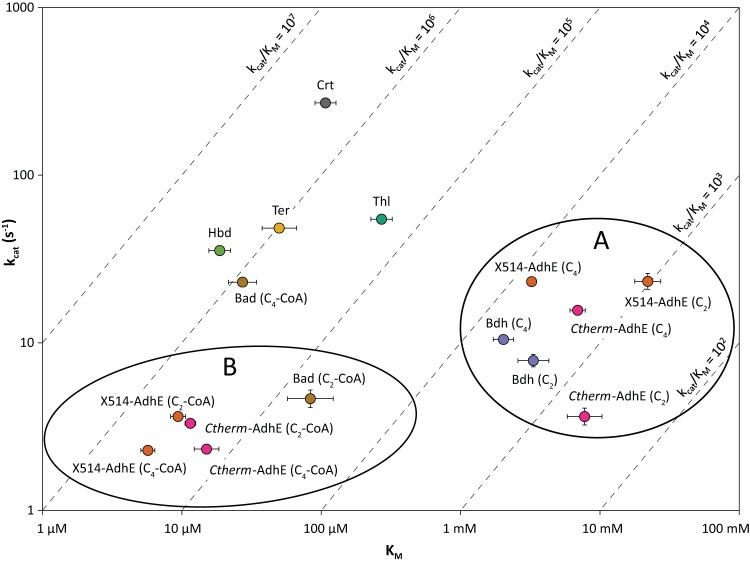
Kinetic parameters of n-butanol pathway enzymes in log space. The broken lines represent constant values of kcat/Km. Substrate abbreviations: C2, acetaldehyde; C4, butyraldehyde; C2-CoA, acetyl-CoA; C4-CoA, butyryl-CoA. Each error bar represents one standard error.
FIG 4
FIG 4
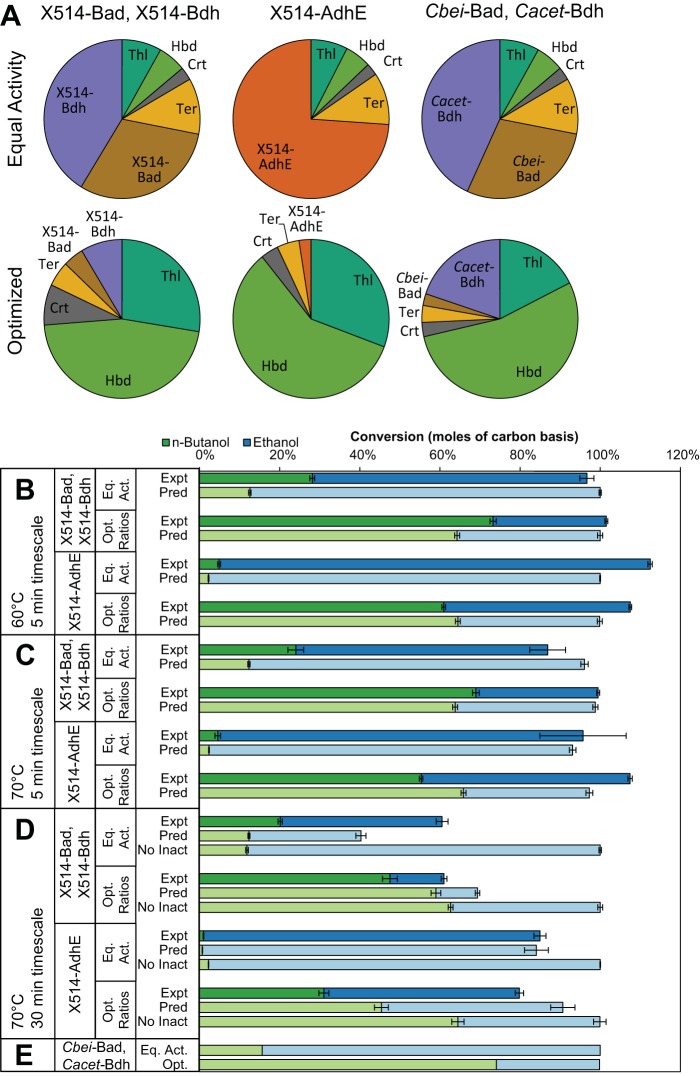
Measured and predicted alcohol production for in vitro assembly of pathway enzymes. (A) Molar enzyme proportions of each pathway variant for equal activities of each enzyme and optimized ratios for maximum n-butanol selectivity. (B) Measured (experimental [Expt]) and model-predicted (Pred) production of alcohols in vitro at 60°C using high enzyme loading for predicted reaction completion in 5 min. (C) Production at 70°C using high enzyme loads. (D) Production at 70°C using low enzyme loads for predicted reaction completion in 30 min, also compared with model predictions without accounting for enzyme inactivation (No Inact). (E) Model predictions of alcohol production using hypothetical thermostable versions of C. beijerinckii Bad (47) and C. acetobutylicum Bdh (44). Each error bar represents one standard error.
FIG 5
FIG 5
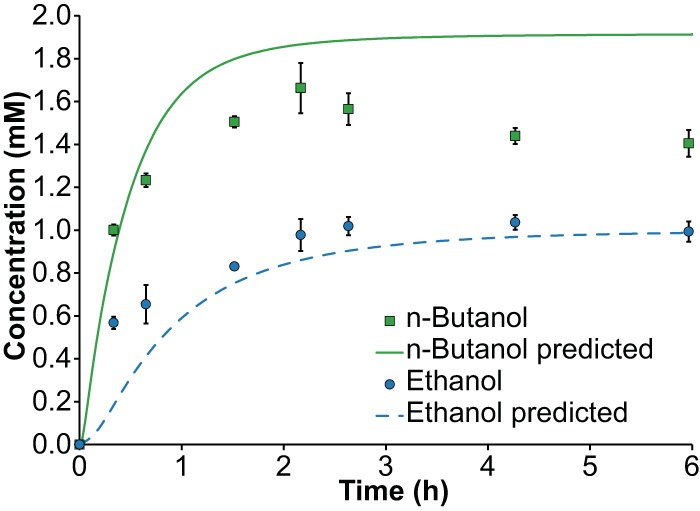
In vitro production of ethanol and n-butanol using X514-Bad/X514-Bdh pathway with optimized enzyme ratios at 60°C and low enzyme loads (predicted n-butanol production complete in 75 min). Each error bar represents one standard error.

References

    1. Bhandiwad A, Shaw AJ, Guss A, Guseva A, Bahl H, Lynd LR. 2014. Metabolic engineering of Thermoanaerobacterium saccharolyticum for n-butanol production. Metab Eng 21:17–25. doi:10.1016/j.ymben.2013.10.012. - DOI - PubMed
    1. Lin PP, Rabe KS, Takasumi JL, Kadisch M, Arnold FH, Liao JC. 2014. Isobutanol production at elevated temperatures in thermophilic Geobacillus thermoglucosidasius. Metab Eng 24:1–8. doi:10.1016/j.ymben.2014.03.006. - DOI - PubMed
    1. Deng Y, Olson DG, Zhou JL, Herring CD, Shaw AJ, Lynd LR. 2013. Redirecting carbon flux through exogenous pyruvate kinase to achieve high ethanol yields in Clostridium thermocellum. Metab Eng 15:151–158. doi:10.1016/j.ymben.2012.11.006. - DOI - PubMed
    1. Thorgersen MP, Lipscomb GL, Schut GJ, Kelly RM, Adams MWW. 2014. Deletion of acetyl-CoA synthetases I and II increases production of 3-hydroxypropionate by the metabolically-engineered hyperthermophile Pyrococcus furiosus. Metab Eng 22:83–88. doi:10.1016/j.ymben.2013.12.006. - DOI - PubMed
    1. Ludlow JM, Clark DS. 1991. Engineering considerations for the application of extremophiles in biotechnology. Crit Rev Biotechnol 10:321–345. doi:10.3109/07388559109038214. - DOI - PubMed

Publication types

MeSH terms

LinkOut - more resources