


Raising the topic of weight in general practice: perspectives of GPs and primary care nurses
- PMID: 26254471
- PMCID: PMC4538258
- DOI: 10.1136/bmjopen-2015-008546
Raising the topic of weight in general practice: perspectives of GPs and primary care nurses
Abstract
Objective: To explore general practitioners' (GPs) and primary care nurses' perceived barriers to raising the topic of weight in general practice.
Design: A qualitative study using the Theoretical Domains Framework (TDF). 34 semistructured interviews were conducted to explore views, opinions and experiences of initiating a discussion about weight. Content and thematic analyses were used to analyse the interview transcripts.
Setting: General practices located in one primary care trust in the South West of England.
Participants: 17 GPs and 17 nurses aged between 32 and 66 years. The modal age range for GPs was 30-39 years and for nurses, 40-49 years.
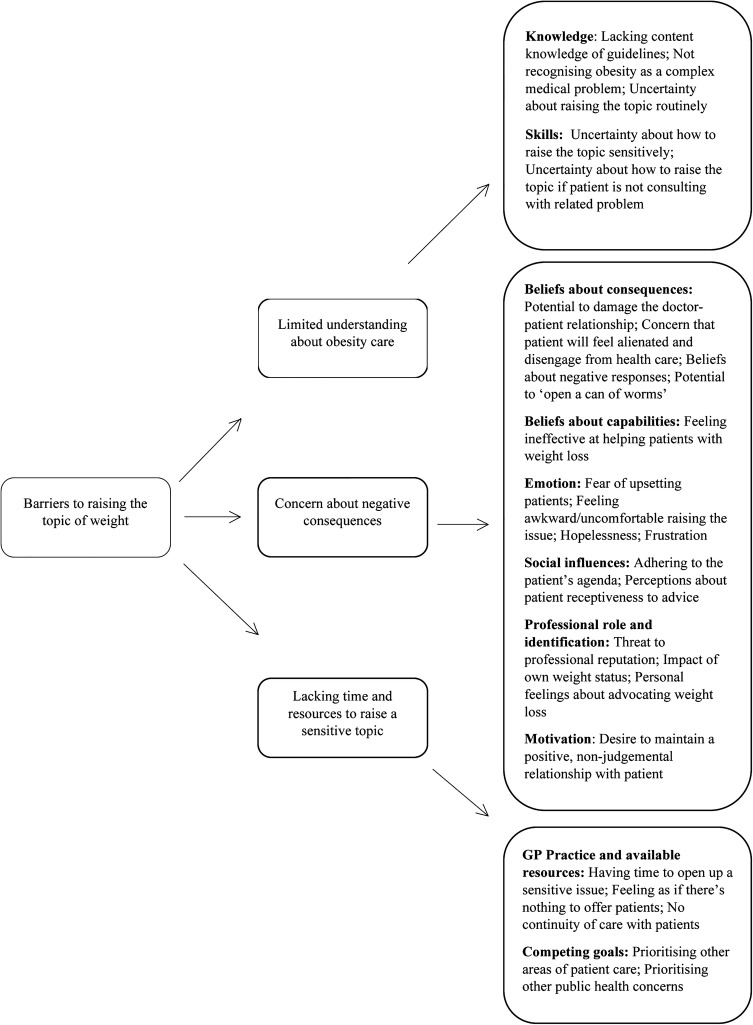
Results: Barriers were synthesised into three main themes: (1) limited understanding about obesity care, (2) concern about negative consequences, and (3) having time and resources to raise a sensitive topic. Most barriers were related to raising the topic in more routine settings, rather than when dealing with an associated medical condition. GPs were particularly worried about damaging their relationship with patients and emphasised the need to follow their patient's agenda.
Conclusions: Uncertainty about obesity, concerns about alienating patients and feeling unable to raise the topic within the constraints of a 10 min consultation, is adding to the reluctance of GPs and nurses to broach the topic of weight. Addressing these concerns through training or by providing evidence of effective interventions that are feasible to deliver within consultations may lead to greater practitioner engagement and willingness to raise the topic.
Keywords: MEDICAL EDUCATION & TRAINING; PREVENTIVE MEDICINE; PRIMARY CARE; PUBLIC HEALTH; QUALITATIVE RESEARCH.
Published by the BMJ Publishing Group Limited. For permission to use (where not already granted under a licence) please go to http://group.bmj.com/group/rights-licensing/permissions.
Figures
References
-
- Academy of Medical Royal Colleges. Measuring up. The medical profession's prescription for the nation's obesity crisis. Academy of Medical Royal Colleges, 2013. http://www.aomrc.org.uk/projects/obesity-steering-group.html (accessed 15 Jan 2014).
-
- Royal College of Physicians. Action on obesity: comprehensive care for all Royal College of Physicians. Report of a working party Royal College of Physicians, 2013. https://www.rcplondon.ac.uk/resources/action-obesity-comprehensive-care-all (accessed Apr 2014).
-
- National Institute for Health and Care Excellence (NICE). Obesity: guidance on the prevention, identification, assessment and management of overweight and obesity in adults and children. NICE, 2014. http://www.nice.org.uk/ (accessed 1 Sep 2014). - PubMed
-
- National Institute for Health and Care Excellence (NICE). Managing overweight and obesity in adults—lifestyle weight management services. NICE, 2014. http://www.nice.org.uk/guidance/ph53 (accessed 18 Aug 2014).
-
- Abid O, Galuska D, Khan LK et al. Are healthcare professionals advising obese patients to lose weight? A trend analysis. Med Gen Med 2005;7:10. - PubMed
Publication types
MeSH terms
LinkOut - more resources
Full Text Sources
Other Literature Sources
Medical
