


Air Current Applied to the Face Improves Exercise Performance in Patients with COPD
- PMID: 26255060
- PMCID: PMC4996349
- DOI: 10.1007/s00408-015-9780-0
Air Current Applied to the Face Improves Exercise Performance in Patients with COPD
Abstract
Purpose: Improving dyspnea and exercise performance are goals of COPD therapy. We tested the hypothesis that air current applied to the face would lessen dyspnea and improve exercise performance in moderate-severe COPD patients.
Methods: We recruited 10 COPD patients (5 men, age 62 ± 6 years, FEV1 0.93 ± 0.11 L (34 ± 3% predicted), TLC 107 ± 6%, RV 172 ± 18%) naïve to the study hypothesis. Each patient was randomized in a crossover fashion to lower extremity ergometry at constant submaximal workload with a 12-diameter fan directed at the patients face or exposed leg. Each patients' studies were separated by at least 1 week. Inspiratory capacity and Borg dyspnea score were measured every 2 min and at maximal exercise.
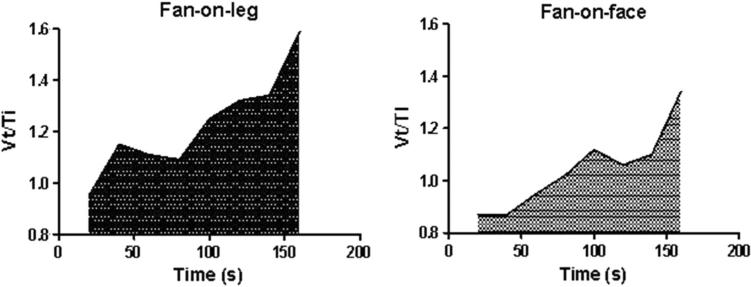
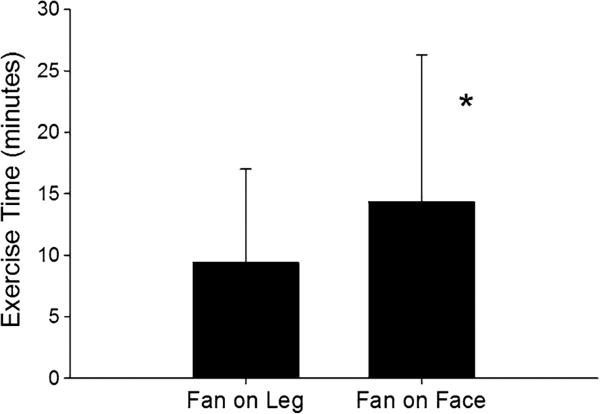
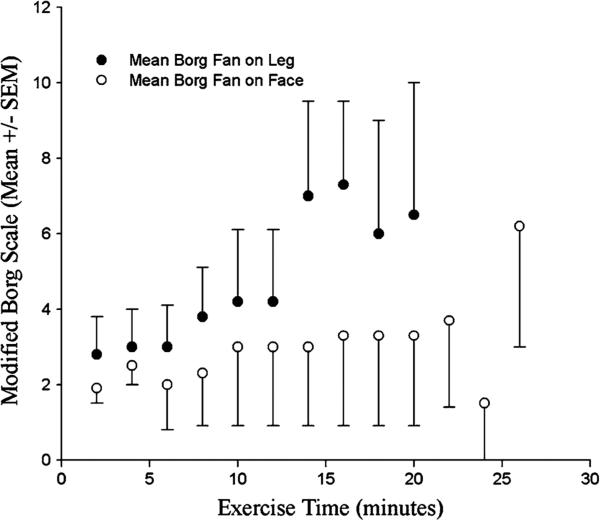
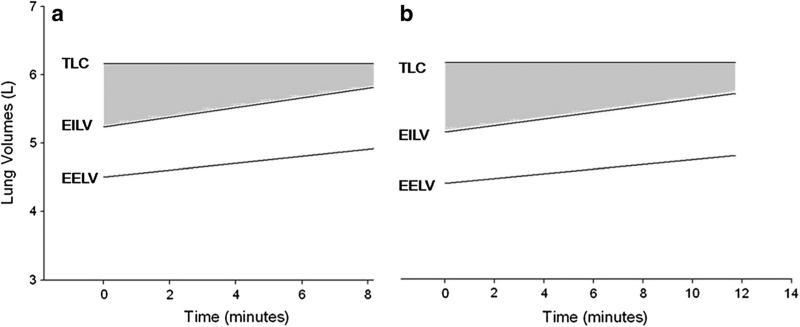
Results: Total exercise time was longer when the fan was directed to the face (14.3 ± 12 vs. 9.4 ± 7.6 min, face vs. leg, respectively, p = 0.03). Inspiratory capacity tended to be greater with the fan directed to the face (1.4 (0.6-3.25) vs. 1.26 (0.56-2.89) L, p = 0.06). There was a reduction in dynamic hyperinflation, as reflected by higher IRV area in the fan on face group (553 ± 562 a.u. vs. 328 ± 319 a.u., p = 0.047). There was a significant improvement in the Borg dyspnea score at maximal exercise (5.0 (0-10) vs. 6.5 (0-10), p = 0.03), despite exercising for 34 % longer with the fan directed to the face.
Conclusions: Air current applied to the face improves exercise performance in COPD. Possible mechanisms include an alteration in breathing pattern that diminishes development of dynamic hyperinflation or to a change in perception of breathlessness.
Keywords: COPD; Dynamic hyperinflation; Emphysema; Exercise physiology.
Figures
References
-
- Kochanek KD, Xu J, Murphy SL, et al. Deaths: preliminary data for 2009. Natl Vital Stat Rep. 2011;59:1–51. - PubMed
-
- Global Initiative for Chronic Obstructive Lung Disease (GOLD) Global strategy for the diagnosis, management, and prevention of COPD. 2008 http://goldcopd.com. - PubMed
-
- O'Donnell DE, Revill SM, Webb KA. Dynamic hyperinflation and exercise intolerance in chronic obstructive pulmonary disease. Am J Respir Crit Care Med. 2001;164(5):770–777. - PubMed
-
- O'Donnell DE, Hamilton AL, Webb KA. Sensory-mechanical relationships during high-intensity, constant-work-rate exercise in COPD. J Appl Physiol. 2006;101(4):1025–1035. - PubMed
-
- O'Donnell DE, Fluge T, Gerken F, et al. Effects of tiotropium on lung hyperinflation, dyspnoea and exercise tolerance in COPD. Eur Respir J. 2004;23(6):832–840. - PubMed
Publication types
MeSH terms
Grants and funding
LinkOut - more resources
Full Text Sources
Other Literature Sources
Medical
