Review
. 2015 Dec 10:219:237-247.
doi: 10.1016/j.jconrel.2015.08.011. Epub 2015 Aug 6.

Small molecules targeting microRNA for cancer therapy: Promises and obstacles

Affiliations
Review

Small molecules targeting microRNA for cancer therapy: Promises and obstacles

Di Wen et al. J Control Release. .

Abstract

Aberrant expression of miRNAs is critically implicated in cancer initiation and progression. Therapeutic approaches focused on regulating miRNAs are therefore a promising approach for treating cancer. Antisense oligonucleotides, miRNA sponges, and CRISPR/Cas9 genome editing systems are being investigated as tools for regulating miRNAs. Despite the accruing insights in the use of these tools, delivery concerns have mitigated clinical application of such systems. In contrast, little attention has been given to the potential of small molecules to modulate miRNA expression for cancer therapy. In these years, many researches proved that small molecules targeting cancer-related miRNAs might have greater potential for cancer treatment. Small molecules targeting cancer related miRNAs showed significantly promising results in different cancer models. However, there are still several obstacles hindering the progress and clinical application in this area. This review discusses the development, mechanisms and application of small molecules for modulating oncogenic miRNAs (oncomiRs). Attention has also been given to screening technologies and perspectives aimed to facilitate clinical translation for small molecule-based miRNA therapeutics.

Keywords: Cancer therapy; OncomiR; Small molecule miRNA inhibitors; miRNA.


Figures

Figure 1
Figure 1
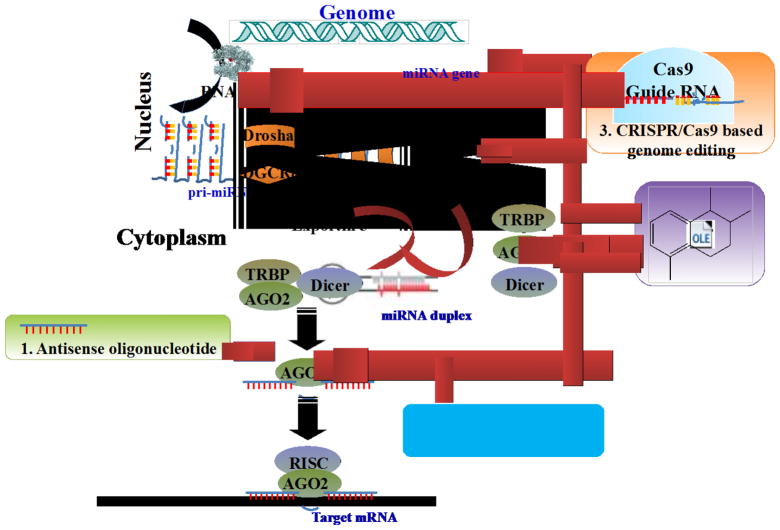
Schemes of miRNA generation and the inhibition effect of antisense oligonucleotide, miRNA sponges, CRISPR/Cas 9 genome editing, and small molecule inhibitor of miRNA (SMIR). miRNA is transcribed by RNA polymerase II into primary transcripts pri-miRNA (~1 to 3 kb long). This pri-miRNA undergoes further processing by the ribonucleases Drosha and DiGeorge syndrome critical region gene 8 (DGCR8) complex in the nucleus, thereby resulting in a hairpin intermediate pre-miRNA (~70–100 nucleotides long) which then transported to the cytoplasm via exportin 5. In the cytoplasm, the pre-miRNA is processed by another ribonuclease, Dicer, into a mature double strand miRNA (~18–25 nucleotides long). After strand separation, the guide strand or mature miRNA is incorporated into an RNA-induced silencing complex (RISC) complex target the 3′-UTR region of mRNAs, resulting is a decreased level of targeted protein, while the passenger strand is commonly degraded. Antisense oligonucleotide and miRNA sponges work on mature miRNA while CRISPR/Cas 9 genome editing works on genome. SMIR works on almost every stage of miRNA biogenesis.
Figure 2
Figure 2
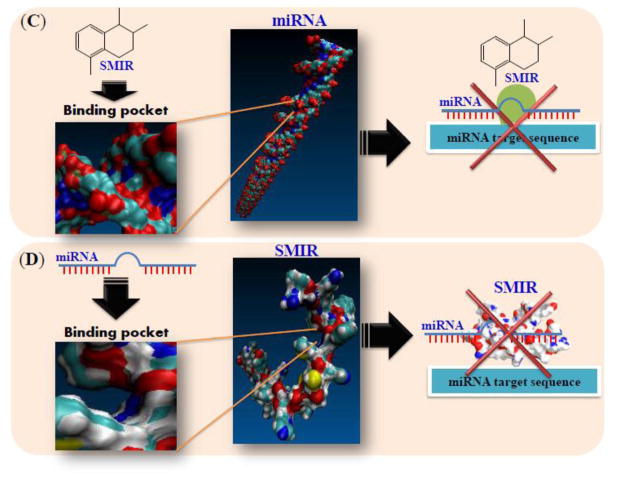
Mechanisms of (A) luciferase/GFP based screening. Effective SMIR binds mature miRNA and further inhibit the binding of this miRNA to miRNA target sequence, leading to the expression of Luciferase/GFP. (B) Molecular beacon-based screening. Effective SMIR binds mature miRNA and further inhibit the activity of Dicer. The 5′-fluorophore (F) and 3′-quencher (Q) attach to each other and no signal can be detected. (C) structure-based design. Effective SMIR binds to the binding pocket of certain miRNA and further prevent this miRNA to bind miRNA target sequence. (D) Peptides or peptoids screening. Effective SMIR (peptides or peptoids) binds specific miRNA and further prevent this miRNA to bind miRNA target sequence. SMIR, small molecule inhibitor of miRNA.
Figure 2
Figure 2
Mechanisms of (A) luciferase/GFP based screening. Effective SMIR binds mature miRNA and further inhibit the binding of this miRNA to miRNA target sequence, leading to the expression of Luciferase/GFP. (B) Molecular beacon-based screening. Effective SMIR binds mature miRNA and further inhibit the activity of Dicer. The 5′-fluorophore (F) and 3′-quencher (Q) attach to each other and no signal can be detected. (C) structure-based design. Effective SMIR binds to the binding pocket of certain miRNA and further prevent this miRNA to bind miRNA target sequence. (D) Peptides or peptoids screening. Effective SMIR (peptides or peptoids) binds specific miRNA and further prevent this miRNA to bind miRNA target sequence. SMIR, small molecule inhibitor of miRNA.

References

    1. Ambros V. MicroRNA pathways in flies and worms: Growth, death, fat, stress, and timing. Cell. 2003;113(6):673–676. - PubMed
    1. Bartel DP. MicroRNAs: Genomics, biogenesis, mechanism, and function. Cell. 2004;116(2):281–297. - PubMed
    1. Lai EC. microRNAs: Runts of the genome assert themselves. Curr Biol. 2003;13(23):R925–36. - PubMed
    1. Croce CM. Causes and consequences of microRNA dysregulation in cancer. Nat Rev Genet. 2009;10(10):704–714. - PMC - PubMed
    1. Esquela-Kerscher A, Slack FJ. Oncomirs - microRNAs with a role in cancer. Nat Rev Cancer. 2006;6(4):259–269. - PubMed

Publication types