. 2015 Aug 20;59(4):576-87.
doi: 10.1016/j.molcel.2015.06.032. Epub 2015 Aug 6.

THZ1 Reveals Roles for Cdk7 in Co-transcriptional Capping and Pausing

Affiliations

THZ1 Reveals Roles for Cdk7 in Co-transcriptional Capping and Pausing

Kyle A Nilson et al. Mol Cell. .

Abstract

The Cdk7 subunit of TFIIH phosphorylates RNA polymerase II (Pol II) during initiation, and, while recent studies show that inhibition of human Cdk7 negatively influences transcription, the mechanisms involved are unclear. Using in vitro transcription with nuclear extract, we demonstrate that THZ1, a covalent Cdk7 inhibitor, causes defects in Pol II phosphorylation, co-transcriptional capping, promoter proximal pausing, and productive elongation. THZ1 does not affect initiation but blocks essentially all Pol II large subunit C-terminal domain (CTD) phosphorylation. We found that guanylylation of nascent RNAs is length dependent and modulated by a THZ1-sensitive factor present in nuclear extract. THZ1 impacts pausing through a capping-independent block of DSIF and NELF loading. The P-TEFb-dependent transition into productive elongation was also inhibited by THZ1, likely due to loss of DSIF. Capping and pausing were also reduced in THZ1-treated cells. Our results provide mechanistic insights into THZ1 action and how Cdk7 broadly influences transcription and capping.


Figures

Figure 1
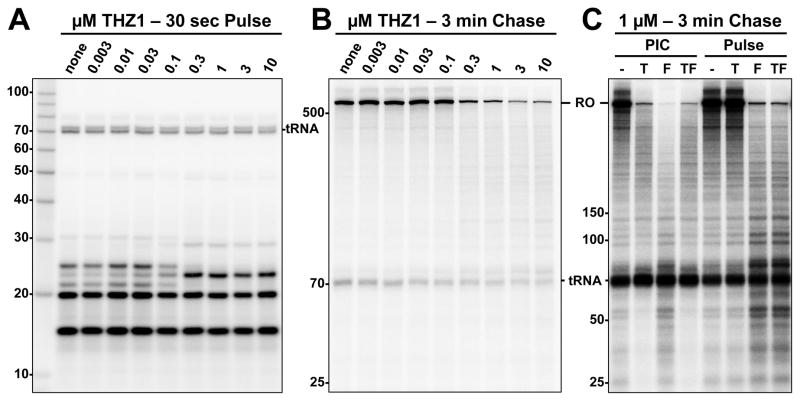
Figure 1. Cdk7 function is not required for initiation but is required for productive elongation and influences promoter-proximal pausing
(A) HeLa nuclear extract, template DNA, and indicated amounts of THZ1 were preincubated for 30 min and pulsed for 30 sec with limiting α-32P-CTP. Labeled transcripts were isolated and resolved by 9% Urea-PAGE. (B) Transcription reactions as in (A) were chased for 3 min with 500 μM CTP prior to RNA isolation. RO: run-off transcripts. 6% Urea-PAGE. (C) Transcription reactions as in (B) except THZ1 (T), Flavopiridol (F), or both (TF) were added during the 30 min preincubation (PIC) or the 30 sec pulse. 6% Urea-PAGE. See also Figure S1.
Figure 2
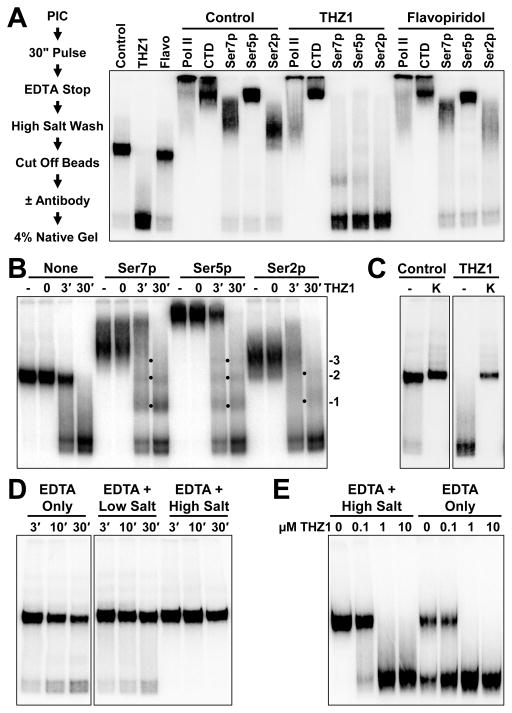
Figure 2. THZ1 inhibits Pol II CTD phosphorylation by Cdk7
(A) Migration of control, THZ1-, and Flavopiridol-treated elongation complexes before or after incubation with indicated antibodies. Elongation complexes are resolved by 4% native gel electrophoresis and visualized by their associated labeled transcripts. Final concentrations during the pulse were 1 μM for Flavopiridol and THZ1. (B) THZ1 was added for the indicated length of time before initiation following the protocol in A except that reactions were stopped in high salt wash buffer with EDTA. Complexes were resolved before or after incubation with the indicated antibodies. Dots and labels denote specific shifts caused by 1, 2, or 3 antibodies. (C) Migration of control and THZ1-treated elongation complexes which were stopped by direct addition of EDTA, incubated for 3 min, isolated, and reacted with mock (−) or P-TEFb kinase (K). (D) Migration of untreated elongation complexes which were first stopped by addition of EDTA only, wash and resuspension with an EDTA-containing low salt buffer, or addition of an EDTA-containing high salt buffer. All were then incubated for indicated times prior to isolation. (E) Migration of elongation complexes treated with indicated amounts of THZ1 which were stopped by addition of an EDTA-containing high salt buffer or EDTA only and incubated for 30 min prior to isolation.
Figure 3
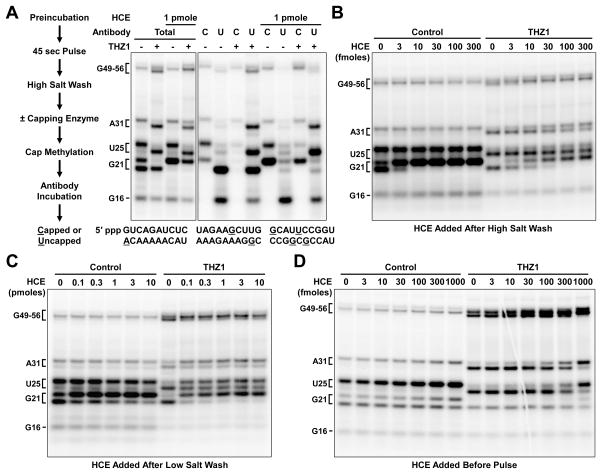
Figure 3. THZ1 alters mRNA capping through multiple mechanisms
(A) Cap status determination after 30 min preincubation ± THZ1, 45 sec limiting CTP pulse, high salt wash, and optional incubation with 1 pmole HCE for 1 min. Final concentration during the pulse was 1 μM for THZ1. Below: transcript sequence with limiting CTP stops underlined. C: capped transcripts recovered with anti-m2,2,7G beads. U: uncapped transcripts found in supernatant. 9% Urea-PAGE. (B) High salt washed elongation complexes generated as in (A) were incubated for 3 min with indicated amounts of HCE. (C) Complexes generated as in (A) except with a low salt wash step were incubated for 3 min with indicated amounts of HCE. (D) Complexes generated as in (A) except indicated amounts of HCE were added 20 min before initiation of transcription by pulse. See also Figure S2.
Figure 4
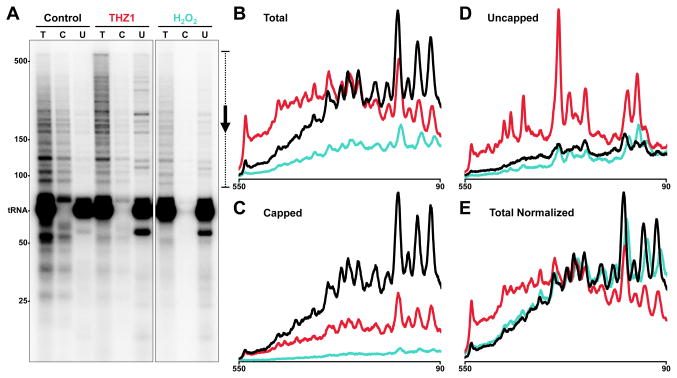
Figure 4. THZ1-induced pause defect is independent of mRNA capping
(A) Cap status determination of transcripts generated by a 30 min preincubation with Flavopiridol alone (Control; black) or in combination with THZ1 (red) or H2O2 (teal), 30 second limiting UTP/CTP pulse, and 3 min chase. Final concentrations during the chase were 1.3 μM for Flavopiridol and THZ1, or 2 mM for H2O2. T: total transcripts. C: capped. U: uncapped. 6% Urea-PAGE. (B–D) Profiles from the indicated region (bracket with arrow) of total (B), capped (C), and uncapped (D) transcripts. The vertical axis height of (B) is double that of (C and D). (E) Profiles from (B) were normalized by equalizing the areas under each curve. See also Figure S3.
Figure 5
Figure 5. THZ1-treated complexes are resistant to pausing by DSIF and NELF
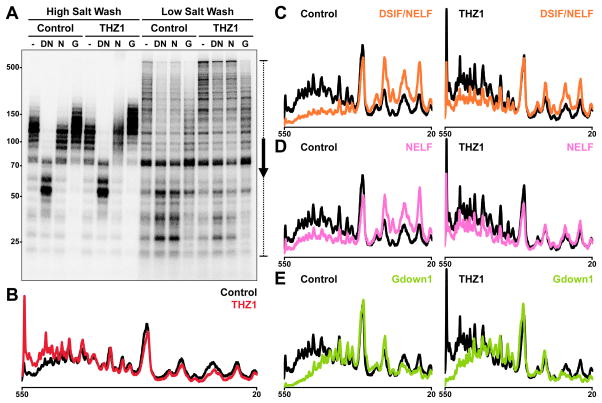
(A) Elongation complexes were generated by preincubation with Flavopiridol alone (Control) or in combination with THZ1 and a 30 sec limiting UTP/CTP pulse. These were then isolated by high or low salt wash, incubated for 5 min with mock (−), DSIF and NELF (DN), NELF only (N), or Gdown1 (G) add-backs, and chased for 3 min. Final concentrations during the chase were 1 μM Flavopiridol and THZ1. 6% Urea-PAGE. (B) Profiles from the indicated region (bracket with arrow) of control (black) or THZ1 (red) low salt wash mock add-backs. (C–E) Profiles of control (left) or THZ1 (right) low salt wash mock (black) add-backs compared with DSIF/NELF (orange) (C), NELF only (pink) (D), or Gdown1 (green) (E) add-backs. (C–E) have the same vertical axis heights.
Figure 6
Figure 6. THZ1 inhibits proper mRNA capping and Pol II elongation in cells
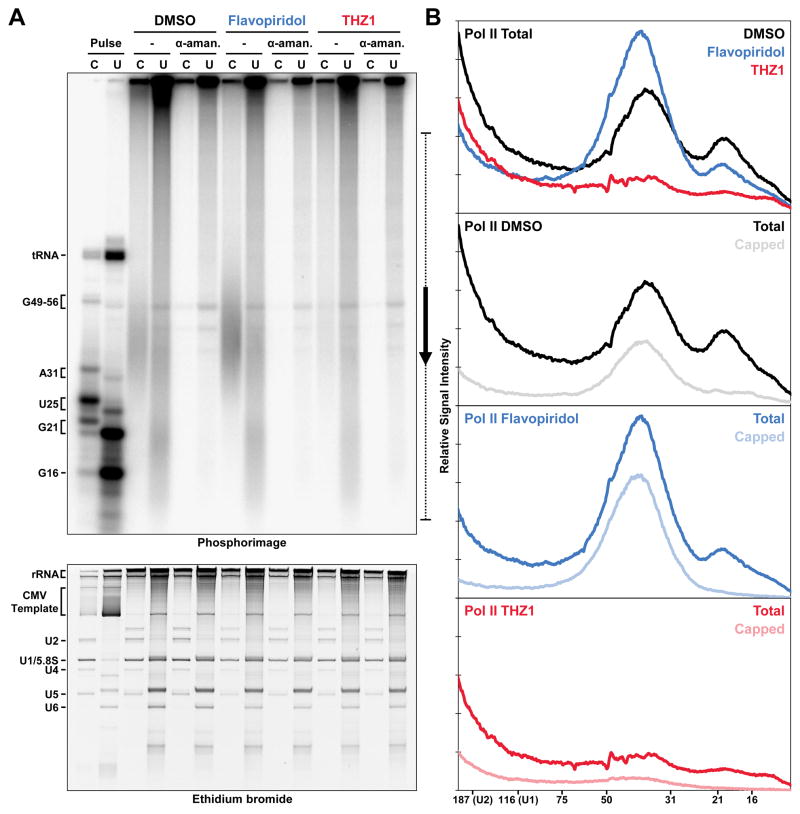
(A) Cap status determination of transcripts generated by 30 sec pulse with limiting α-32P-CTP or by nuclear run-ons performed only with α-32P-CTP in the absence or presence of 4 μg/ml α-amanitin using nuclei from HeLa cells treated 1 hr with DMSO (black), 1 μM Flavopiridol (blue), or 1 μM THZ1 (red). snRNAs with (U2, U1, U4, U5) and without (5.8S, U6) trimethyl-guanosine cap structures are indicated. 9% Urea-PAGE. (B) Profiles from the indicated region (bracket with arrow) of Pol II transcripts generated by taking the difference between lanes with or without α-amanitin. Total profiles were generated by combining capped and uncapped lanes. All plots have the same vertical axis height. See also Figures S4 and S5.
Figure 7
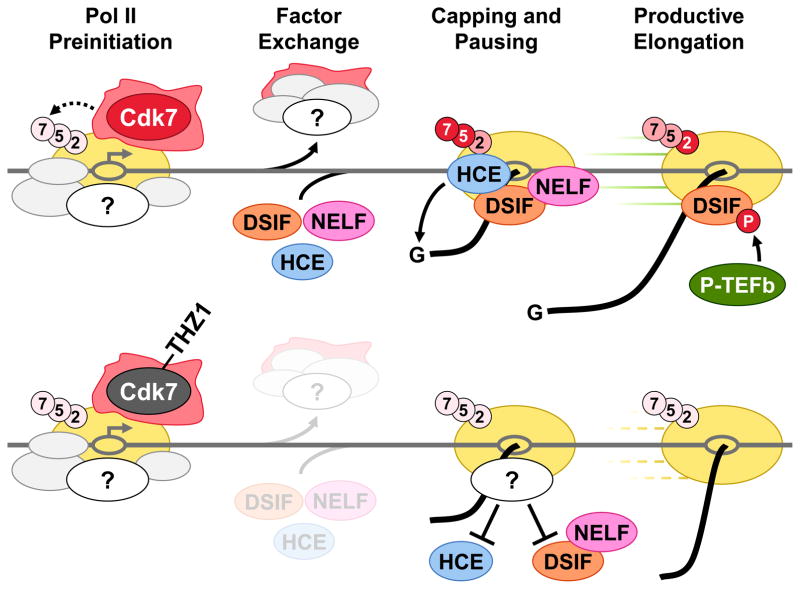
Figure 7. The role of Cdk7 in CTD phosphorylation, capping, pausing, and productive elongation
The diagram illustrates the cascade of events dependent on Cdk7 activity (top panel) and the effects of Cdk7 inhibition by THZ1 (bottom panel). Relative CTD phosphorylation is depicted by color intensity (red > pink > light pink). An unknown factor (or factors) present in extract which blocks capping and DSIF loading is shown.

Comment in

References

    1. Adamson TE, Shore SM, Price DH. Analysis of RNA polymerase II elongation in vitro. Methods Enzymol. 2003;371:264–275. - PubMed
    1. Akoulitchev S, Makela TP, Weinberg RA, Reinberg D. Requirement for TFIIH kinase activity in transcription by RNA polymerase II. Nature. 1995;377:557–560. - PubMed
    1. Bartkowiak B, Liu P, Phatnani HP, Fuda NJ, Cooper JJ, Price DH, Adelman K, Lis JT, Greenleaf AL. CDK12 is a transcription elongation-associated CTD kinase, the metazoan ortholog of yeast Ctk1. Genes Dev. 2010;24:2303–2316. - PMC - PubMed
    1. Bataille AR, Jeronimo C, Jacques PE, Laramee L, Fortin ME, Forest A, Bergeron M, Hanes SD, Robert F. A universal RNA polymerase II CTD cycle is orchestrated by complex interplays between kinase, phosphatase, and isomerase enzymes along genes. Mol Cell. 2012;45:158–170. - PubMed
    1. Bentley DL. Coupling mRNA processing with transcription in time and space. Nat Rev Genet. 2014;15:163–175. - PMC - PubMed

Publication types

MeSH terms