


Catheter Ablation for Atrial Fibrillation in Heart Failure Patients: A Meta-Analysis of Randomized Controlled Trials
- PMID: 26258174
- PMCID: PMC4525704
- DOI: 10.1016/j.jacep.2015.02.018
Catheter Ablation for Atrial Fibrillation in Heart Failure Patients: A Meta-Analysis of Randomized Controlled Trials
Abstract
Background: Rhythm control with antiarrhythmic drugs (AADs) is not superior to rate control in patients with heart failure (HF) and atrial fibrillation (AF), but AF ablation may be more successful at achieving rhythm control than AADs. However, risks for both ablation and AADs are likely higher and success rates lower in patients with HF.
Objective: To compare rate control versus AF catheter ablation strategies in patients with AF and HF.
Methods: We conducted a meta-analysis of trials which randomized HF patients (LVEF<50%) with AF to a rate control or AF catheter ablation strategy and reported change in LVEF, quality of life, 6-minute walk test, or peak oxygen consumption. Study quality and heterogenity were assessed using Jadad scores and Cochran's Q statistics, respectively. Mantel Haenszel relative risks and mean differences were calculated using random effect models.
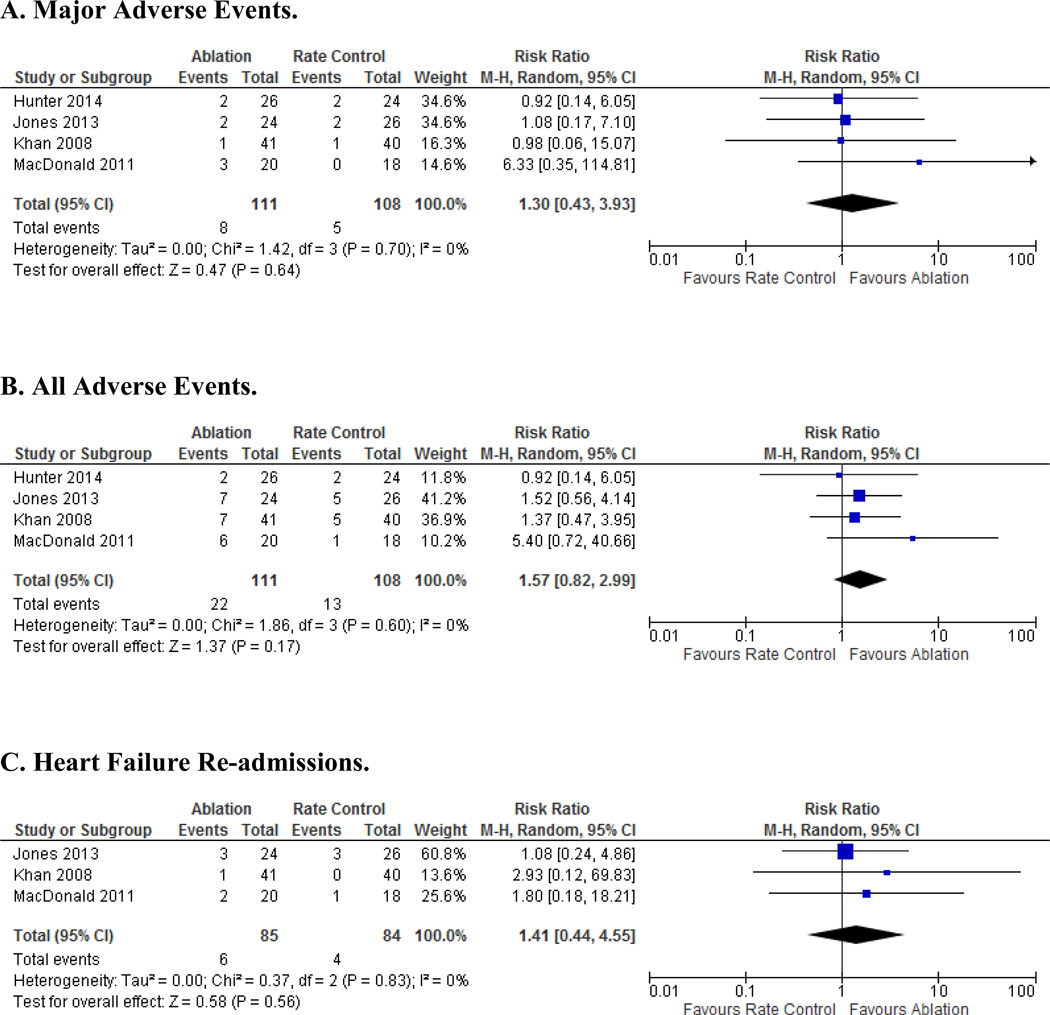
Results: Four trials (N=224) met inclusion criteria; 82.5% (n=185) had persistent AF. AF ablation was associated with an increase in LVEF (mean difference 8.5%; 95%CI 6.4,10.7%; P<0.001) compared to rate control. AF ablation was superior in improving quality of life by Minnesota Living with Heart Failure (MLWHF) questionnaire scores (mean difference -11.9; 95%CI -17.1, -6.6; P<0.001). Peak oxygen consumption and 6-minute walk distance increased in AF ablation compared to rate control patients (mean difference 3.2; 95%CI 1.1,5.2; P=0.003; mean difference 34.8; 95%CI 2.9, 66.7; P = 0.03, respectively). In the persistent AF subgroup LVEF and MLWHF were significantly improved with AF ablation. Major adverse event rates (RR 1.3; 95% CI, 0.4, 3.9; p=0.64) were not significantly different. No significant heterogeneity was evident.
Conclusions: In patients with HF and AF, AF catheter ablation is superior to rate control in improving LVEF, quality of life and functional capacity. Prior to accepting a rate control strategy in HF patients with persistent or drug refractory AF, consideration should be given to AF ablation.
Keywords: Atrial fibrillation; catheter ablation; heart failure; pulmonary vein isolation.
Figures


References
-
- Chen LY, Shen WK. Epidemiology of atrial fibrillation: A current perspective. Heart Rhythm. 2007;4:S1–S6. - PubMed
-
- Kim MH, Johnston SS, Chu BC, Dalal MR, Schulman KL. Estimation of total incremental health care costs in patients with atrial fibrillation in the united states. Circ Cardiovasc Qual Outcomes. 2011;4:313–320. - PubMed
-
- Levy D, Kenchaiah S, Larson MG, et al. Long-term trends in the incidence of and survival with heart failure. N Engl J Med. 2002;347:1397–1402. - PubMed
-
- Berry C, Murdoch DR, McMurray JJ. Economics of chronic heart failure. Eur J Heart Fail. 2001;3:283–291. - PubMed
-
- Maisel WH, Stevenson LW. Atrial fibrillation in heart failure: Epidemiology, pathophysiology, and rationale for therapy. Am J Cardiol. 2003;91:2D–8D. - PubMed
Grants and funding
LinkOut - more resources
Full Text Sources
Other Literature Sources
Research Materials
Miscellaneous