. 2015 Aug 10:6:7919.
doi: 10.1038/ncomms8919.

A scalable and operationally simple radical trifluoromethylation

Affiliations

A scalable and operationally simple radical trifluoromethylation

Joel W Beatty et al. Nat Commun. .

Abstract

The large number of reagents that have been developed for the synthesis of trifluoromethylated compounds is a testament to the importance of the CF3 group as well as the associated synthetic challenge. Current state-of-the-art reagents for appending the CF3 functionality directly are highly effective; however, their use on preparative scale has minimal precedent because they require multistep synthesis for their preparation, and/or are prohibitively expensive for large-scale application. For a scalable trifluoromethylation methodology, trifluoroacetic acid and its anhydride represent an attractive solution in terms of cost and availability; however, because of the exceedingly high oxidation potential of trifluoroacetate, previous endeavours to use this material as a CF3 source have required the use of highly forcing conditions. Here we report a strategy for the use of trifluoroacetic anhydride for a scalable and operationally simple trifluoromethylation reaction using pyridine N-oxide and photoredox catalysis to affect a facile decarboxylation to the CF3 radical.


Figures

Figure 1
Figure 1. Design principles for a mild photochemical decarboxylation of trifluoroacetate.
(a) TFA and TFAA are desirable CF3 sources from the perspective of availability and cost, but have traditionally proven challenging to utilize. (b) Strategic electrochemical tuning using the sacrificial redox auxiliary pyridine N-oxide allows for reductive decarboxylation within the electrochemical window of tris(bipyridine)ruthenium(II). The reagent undergoes irreversible reduction (determined with differential pulse voltammetry, E1/2red=−1.10 V versus SCE in MeCN, Supplementary Figs 1 and 2) with onset reduction observable at −0.86 V versus SCE.
Figure 2
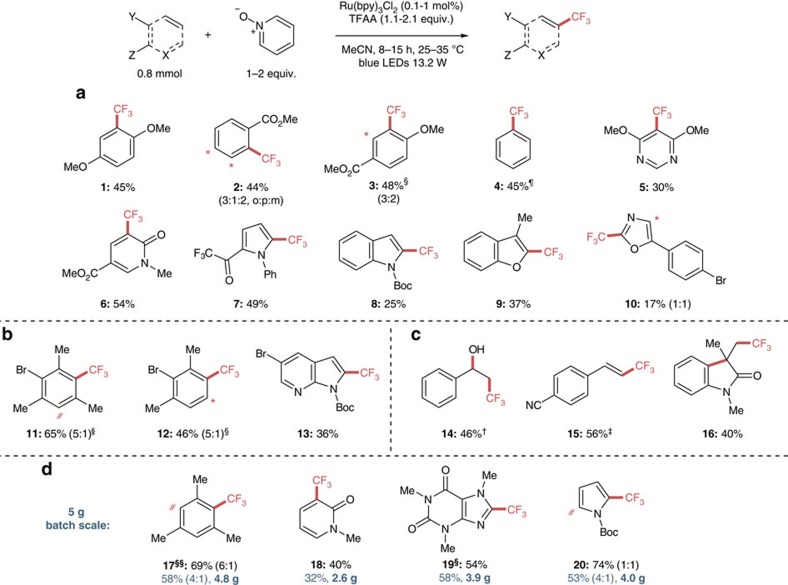
Figure 2. Scalable radical trifluoromethylation of arenes, heteroarenes and alkenes with trifluoroacetic anhydride.
(a) A variety of electron-rich and electron-neutral substrates are amenable to trifluoromethylation. (b) Substrates with functionality for cross-coupling were compatible with the reaction conditions. (c) Radical trifluoromethylation of alkenes. (d) Products 1720 were obtained from reactions run on 5 g scale using 0.1 mol% Ru(bpy)3Cl2. Isolated yields are indicated below each entry, except in the case of volatile compounds (19F NMR yields) and represent a single experiment. See Supplementary Methods for experimental details. *Position of functionalization on the minor regioisomeric product. ¶10 equiv. benzene. #Position of functionalization on the minor doubly functionalized product. §4 equiv. of pyridine N-oxide and 8 equiv. of TFAA, 24 h. †Run in CH2Cl2, stirred with methanol on reaction completion. ‡Run in CH2Cl2, stirred with DBU on reaction completion. §§3 equiv. of pyridine N-oxide and 3.1 equiv. of TFAA. Ru(bpy)3Cl2, tris(bipyridine)ruthenium(II) chloride; TFAA, trifluoroacetic anhydride; MeCN, acetonitrile; Me, methyl; Boc, tert-butyloxycarbonyl; Ph, phenyl; Ts, para-toluenesulfonyl.
Figure 3
Figure 3. Synthetic utility of the trifluoromethylation procedure.
(a) Trifluoromethylation of cross-coupling precursors. (b) Trifluoromethylation followed by cross-coupling leads to the production of specialty scaffolds. (c) Synthesis of 3-(trifluoromethyl)pyridine derivatives can be accomplished through pyridone functionalization. Boc, tert-butyloxycarbonyl; SPhos, 2-dicyclohexylphosphino-2′,6′-dimethoxybiphenyl; BMIDA, boronic acid methyliminodiacetic acid ester. Yields represent a single experiment.
Figure 4
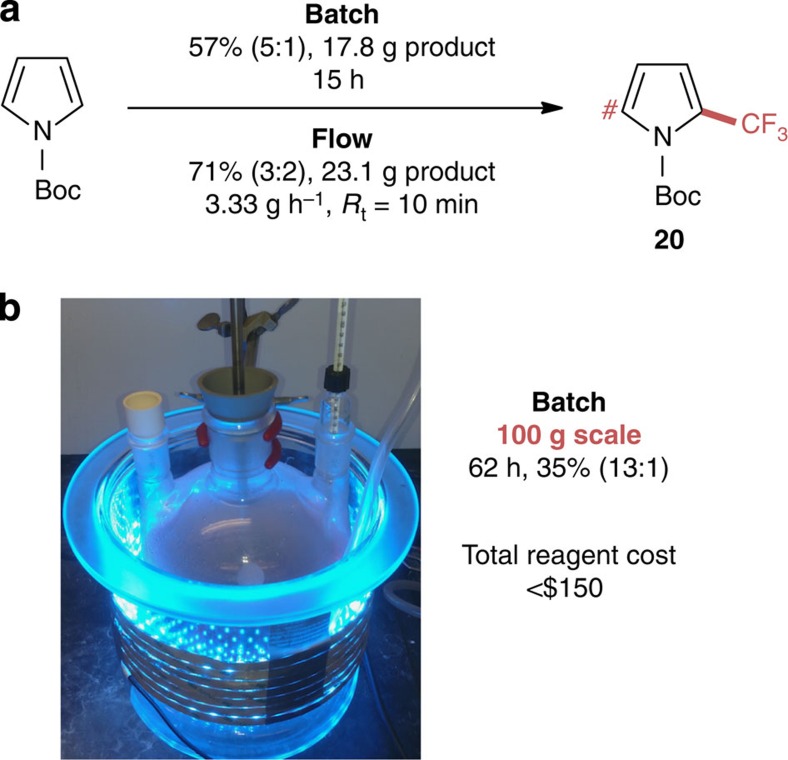
Figure 4. Scalable trifluoromethylation of N-Boc-pyrrole in batch and flow.
(a) An 18.3-g reaction in batch provides 17.8 g of product (57%) in 15 h. Improved yields were obtained when the reaction was run at a steady state in flow, with a 71% yield of isolated material from 20 g of starting material. (b) The reaction can be run on 100 g scale for <$150 total reagent and catalyst cost calculated using academic vendor pricing. #Position of functionalization on the minor doubly functionalized product. Yields represent a single experiment. Boc, tert-butyloxycarbonyl.

References

    1. Müller K., Faeh C. & Diedrich F. Fluorine in pharmaceuticals: looking beyond intuition. Science 317, 1881–1886 (2007). - PubMed
    1. Hagmann W. K. The many roles for fluorine in medicinal chemistry. J. Med. Chem. 51, 4359–4369 (2008). - PubMed
    1. Alonso C., De Marigorta E. M., Rubiales G. & Palacios F. Carbon trifluoromethylation reactions of hydrocarbon derivatives and heteroarenes. Chem. Rev. 115, 1847–1935 (2015). - PubMed
    1. Liang T., Neumann C. N. & Ritter T. Introduction of fluorine and fluorine-containing functional groups. Angew. Chem. Int. Ed. 52, 8214–8264 (2013). - PubMed
    1. Nagib D. A. & MacMillan D. W. C. Trifluoromethylation of arenes and heteroarenes by means of photoredox catalysis. Nature 480, 224–227 (2011). - PMC - PubMed

Publication types