


Inverse expression of somatostatin and CXCR4 chemokine receptors in gastroenteropancreatic neuroendocrine neoplasms of different malignancy
- PMID: 26259237
- PMCID: PMC4695009
- DOI: 10.18632/oncotarget.4491
Inverse expression of somatostatin and CXCR4 chemokine receptors in gastroenteropancreatic neuroendocrine neoplasms of different malignancy
Abstract
Introduction: Somatostatin receptors (SSTR) are widely distributed in well-differentiated neuroendocrine neoplasms (NEN) and serve as primary targets for diagnostics and treatment. An overexpression of the chemokine receptor CXCR4, in contrast, is considered to be present mainly in highly proliferative and advanced tumors. Comparative data are still lacking, however, for neuroendocrine carcinomas (NEC).
Methods: SSTR subtype (1, 2A, 3, 5) and CXCR4 expression was evaluated in G1 (n = 31), G2 (n = 47), and low (G3a; Ki-67: 21-49%; n = 21) and highly proliferative (G3b; Ki-67: >50%, n = 22) G3 (total n = 43) gastroenteropancreatic NEN samples by performing immunohistochemistry with monoclonal rabbit anti-human anti-SSTR and anti-CXCR4 antibodies, respectively, and was correlated with clinical data.
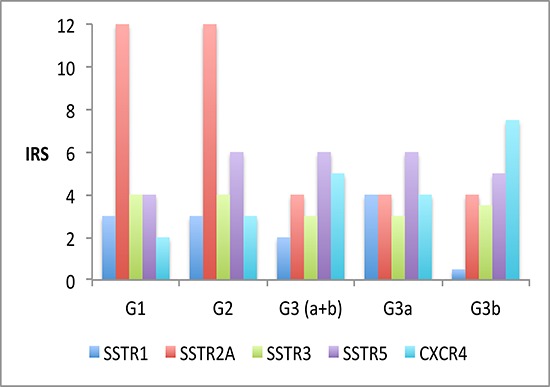
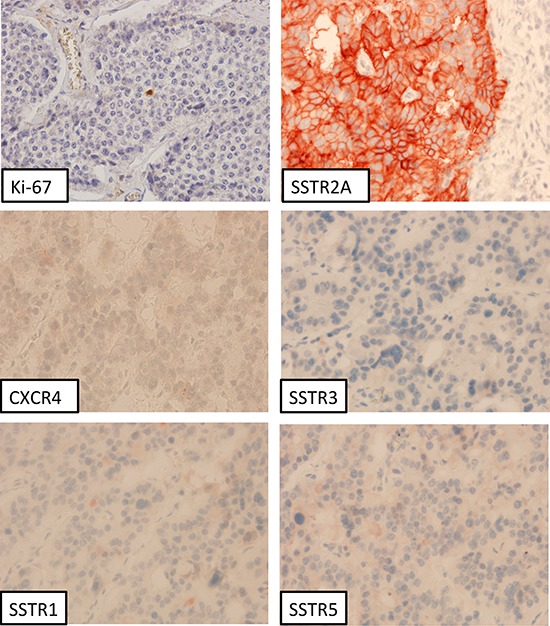
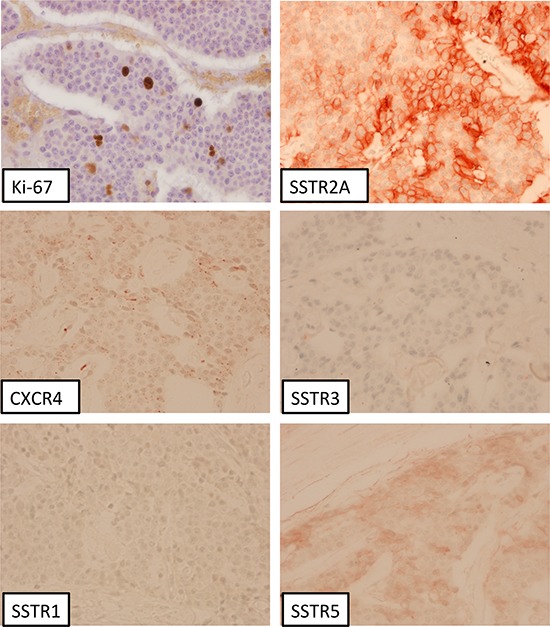
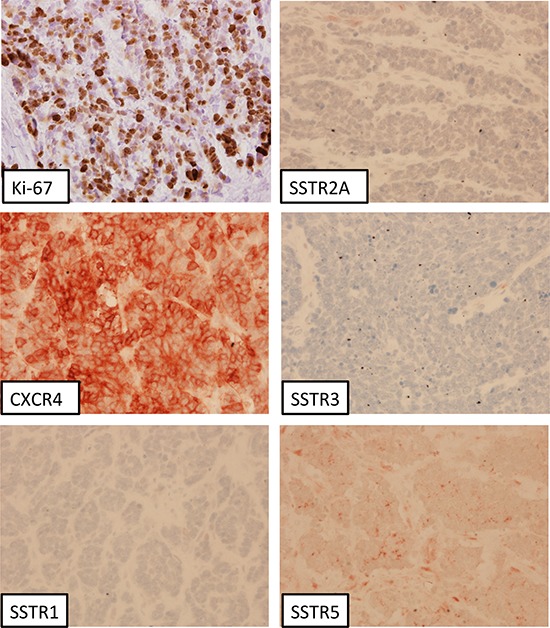
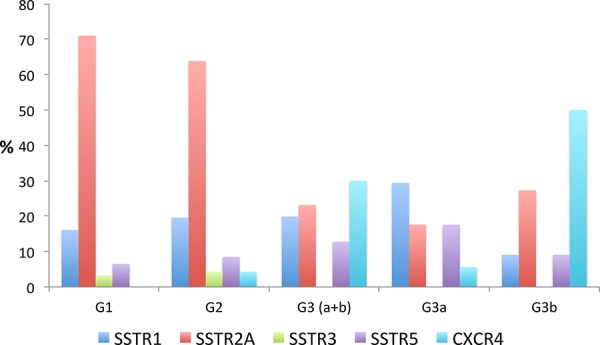
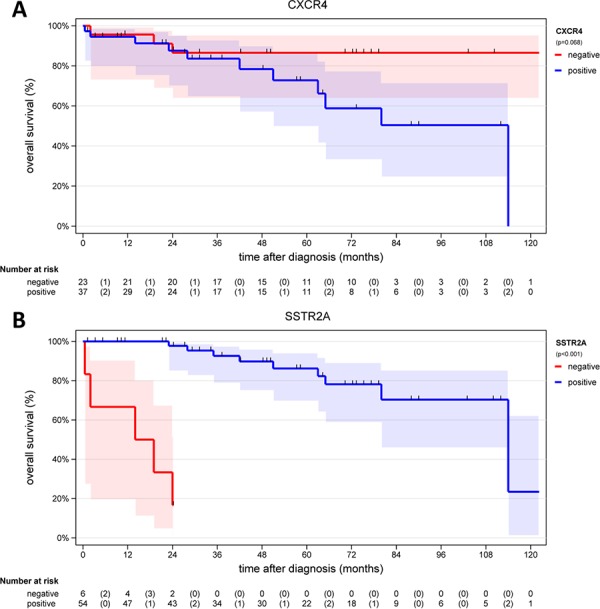
Results: Both CXCR4 and SSTR were widely expressed in all tumors investigated. CXCR4 expression differed significantly between the G1 and G3 specimens and within the G3 group (G3a to G3b), and was positively correlated with Ki-67 expression. SSTR2A, in contrast, exhibited an inverse association with Ki-67. SSTR2A was highly expressed in G1 and G2 tumors, but was significantly less abundant in G3 carcinomas. Additionally, SSTR1 expression was higher in G3a than in G3b tumors.
Conclusion: We observed an elevation in CXCR4 and a decrease in SSTR2A expression with increasing malignancy. Interestingly, 23% of the G3 specimens had strong SSTR2A expression. Because CXCR4 was strongly expressed in highly proliferative G3 carcinomas, it is an interesting new target and needs to be validated in larger studies.
Keywords: CXCR4; chemokine receptor; neuroendocrine carcinoma; neuroendocrine tumor; somatostatin receptor.
Conflict of interest statement
Kaemmerer D. received support for travelling to meetings by the companies IPSEN and PFIZER. All other authors declare no conflict of interests.
Figures
References
-
- Modlin IM, Lye KD, Kidd M. A 5-decade analysis of 13, 715 carcinoid tumors. Cancer. 2003;97:934–959. - PubMed
-
- Ito T, Igarashi H, Nakamura K, Sasano H, Okusaka T, Takano K, Komoto I, Tanaka M, Imamura M, Jensen RT, Takayanagi R, Shimatsu A. Epidemiological trends of pancreatic and gastrointestinal neuroendocrine tumors in Japan: a nationwide survey analysis. J Gastroenterol. 2015;50:58–64. - PubMed
-
- Fraenkel M, Kim M, Faggiano A, de Herder WW, Valk GD. Incidence of gastroenteropancreatic neuroendocrine tumours: a systematic review of the literature. Endocr Relat Cancer. 2014;21:R153–163. - PubMed
-
- Velayoudom-Cephise FL, Duvillard P, Foucan L, Hadoux J, Chougnet CN, Leboulleux S, Malka D, Guigay J, Goere D, Debaere T, Caramella C, Schlumberger M, Planchard D, Elias D, Ducreux M, Scoazec JY, et al. Are G3 ENETS neuroendocrine neoplasms heterogeneous? Endocr Relat Cancer. 2013;20:649–657. - PubMed
Publication types
MeSH terms
Substances
LinkOut - more resources
Full Text Sources
Other Literature Sources
Medical
Miscellaneous
