


Reliability of Assessing Hand Osteoarthritis on Digital Photographs and Associations With Radiographic and Clinical Findings
- PMID: 26259552
- PMCID: PMC4153954
- DOI: 10.1002/acr.22225
Reliability of Assessing Hand Osteoarthritis on Digital Photographs and Associations With Radiographic and Clinical Findings
Abstract
Objective: To investigate the reliability and construct validity of an atlas for grading hand osteoarthritis (OA) on photographs in a separate younger community-dwelling population than the development cohort.
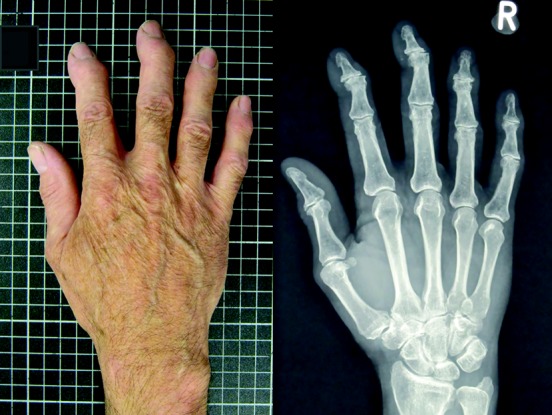
Methods: Participants were community-dwelling adults (ages ≥50 years) in North Staffordshire, UK with hand pain or hand problems in the last year who attended a research clinic. High-quality photographs were taken in a standardized position. A photographic atlas was used to score hand joints (second and third distal interphalangeal [DIP], second and third proximal interphalangeal [PIP], and first carpometacarpal [CMC] joints) and joint groups (DIP, PIP, and CMC joints) for OA on a 0-3 scale. Hand radiographs were graded for OA using the Kellgren/Lawrence (K/L) grading system. Clinical features (nodes, bony enlargement, and deformity) were determined by physical examination. Associations of photographic hand OA grades with radiographic OA and clinical features were determined to assess construct validity.
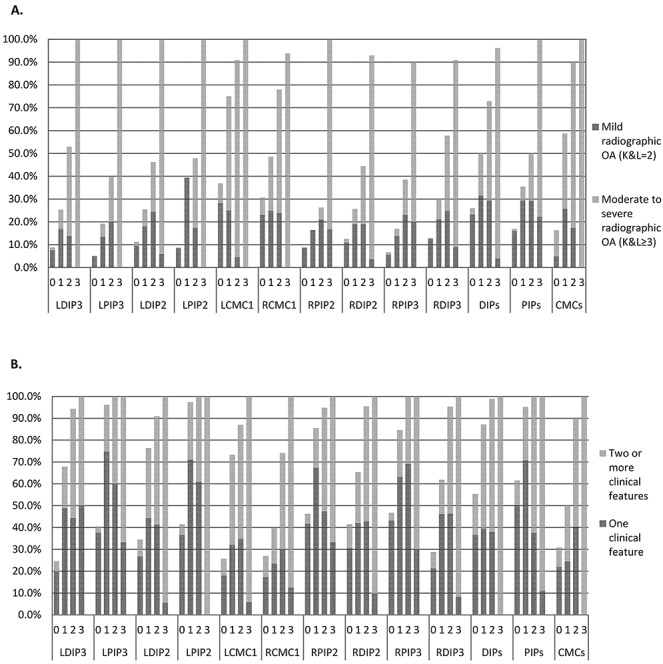
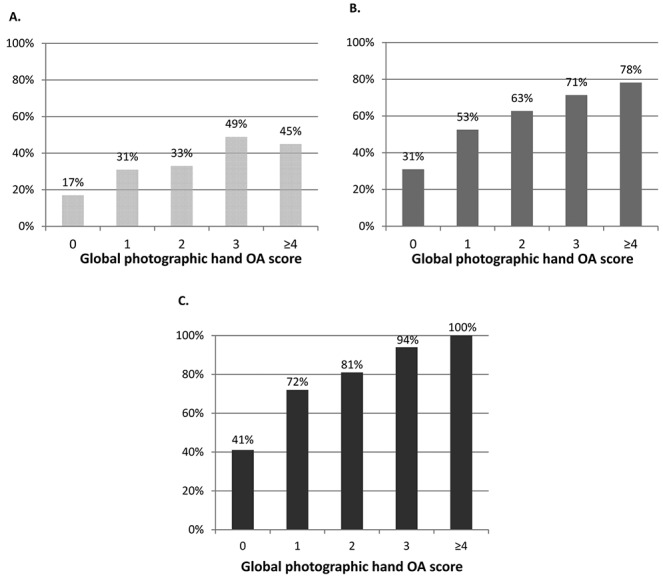
Results: In total, 558 participants (mean age 64 years, 62% women) were included in the analyses. Reliability for scoring OA on the photographs was good (mean intrarater intraclass correlation coefficient [ICC] 0.77 and mean interrater ICC 0.71). At the joint level, photographic hand OA grade was positively associated with radiographic OA grade (Spearman's ρ = 0.19-0.57, P < 0.001) and the number of clinical features (Spearman's ρ = 0.36-0.59, P < 0.001). At the person level, individuals with higher global photographic OA scores had higher summed K/L scores and higher percentages meeting the American College of Rheumatology clinical hand OA criteria.
Conclusion: This photographic scoring system was reliable and a good indicator of hand OA in a separate younger community-dwelling population than the development cohort. This method of data collection offers researchers a feasible alternative to physical examination and radiography.
© 2014 The Authors. Arthritis Care & Research is published by Wiley Periodicals, Inc. on behalf of the American College of Rheumatology.
Figures
References
-
- Wilder FV, Barrett JP, Farina EJ. Joint-specific prevalence of osteoarthritis of the hand. Osteoarthritis Cartilage. 2006;14:953–7. - PubMed
-
- Dziedzic K, Thomas E, Hill S, Wilkie R, Peat G, Croft PR. The impact of musculoskeletal hand problems in older adults: findings from the North Staffordshire Osteoarthritis Project (NorStOP) Rheumatology (Oxford) 2007;46:963–7. - PubMed
-
- Hart DJ, Spector TD. Definition and epidemiology of osteoarthritis of the hand: a review. Osteoarthritis Cartilage. 2000;8:S2–7. - PubMed
-
- Salaffi F, Carotti M, Stancati A, Grassi W. Radiographic assessment of osteoarthritis: analysis of disease progression. Aging Clin Exp Res. 2003;15:391–404. - PubMed
Publication types
MeSH terms
Grants and funding
LinkOut - more resources
Full Text Sources
Other Literature Sources
Medical
