. 2015:1335:177-89.
doi: 10.1007/978-1-4939-2914-6_12.

Approaches to Assess Functional Selectivity in GPCRs: Evaluating G Protein Signaling in an Endogenous Environment

Affiliations

Approaches to Assess Functional Selectivity in GPCRs: Evaluating G Protein Signaling in an Endogenous Environment

Laura M Bohn et al. Methods Mol Biol. 2015.

Abstract

Ligand-directed signaling, biased agonism, and functional selectivity are terms that describe the propensity of a ligand to drive signaling toward one GPCR pathway over another. Most of the early examples demonstrated to date examine the divergence between GPCR signaling to G protein coupling and βarrestin2 recruitment. As biased agonists begin to become available based on cell-based screening criteria, a need arises to determine if G protein signaling biases will be maintained in the endogenous setting, wherein receptors are functioning to control relevant biological responses. This report presents our method and offers tips for evaluating G protein signaling in endogenous tissues. Predominately, brain tissues are discussed here; optimization points that can be applied to any tissues are highlighted.


Figures
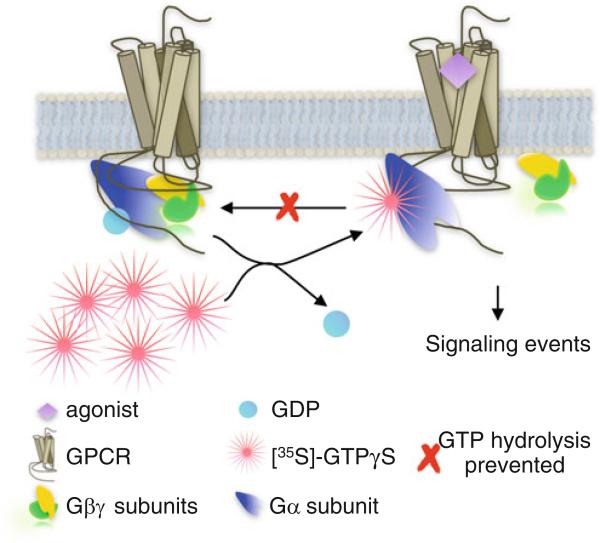
Fig. 1
Fig. 1
G protein signaling. First, the isolated membranes are incubated with GDP in order to prime the available Gα protein in the active state. Upon activation of the G protein by the GPCR, GDP is exchanged for GTP. By providing a nonhydrolyzable (or hydrolysis resistant) radiolabeled form of GTP, we are able to quantify the stimulated accumulation of GTP-bound G protein as a function of agonist stimulation in a set amount of membrane protein
Fig. 2
Fig. 2
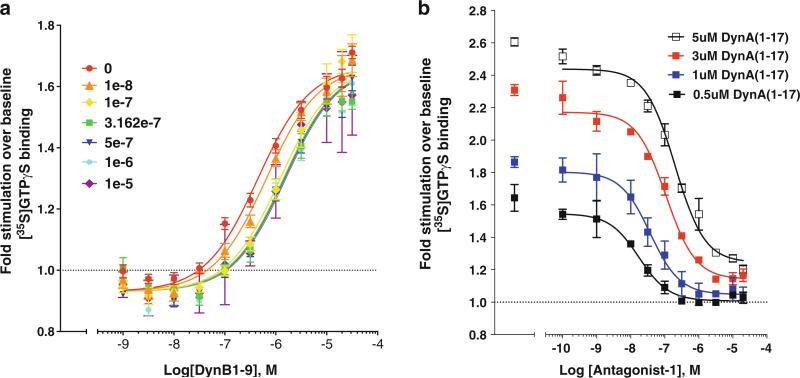
Examples demonstrating agonist stimulation (for dynorphin B); allosteric modulation of dynorphin B (1–9) (a), and antagonist effects for a nondisclosed antagonist against Dynorphin A (1–17) (b) at the Kappa Opioid Receptor (KOR). These data are presented for demonstration of how the assays can be utilized and values are not to be derived (sample assays performed in duplicate (a), n = 3 (b))
Fig. 3
Fig. 3
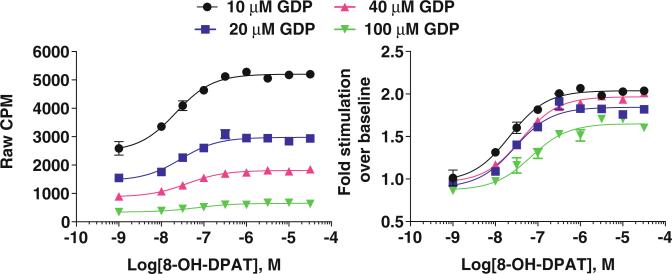
Examples demonstrating the effect of GDP concentration of basal signaling levels in rat hippocampus membrane preparations and how this influences the determination of the fold stimulation. In these samples, we opted to work with the 10 μM concentration of GDP. Hippocampus homogenates contained 2 μg protein per well, 100 pM and [35S]-GTPγS

References

    1. Rajagopal S, Rajagopal K, Lefkowitz RJ. Teaching old receptors new tricks: biasing seven-transmembrane receptors. Nat Rev Drug Discov. 2010;9:373–386. - PMC - PubMed
    1. Wisler J, Xiao K, Thomsen A, Lefkowitz R. Recent developments in biased agonism. Curr Opin Cell Biol. 2014;27:18. - PMC - PubMed
    1. Zhou L, Lovell KM, Frankowski KJ, Slauson SR, Phillips AM, Streicher JM, Stahl E, Schmid CL, Hodder P, Madoux F. Development of functionally selective, small molecule agonists at kappa opioid receptors. J Biol Chem. 2013;288:36703–36716. - PMC - PubMed
    1. Rahmeh R, Damian M, Cottet M, Orcel H, Mendre C, Durroux T, Sharma KS, Durand G, Pucci B, Trinquet E. Structural insights into biased G protein-coupled receptor signaling revealed by fluorescence spectroscopy. Proc Natl Acad Sci. 2012;109:6733–6738. - PMC - PubMed
    1. Rivero G, Llorente J, McPherson J, Cooke A, Mundell SJ, McArdle CA, Rosethorne EM, Charlton SJ, Krasel C, Bailey CP. Endomorphin-2: a biased agonist at the μ-opioid receptor. Mol Pharmacol. 2012;82:178–188. - PMC - PubMed

Publication types

LinkOut - more resources