


Risk of Subsequent Neoplasms During the Fifth and Sixth Decades of Life in the Childhood Cancer Survivor Study Cohort
- PMID: 26261260
- PMCID: PMC4622098
- DOI: 10.1200/JCO.2015.60.9487
Risk of Subsequent Neoplasms During the Fifth and Sixth Decades of Life in the Childhood Cancer Survivor Study Cohort
Erratum in
-
Errata.J Clin Oncol. 2018 Mar 10;36(8):833-834. doi: 10.1200/JCO.2018.77.9884. J Clin Oncol. 2018. PMID: 31329710 Free PMC article.
Abstract
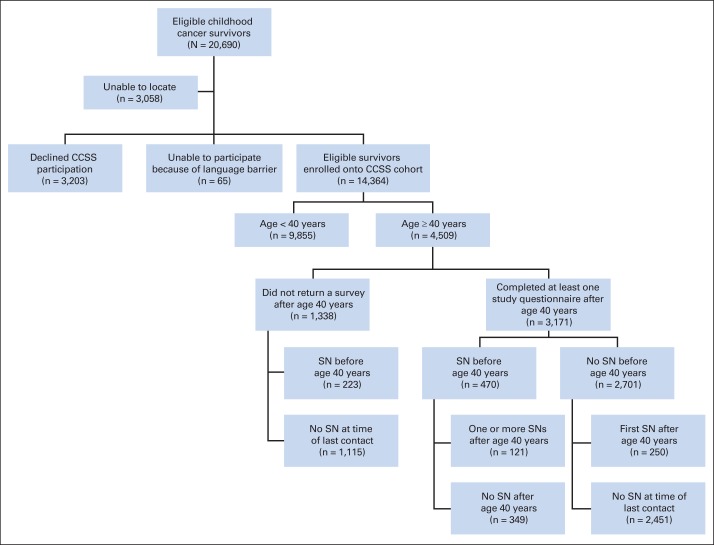
Purpose: Survivors of childhood cancer have an increased risk for subsequent neoplasms (SNs), but the incidence beyond the age of 40 years and associations with therapeutic exposures have not been well described.
Patients and methods: Among 14,364 survivors of childhood cancer diagnosed between 1970 and 1986, 3,171 had an attained age of 40 years or older at the time of last contact. Cumulative incidence of SNs, standardized incidence ratios (SIRs), excess absolute risk of subsequent malignant neoplasms (SMNs), and relative risks (RRs) for SMNs and nonmelanoma skin cancers were calculated.
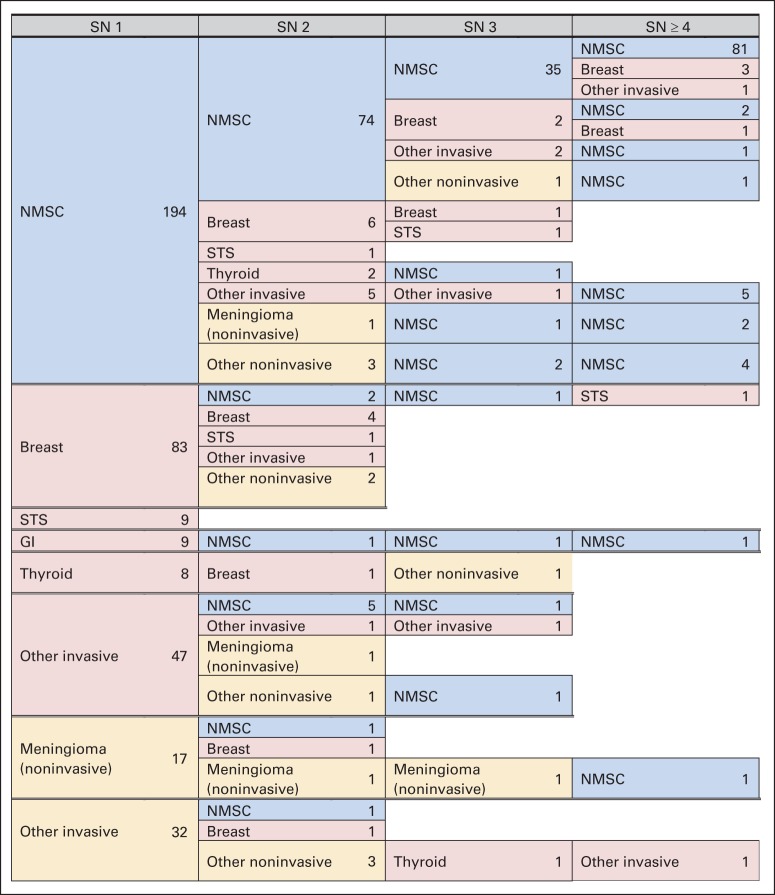
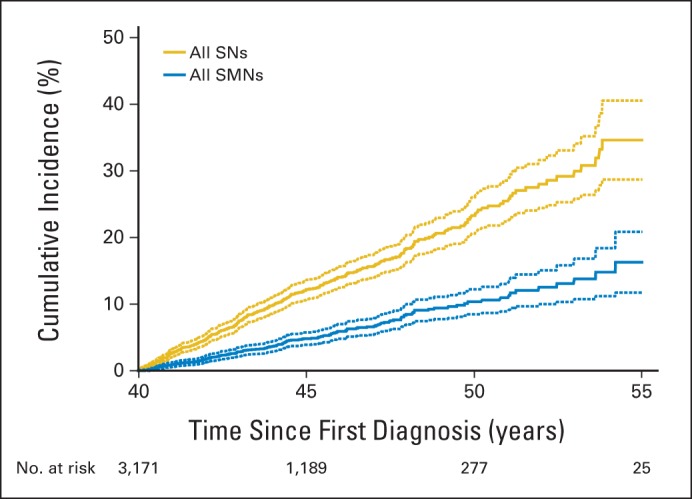
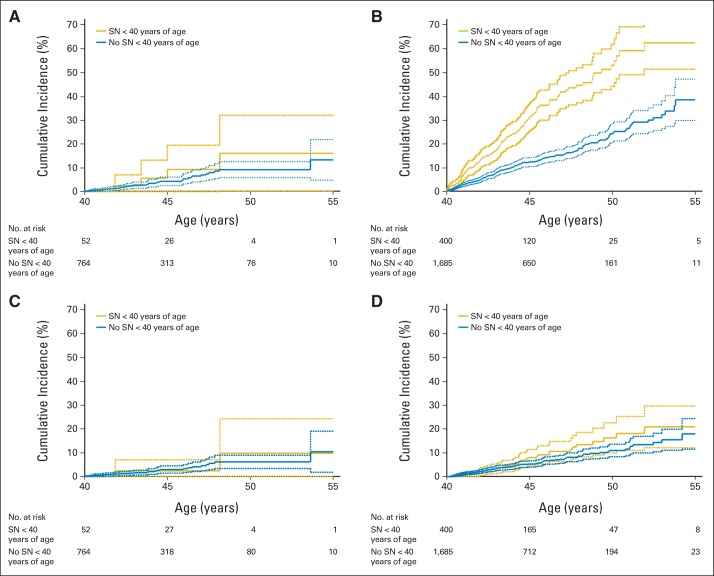
Results: In total, 679 SNs were diagnosed in patients age 40 years or older. These included 196 SMNs, 419 nonmelanoma skin cancers, 21 nonmalignant meningiomas, and 43 other benign neoplasms. At age 55 years, the cumulative incidence of new SNs and SMNs occurring after age 40 years was 34.6% (95% CI, 28.7 to 40.6) and 16.3% (95% CI, 11.7 to 20.9), respectively. Survivors were twice as likely as the general population to receive a diagnosis of SMN after age 40 years (SIR, 2.2; 95% CI, 1.9 to 2.5). Among SMNs, risk was increased for breast cancer (SIR, 5.5; 95% CI, 4.5 to 6.7), renal cancer (SIR, 3.9; 95% CI, 2.0 to 7.5), soft tissue sarcoma (SIR, 2.6; 95% CI, 1.5 to 4.4), and thyroid cancer (SIR, 1.9; 95% CI, 1.0 to 3.5). Female sex (RR, 1.9; 95% CI, 1.3 to 2.6; P < .001) and therapeutic radiation exposure (RR, 2.2; 95% CI, 1.4 to 3.3; P < .001) were associated with an increased for risk for SMN in multivariable analysis.
Conclusion: Even after age 40 years, survivors of childhood cancer remain at increased risk for treatment-related SNs. These data suggest the need for life-long monitoring and should inform anticipatory guidance provided to survivors of childhood cancer.
© 2015 by American Society of Clinical Oncology.
Conflict of interest statement
Authors' disclosures of potential conflicts of interest are found in the article online at
Figures
Comment in
-
Surveillance of Childhood Cancer Survivors: A Lifelong Affair.J Clin Oncol. 2015 Nov 1;33(31):3531-2. doi: 10.1200/JCO.2015.62.7703. Epub 2015 Aug 10. J Clin Oncol. 2015. PMID: 26261248 Free PMC article. No abstract available.
References
-
- Howlader N, Noone AM, Krapcho M, et al. SEER Cancer Statistics Review, 1975-2011. Bethesda, MD: National Cancer Institute; 2014.
-
- Garwicz S, Anderson H, Olsen JH, et al. Second malignant neoplasms after cancer in childhood and adolescence: A population-based case-control study in the 5 Nordic countries. Int J Cancer. 2000;88:672–678. - PubMed
-
- Inskip PD, Curtis RE. New malignancies following childhood cancer in the United States, 1973-2002. Int J Cancer. 2007;121:2233–2240. - PubMed
Publication types
MeSH terms
Grants and funding
LinkOut - more resources
Full Text Sources
