


Role of systemic inflammation in cirrhosis: From pathogenesis to prognosis
- PMID: 26261687
- PMCID: PMC4528271
- DOI: 10.4254/wjh.v7.i16.1974
Role of systemic inflammation in cirrhosis: From pathogenesis to prognosis
Abstract
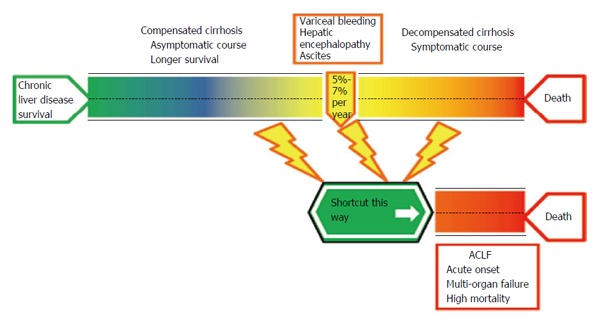
The natural history of cirrhosis can be divided into an initial stage, known as compensated cirrhosis, and an advanced stage which encompasses both decompensated cirrhosis and acute-on-chronic liver failure (ACLF). The latter syndrome has been recently described as an acute deterioration of liver function in patients with cirrhosis, which is usually triggered by a precipitating event and results in the failure of one or more organs and high short-term mortality rates. Each stage is characterized by distinctive clinical manifestations and prognoses. One of the key elements involved in cirrhosis physiopathology is systemic inflammation, recently described as one of the components in the cirrhosis-associated immune dysfunction syndrome. This syndrome refers to the combination of immune deficiency and exacerbated inflammation that coexist during the course of cirrhosis and relates to the appearance of clinical complications. Since systemic inflammation is often difficult to assess in cirrhosis patients, new objective, reproducible and readily-available markers are needed in order to optimize prognosis and lengthen survival. Thus, surrogate serum markers and clinical parameters of systemic inflammation have been sought to improve disease follow-up and management, especially in decompensated cirrhosis and ACLF. Leukocyte counts (evaluated as total leukocytes, total eosinophils or neutrophil:lymphocyte ratio) and plasma levels of procalcitonin or C-reactive protein have been proposed as prognostic markers, each with advantages and shortcomings. Research and prospective randomized studies that validate these and other markers are clearly warranted.
Keywords: Acute-on-chronic liver failure; Cirrhosis; Immune dysfunction; Prognosis; Systemic inflammation.
Figures
References
-
- Asrani SK, Kamath PS. Natural history of cirrhosis. Curr Gastroenterol Rep. 2013;15:308. - PubMed
-
- D’Amico G, Garcia-Tsao G, Pagliaro L. Natural history and prognostic indicators of survival in cirrhosis: a systematic review of 118 studies. J Hepatol. 2006;44:217–231. - PubMed
-
- Jalan R, Gines P, Olson JC, Mookerjee RP, Moreau R, Garcia-Tsao G, Arroyo V, Kamath PS. Acute-on chronic liver failure. J Hepatol. 2012;57:1336–1348. - PubMed
-
- Moreau R, Arroyo V. Acute-on-chronic liver failure: a new clinical entity. Clin Gastroenterol Hepatol. 2015;13:836–841. - PubMed
-
- Arroyo V, García-Martinez R, Salvatella X. Human serum albumin, systemic inflammation, and cirrhosis. J Hepatol. 2014;61:396–407. - PubMed
LinkOut - more resources
Full Text Sources
Other Literature Sources
Research Materials
