. 2015 Aug 12:5:12955.
doi: 10.1038/srep12955.

Variable alterations of the microbiota, without metabolic or immunological change, following faecal microbiota transplantation in patients with chronic pouchitis

Affiliations

Variable alterations of the microbiota, without metabolic or immunological change, following faecal microbiota transplantation in patients with chronic pouchitis

J Landy et al. Sci Rep. .

Abstract

Faecal microbiota transplantation (FMT) is effective in the treatment of Clostridium difficile infection, where efficacy correlates with changes in microbiota diversity and composition. The effects of FMT on recipient microbiota in inflammatory bowel diseases (IBD) remain unclear. We assessed the effects of FMT on microbiota composition and function, mucosal immune response, and clinical outcome in patients with chronic pouchitis. Eight patients with chronic pouchitis (current PDAI ≥7) were treated with FMT via nasogastric administration. Clinical activity was assessed before and four weeks following FMT. Faecal coliform antibiotic sensitivities were analysed, and changes in pouch faecal and mucosal microbiota assessed by 16S rRNA gene pyrosequencing and (1)H NMR spectroscopy. Lamina propria dendritic cell phenotype and cytokine profiles were assessed by flow cytometric analysis and multiplex assay. Following FMT, there were variable shifts in faecal and mucosal microbiota composition and, in some patients, changes in proportional abundance of species suggestive of a "healthier" pouch microbiota. However, there were no significant FMT-induced metabolic or immunological changes, or beneficial clinical response. Given the lack of clinical response following FMT via a single nasogastric administration our results suggest that FMT/bacteriotherapy for pouchitis patients requires further optimisation.


Figures
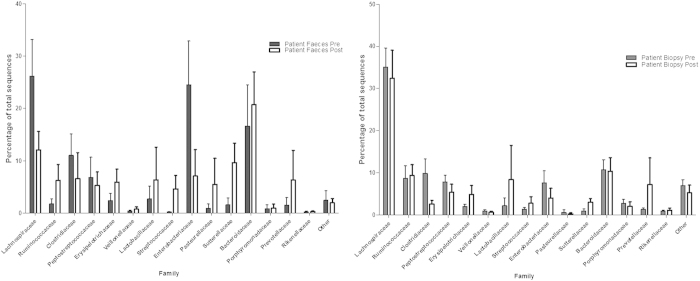
Figure 1
Figure 1. Analysis of bacterial families in stool and biopsy samples pre and post FMT.
Percentage of sequences identified from the bacterial families of >1% total relative abundance in: (A) patient stool samples pre (n = 7) and post FMT (n = 8); (B) patient mucosal samples pre (n = 8) and post FMT (n = 5).
Figure 2
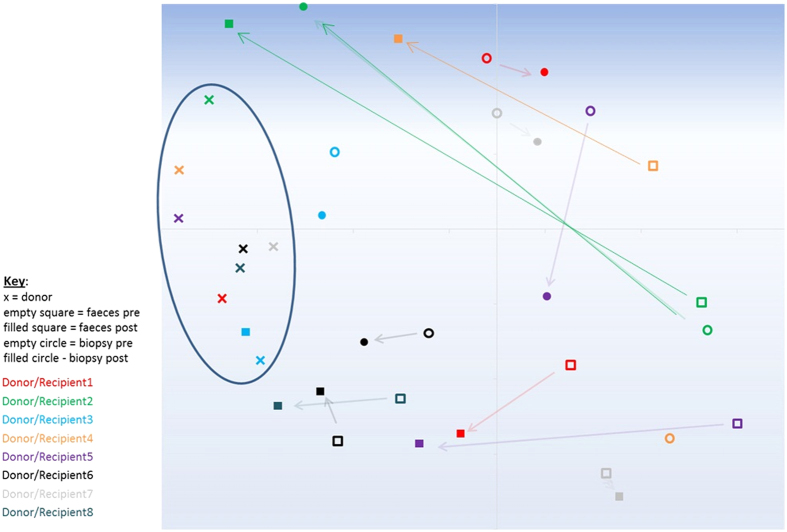
Figure 2. Non-metric multidimensional scaling (NMDS) analysis for donor and patient samples pre and post FMT.
NMDS analysis, calculated in mothur using the Bray Curtis calculator, of donor stool (x) and patient stool pre FMT (open squares) and post FMT (filled squares) and patient mucosal samples pre FMT (open circles) and post FMT (filled circles) for each patient and donor. Oval shows distinct clustering of healthy donor faecal microbiota sample profiles in comparison to the pouchitis patient samples, arrows indicate directional shifts in patient samples post FMT.
Figure 3
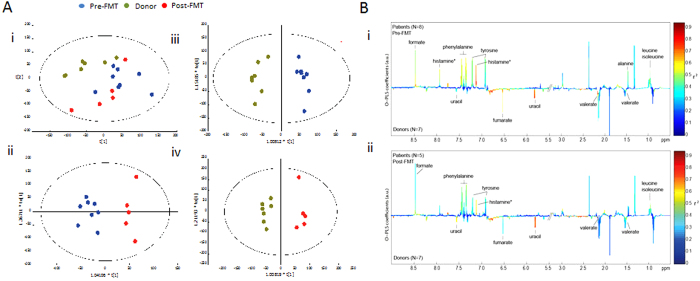
Figure 3. 1H NMR-based metabonomic analysis of faecal samples from donors and patients.
(A) PCA scores plot of 1H NMR profiles of fresh faecal water samples obtained from donors and patients at pre and post FMT (i). OPLS-DA scores plots of pre- and post FMT (ii, Q2Y < 0, p > 0.05), donors and patients at pre-FMT (iii, Q2Y = 0.81, p = 0.001), and donors and patients at post-FMT (iv, Q2Y = 0.72, p = 0.04). (B) O-PLS-DA loadings plots of 1H NMR profiles of fresh faecal water samples from donors and patients at pre-FMT (i) and donors and patients at post-FMT (ii). Peaks pointing upwards represent higher levels of metabolites in patients compared with donors and vice versa. The colours of peaks represent the correlation (r2) between the metabolites and the classification (e.g. patients or donors).

References

    1. Sartor R. Microbial Influences in Inflammatory Bowel Diseases. Gastroenterology 134, 577–594, 10.1053/j.gastro.2007.11.059 (2008). - DOI - PubMed
    1. Nicholson J. K. et al. Host-gut microbiota metabolic interactions. Science 336, 1262–1267, 10.1126/science.1223813 (2012). - DOI - PubMed
    1. Holmes E. et al. Therapeutic modulation of microbiota-host metabolic interactions. Sci Transl Med 4, 137rv136, 10.1126/scitranslmed.3004244 (2012). - DOI - PubMed
    1. Hedin C., Whelan K. & Lindsay J. O. Evidence for the use of probiotics and prebiotics in inflammatory bowel disease: a review of clinical trials. Proceedings of the Nutrition Society 66, 307–315, 10.1017/s0029665107005563 (2007). - DOI - PubMed
    1. Tannock G. W. et al. Comprehensive analysis of the bacterial content of stool from patients with chronic pouchitis, normal pouches, or familial adenomatous polyposis pouches. Inflamm Bowel Dis 18, 925–934, 10.1002/ibd.21936 (2012). - DOI - PubMed

Publication types