. 2016 Feb;45(1):29-41.
doi: 10.1007/s13280-015-0685-1. Epub 2015 Aug 12.

Contributions of a global network of tree diversity experiments to sustainable forest plantations

Affiliations

Contributions of a global network of tree diversity experiments to sustainable forest plantations

Kris Verheyen et al. Ambio. 2016 Feb.

Abstract

The area of forest plantations is increasing worldwide helping to meet timber demand and protect natural forests. However, with global change, monospecific plantations are increasingly vulnerable to abiotic and biotic disturbances. As an adaption measure we need to move to plantations that are more diverse in genotypes, species, and structure, with a design underpinned by science. TreeDivNet, a global network of tree diversity experiments, responds to this need by assessing the advantages and disadvantages of mixed species plantations. The network currently consists of 18 experiments, distributed over 36 sites and five ecoregions. With plantations 1-15 years old, TreeDivNet can already provide relevant data for forest policy and management. In this paper, we highlight some early results on the carbon sequestration and pest resistance potential of more diverse plantations. Finally, suggestions are made for new, innovative experiments in understudied regions to complement the existing network.

Keywords: Biodiversity experiments; Ecological restoration; Functional biodiversity research; Plantation forest; Sustainable forest management.


Figures

Fig. 1
Fig. 1
The 18 experiments of TreeDivNet in the boreal (bo), temperate (te), Mediterranean (me), subtropical (st), and tropical (tr) regions of the world. The dark gray dots represent the IDENT experiment; the light gray dotted ones are the ECOLINK-Salix experiment; the other experiments are in black. See Table 1 for the characteristics of the experiments. Map based on Olson et al. (2001), data from http://www.worldwildlife.org/publications/terrestrial-ecoregions-of-the-world
Fig. 2
Fig. 2
Example of the design of one of the TreeDivNet experiments. The FORBIO experiment was established at three sites in Belgium. The tree species diversity per plot ranges from one to four species. The within-plot design is shown for a two-species and a four-species plot. The trees were planted on a 1.5 m × 1.5 m grid, in small monospecific patches of 3 × 3 trees. These patches are arranged in a checkerboard pattern in the two-species mixtures and randomly attributed to the species in the three- and four-species mixtures (see Verheyen et al. for more details)
Fig. 3
Fig. 3
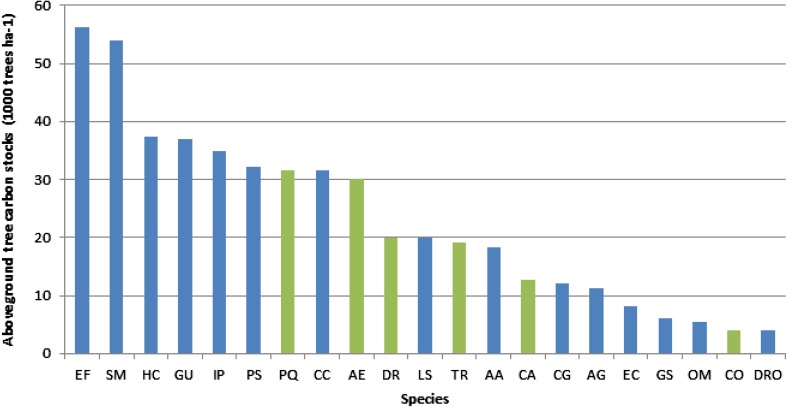
Aboveground biomass (Mg C ha−1) after 10 years of growth in the Sardinilla experiment (Panama). The common timber species are indicated in green in the figure and underlined here. Species abbreviations are the first letter of the genus and species name: Albizia adinocephala, Anacardium excelsum, Astronium graveolens, Cordia alliodora, Calycophyllum candidissimum, Colubrina glandulosa, Cedrela odorata, Dalbergia retusa, Diphysa robinioides (DRO), Enterolobium cyclocarpum, Erythrina fusca, Gliricidia sepium, Guazuma ulmifolia, Hura crepitans, Inga punctata, Luehea seemannii, Ormosia macrocalyx, Pachira quinata, Pseudosamanea guachapele, Spondias mombin, Tabebuia rosea. The biomass was calculated using the equation of Chave et al. (2005) equation for tropical moist forest, and mean tree biomass per species was scaled up to 1 ha assuming 1000 trees per plot. Estimations were done for the species represented in the Sardinilla planted forest by at least five individuals
Fig. 4
Fig. 4
Aboveground carbon (Mg C ha−1) after 9 years of growth at the BangorDIVERSE experiment (UK). Species abbreviations are the first letter of the genus and species name: Alnus glutinosa, Acer pseudoplatanus, Betula pendula, Castanea sativa, Fraxinus excelsior, Fagus sylvatica. The biomass was calculated using general European temperate forest equations from Ziania et al. (2005) and site-specific equations from Smith et al. (2013). Mean tree biomass per species was scaled up to one hectare assuming 1000 trees per plot. Biomass estimations were based on the average species diameter of each replicate plot (n = 3)
Fig. 5
Fig. 5
Species-specific responses of defoliation (chewing + skeletonizing damage) to tree diversity in four TreeDivNet experiments. Green and red arrows indicate reduced and increased herbivory in mixed plots as compared to monocultures, i.e., associational resistance and associational susceptibility, respectively. It was estimated based on the site-specific difference in mean damage on a given species grown in mixtures and mean damage on corresponding monocultures. Data were taken from Setiawan et al. (2014) for the FORBIO experiment and from Haase et al. (2015) for the BIOTREE, ORPHEE, and Satakunta experiment

References

    1. Adair EC, Reich PB, Hobbie SE, Knops JMH. Interactive effects of time, CO2, N, and diversity on total belowground carbon allocation and ecosystem carbon storage in a grassland community. Ecosystems. 2009;12:1037–1052. doi: 10.1007/s10021-009-9278-9. - DOI
    1. Baeten L, Verheyen K, Wirth C, Bruelheide H, Bussotti F, Finér L, Jaroszewicz B, Selvi F, et al. A novel comparative research platform designed to determine the functional significance of tree species diversity in European forests. Perspectives in Plant Ecology, Evolution and Systematics. 2013;15:281–291. doi: 10.1016/j.ppees.2013.07.002. - DOI
    1. Bauhus J, van der Meer P, Kanninen M. Ecosystem goods and services from plantation forests. London: Earthscan; 2010.
    1. Borer ET, Harpole WS, Adler PB, Lind EM, Orrock JL, Seabloom EW, Smith MD. Finding generality in ecology: A model for globally distributed experiments. Methods in Ecology and Evolution. 2014;5:65–73. doi: 10.1111/2041-210X.12125. - DOI
    1. Bruelheide H, Nadrowski K, Assmann T, Bauhus J, Both S, Buscot F, Chen X-Y, Ding B, et al. Designing forest biodiversity experiments: General considerations illustrated by a new large experiment in subtropical China. Methods in Ecology and Evolution. 2014;5:74–89. doi: 10.1111/2041-210X.12126. - DOI

LinkOut - more resources