


A Cohort Study of Myocardial Perfusion Imaging in Veteran Patients Without Symptoms: Contributing Factors and Results of Testing
- PMID: 26266347
- PMCID: PMC4616717
- DOI: 10.1097/MD.0000000000001154
A Cohort Study of Myocardial Perfusion Imaging in Veteran Patients Without Symptoms: Contributing Factors and Results of Testing
Abstract
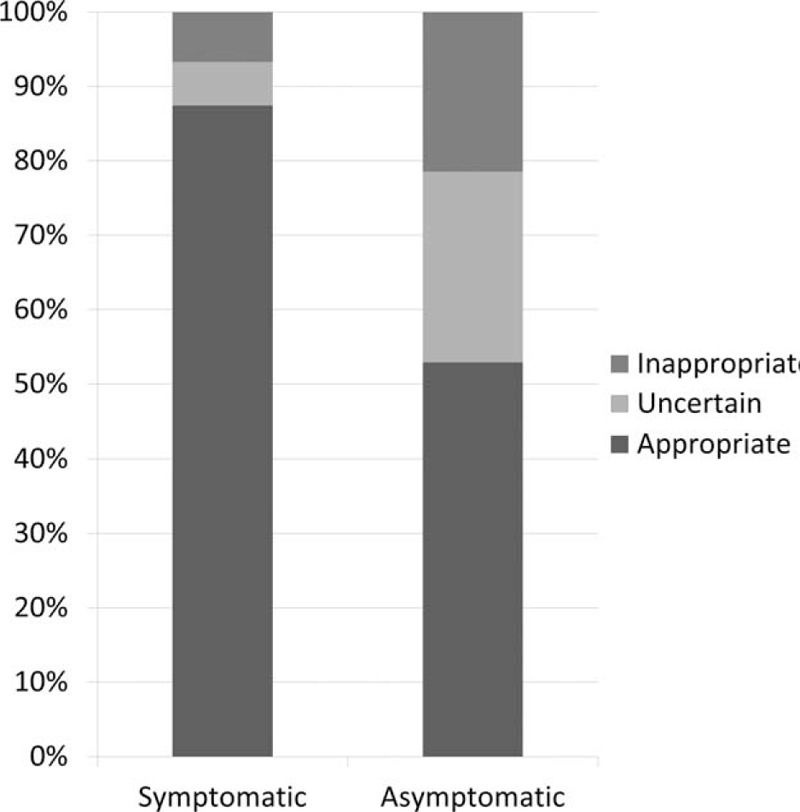
Myocardial perfusion imaging (MPI) is commonly used to detect ischemia. Concerns about silent ischemia may encourage orders for MPI in asymptomatic patients. Factors contributing to this practice are poorly described and the clinical utility is questionable.We conducted a single center retrospective cohort investigation on Veterans who underwent MPI between December 2010 and July 2011. We gathered data on symptoms, baseline characteristics, results of MPI, and cardiovascular events within 1 year. MPI were categorized using 2009 appropriate use criteria (AUC).Of 592 patients, 127 (21.5%) had no symptoms at the time of MPI. Comparing symptomatic and asymptomatic patients, no differences were observed in baseline characteristics except abnormal ECG, more common in asymptomatic patients (n = 86, 67.7% vs. n = 232, 49.9% for symptomatic patients, P < 0.0001). Asymptomatic MPI were more commonly inappropriate (n = 26, 21.5% vs. n = 31, 6.7% for appropriate/uncertain, P < 0.0001). Detection of ischemia between patients with and without symptoms was not different (P = 0.86); however, among asymptomatic MPI that also demonstrated ischemia, none were inappropriate (n = 10 appropriate, n = 7 uncertain). In multivariate regression, 2 factors were associated with asymptomatic status, abnormal ECG (odds ratio [OR] 2.29, 95% confidence interval [CI] 1.5-3.49) and age over the median (OR 0.63, 95% CI: 0.41-0.95).A substantial portion of MPI tests are ordered for patients without symptoms. When compared to symptomatic patients, MPI for asymptomatic patient were more commonly inappropriate; however, the prevalence of ischemia was similar. MPI may be clinically relevant in some asymptomatic patients and decisions to test should be based on the AUC.
Conflict of interest statement
The authors have no conflicts of interest to disclose.
Figures
References
-
- Younis LT, Byers S, Shaw L, et al. Prognostic importance of silent myocardial ischemia detected by intravenous dipyridamole thallium myocardial imaging in asymptomatic patients with coronary artery disease. J Am Coll Cardiol 1989; 14:1635–1641. - PubMed
-
- Marcelo FD, Rory H. Should we screen for occult coronary artery disease among asymptomatic patients with diabetes? JACC 2005; 45:50–53. - PubMed
-
- Hendel RC, Berman DS, Di Carli MF, et al. ACCF/ASNC/ACR/AHA/ASE/SCCT/SCMR/SNM 2009 Appropriate use criteria for cardiac radionuclide imaging: a report of the American College of Cardiology Foundation Appropriate Use Criteria Task Force, the American Society of Nuclear Cardiology, the American College of Radiology, the American Heart Association, the American Society of Echocardiography, the Society of Cardiovascular Computed Tomography, the Society for Cardiovascular Magnetic Resonance, and the Society of Nuclear Medicine. Circulation 2009; 199:e561–e587. - PubMed
-
- Winchester DE, Meral R, Ryals S, et al. Appropriate use of myocardial perfusion imaging in a veteran population: profit motives and professional liability concerns. JAMA Intern Med 2013; 173:1381–1383. - PubMed
Publication types
MeSH terms
Grants and funding
LinkOut - more resources
Full Text Sources
