. 2013 Dec;1(1):22.
doi: 10.1186/2197-425X-1-3. Epub 2013 Oct 29.

Epitope specificity of anti-Adrenomedullin antibodies determines efficacy of mortality reduction in a cecal ligation and puncture mouse model

Affiliations

Epitope specificity of anti-Adrenomedullin antibodies determines efficacy of mortality reduction in a cecal ligation and puncture mouse model

Joachim Struck et al. Intensive Care Med Exp. 2013 Dec.

Abstract

Introduction: Adrenomedullin (ADM), a circulating vasodilatory peptide, plays an important role in the development of sepsis-associated hemodynamic and microcirculatory disorders. While administration of exogenous ADM had beneficial effects in several septic animal models, elevated ADM concentrations are associated with a bad outcome. This prompted us to test the effect of various anti-ADM antibodies in a cecal ligation and puncture (CLP) mouse model.

Methods: To gain new potential compounds for the treatment or prevention of septic shock we followed an alternative strategy to influence the ADM system: High-affinity anti-ADM antibodies with different epitope specificities were developed and their antagonist activity in vitro and their ability to reduce mortality in a CLP mouse model were assessed.

Results: An anti-ADM antibody directed against the N-terminus substantially increased the survival of mice in a CLP model (HR = 0.077 (CI = 0.0189 to 0.315), p = 0.0004), whereas other antibodies with similar affinities but different epitope specificities were much less potent. The efficacious antibody, in contrast to an anti-C-terminal antibody, only partially inhibited ADM agonist activity in vitro. Healthy mice were not negatively affected by the N-terminal antibody.

Conclusions: An anti-N-terminal ADM antibody, as opposed to antibodies with other epitope specificities, strongly reduces mortality in CLP mice.


Figures
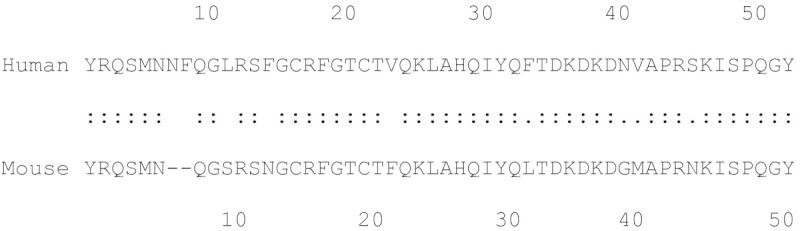
Figure 1
Figure 1
Amino acid sequences of human and mouse Adrenomedullin. Monoclonal antibodies were developed against peptides representing positions 1–21, 21–32 and 42–52 of human Adrenomedullin and against peptides representing positions 1–19, 19–31, 40–50 of mouse Adrenomedullin.
Figure 2
Figure 2
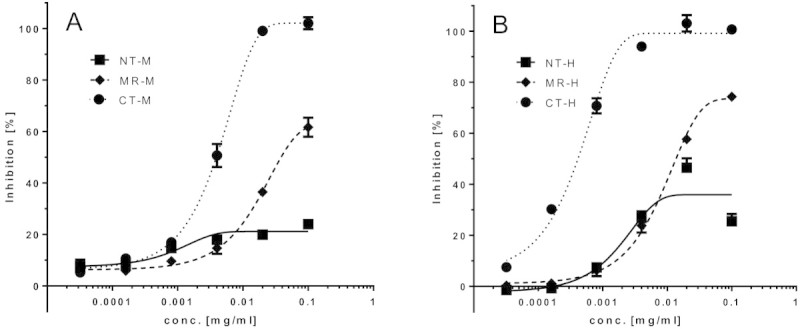
Dose/response curves for various anti-ADM antibodies affecting ADM-induced cAMP response in an ADM bioassay (antagonist activity). The monoclonal antibodies used were directed against the N-terminus (NT-M), mid-region (MR-M) and C-terminus (CT-M) of mouse ADM in the presence of 0.67 nM mouse ADM (panel A), and directed against the N-terminus (NT-H), mid-region (MR-H) and C-terminus (CT-H) of human ADM in the presence of 5.63 nM human ADM (panel B).
Figure 3
Figure 3
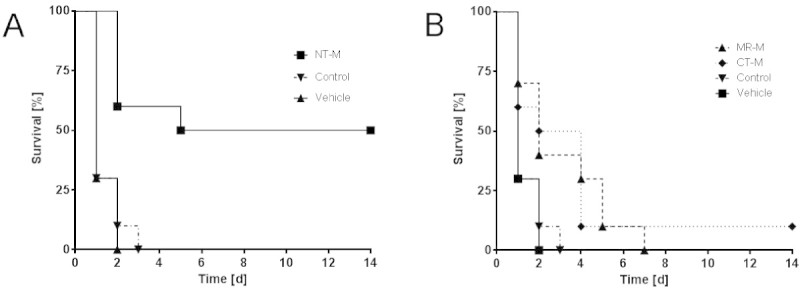
Survival rates of CLP mice treated with various antibodies. The monoclonal antibodies used were directed against the N-terminus (NT-M) (Panel A), and mid-region (MR-M) and C-terminus (CT-M) of mouse ADM (Panel B). An unspecific mouse IgG was used as control (shown in Panels A and B). For statistics see main text.
Figure 4
Figure 4
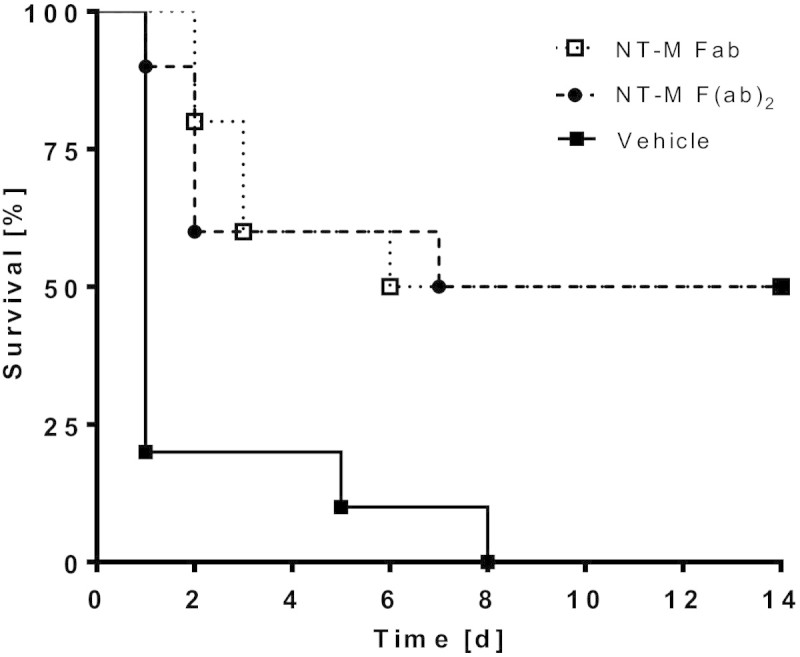
Survival rates of CLP mice treated with NT-M antibody fragments. Fab and F(ab)2 fragments of the antibody directed against the N-terminus (NT-M) of ADM were tested. For statistics see main text.

References

    1. Angus DC, Linde-Zwirble WT, Lidicker J, Clermont G, Carcillo J, Pinsky MR. Epidemiology of severe sepsis in the United States: analysis of incidence, outcome, and associated costs of care. Crit Care Med. 2001;29(7):1303–1310. doi: 10.1097/00003246-200107000-00002. - DOI - PubMed
    1. Martin GS, Mannino DM, Eaton S, Moss M. The epidemiology of sepsis in the United States from 1979 through 2000. N Engl J Med. 2003;348(16):1546–1554. doi: 10.1056/NEJMoa022139. - DOI - PubMed
    1. Melamed A, Sorvillo FJ. The burden of sepsis-associated mortality in the United States from 1999 to 2005: an analysis of multiple-cause-of-death data. Crit Care. 2009;13(1):R28. doi: 10.1186/cc7733. - DOI - PMC - PubMed
    1. Aziz M, Jacob A, Yang WL, Matsuda A, Wang P. Current trends in inflammatory and immunomodulatory mediators in sepsis. J Leukoc Biol. 2012;93(3):329–42. doi: 10.1189/jlb.0912437. - DOI - PMC - PubMed
    1. Hotchkiss RS, Karl IE. The pathophysiology and treatment of sepsis. N Engl J Med. 2003;348(2):138–150. doi: 10.1056/NEJMra021333. - DOI - PubMed