The Contribution of Missed Clinic Visits to Disparities in HIV Viral Load Outcomes
- PMID: 26270301
- PMCID: PMC4566539
- DOI: 10.2105/AJPH.2015.302695
The Contribution of Missed Clinic Visits to Disparities in HIV Viral Load Outcomes
Abstract
Objectives: We explored the contribution of missed primary HIV care visits ("no-show") to observed disparities in virological failure (VF) among Black persons and persons with injection drug use (IDU) history.
Methods: We used patient-level data from 6 academic clinics, before the Centers for Disease Control and Prevention and Health Resources and Services Administration Retention in Care intervention. We employed staged multivariable logistic regression and multivariable models stratified by no-show visit frequency to evaluate the association of sociodemographic factors with VF. We used multiple imputations to assign missing viral load values.
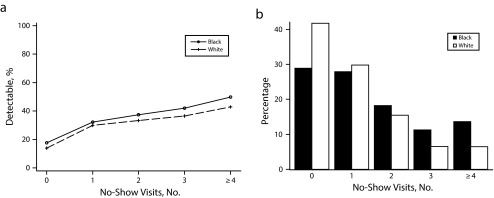
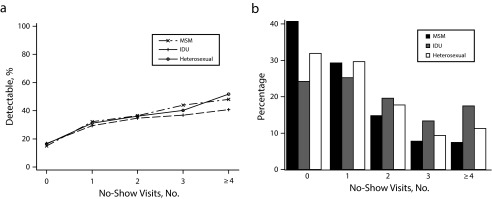
Results: Among 10 053 patients (mean age = 46 years; 35% female; 64% Black; 15% with IDU history), 31% experienced VF. Although Black patients and patients with IDU history were significantly more likely to experience VF in initial analyses, race and IDU parameter estimates were attenuated after sequential addition of no-show frequency. In stratified models, race and IDU were not statistically significantly associated with VF at any no-show level.
Conclusions: Because missed clinic visits contributed to observed differences in viral load outcomes among Black and IDU patients, achieving an improved understanding of differential visit attendance is imperative to reducing disparities in HIV.
Figures
References
-
- An Q, Prejean J, Hall HI. Racial disparity in US diagnoses of acquired immune deficiency syndrome, 2000–2009. Am J Prev Med. 2012;43(5):461–466. - PubMed
-
- Hall HI, Frazier EL, Rhodes P et al. Differences in human immunodeficiency virus care and treatment among subpopulations in the United States. JAMA Intern Med. 2013;173(14):1337–1344. - PubMed
-
- Lansky A, Brooks JT, DiNenno E, Heffelfinger J, Hall HI, Mermin J. Epidemiology of HIV in the United States. J Acquir Immune Defic Syndr. 2010;55(suppl 2):S64–S68. - PubMed
-
- Barash ET, Hanson DL, Buskin SE, Teshale E. HIV-infected injection drug users: health care utilization and morbidity. J Health Care Poor Underserved. 2007;18(3):675–686. - PubMed
Publication types
MeSH terms
Grants and funding
LinkOut - more resources
Full Text Sources
Medical