Review
. 2016 Jan;51(1):7-21.
doi: 10.1007/s12020-015-0715-6. Epub 2015 Aug 14.

Role of the steroidogenic acute regulatory protein in health and disease

Affiliations
Review

Role of the steroidogenic acute regulatory protein in health and disease

Pulak R Manna et al. Endocrine. 2016 Jan.

Abstract

Steroid hormones are an important class of regulatory molecules that are synthesized in steroidogenic cells of the adrenal, ovary, testis, placenta, brain, and skin, and influence a spectrum of developmental and physiological processes. The steroidogenic acute regulatory protein (STAR) predominantly mediates the rate-limiting step in steroid biosynthesis, i.e., the transport of the substrate of all steroid hormones, cholesterol, from the outer to the inner mitochondrial membrane. At the inner membrane, cytochrome P450 cholesterol side chain cleavage enzyme cleaves the cholesterol side chain to form the first steroid, pregnenolone, which is converted by a series of enzymes to various steroid hormones in specific tissues. Both basic and clinical evidence have demonstrated the crucial involvement of the STAR protein in the regulation of steroid biosynthesis. Multiple levels of regulation impinge on STAR action. Recent findings demonstrate that hormone-sensitive lipase, through its action on the hydrolysis of cholesteryl esters, plays an important role in regulating STAR expression and steroidogenesis which involve the liver X receptor pathway. Activation of the latter influences macrophage cholesterol efflux that is a key process in the prevention of atherosclerotic cardiovascular disease. Appropriate regulation of steroid hormones is vital for proper functioning of many important biological activities, which are also paramount for geriatric populations to live longer and healthier. This review summarizes the current level of understanding on tissue-specific and hormone-induced regulation of STAR expression and steroidogenesis, and provides insights into a number of cholesterol and/or steroid coupled physiological and pathophysiological consequences.

Keywords: Aging; Atherosclerosis; HSL and LXR; STAR; STAR deficiency and Lipoid CAH; Steroidogenesis.


Conflict of interest statement

Conflicts of Interest

The authors declare no conflict of interest.

Figures
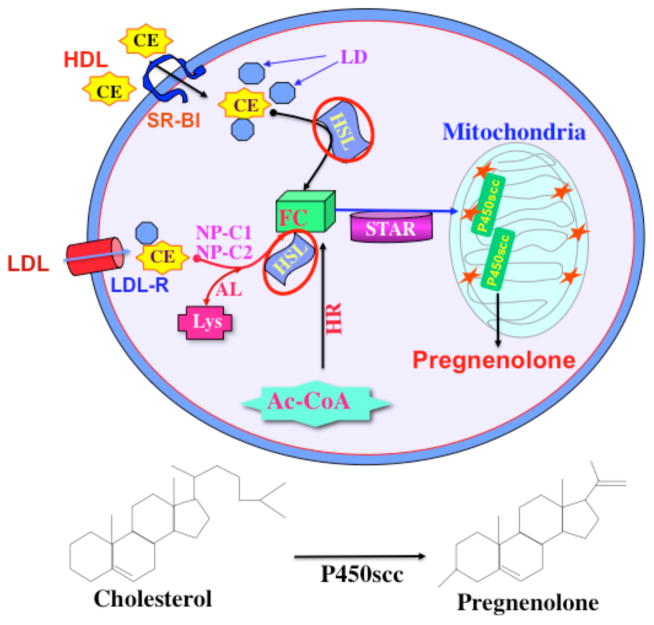
Fig. 1
Fig. 1
A model illustrating CE metabolism and its relevance to steroidogenesis. Cholesterol utilized for steroidogenesis is derived from a number of sources. The hydrolysis of CEs stored in lipid droplets is an important source of cholesterol for optimum steroid biosynthesis. HSL is a multifunctional enzyme that is responsible for NCEH activity. Circulating lipoprotins (HDL or LDL) bind to SR-B1 and release CEs into the cells. In rodents, free cholesterol (FC) utilized for steroid synthesis is mostly obtained via HDL mediated CE internalization and followed by cleavage by HSL. Receptor-mediated uptake of lipoprotein-derived CEs is processed via the LDL receptor in the human systems. De novo synthesis of cholesterol from acetyl-coenzyme A (AC-CoA) provides also FC for steroid synthesis. The STAR protein regulates steroid biosynthesis by controlling the transport of cholesterol from the outer to the inner mitochondrial membrane. Conversion of cholesterol to pregnenolone is the first enzymatic step in steroid hormone biosynthesis (bottom panel). Pregnenolone is then converted to various steroid hormones by a series of enzymes in specific tissues. LD, lipid droplets; AL, acid lipase; NP-C1 and C2, Niemann Pick C1 and C2; Lys, lisosome; HR, HMG-Coenzme A reductase. Revised and represented with permission from Molecular Human Reproduction (3).
Fig. 2
Fig. 2
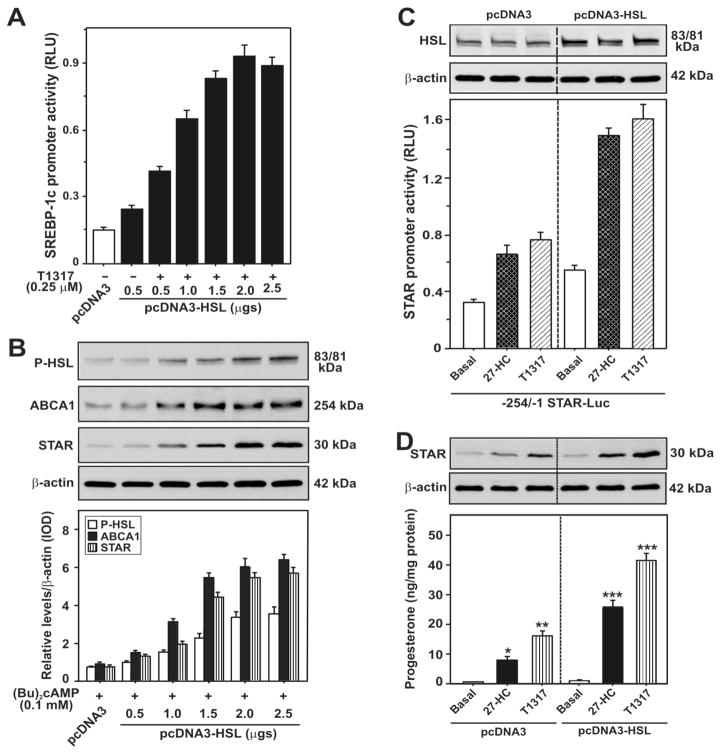
Overexpression of HSL on 27-HC and/or T1317 and (Bu)2cAMP stimulated SREBP-1c and STAR promoter activity, and HSL, P-HSL, ABCA1, and STAR and steroid levels. MA-10 cells were transfected with pcDNA3-HSL at either increasing (0.5–2.5 μg; A and B) or fixed (2.0 μg; C and D) amounts of cDNAs, within the context of either the −2.7 kb/+1 bp SREBP-1c (A) or −254/−1 bp STAR (C) promoter-driven luciferase reporter plasmid, in the presence of pRL-SV40. Following 36h of transfection, cells were treated without or with 27-HC (0.25 μM) and T1317 (0.25 μM) for an additional 6h. Luciferase activity in the cell lysates was determined and expressed as SREBP-1c (A) and STAR (C) promoter activity, RLU (luciferase/renilla). Cells were also processed for immunoblotting (B). Representative immunoblots illustrate HSL, P-HSL, ABCA1, and STAR in different groups using 20–30 μg of total cellular protein (B–D). Immunoblots shown are representative of four independent experiments. β-actin expression was assessed as a loading control (C and D). *, p < 0.05; **, p < 0.01; ***, p < 0.001 vs. basal. (Revised and represented following copyright permission, “this research was originally published in The Journal of Biological Chemistry, Manna PR, Cohen-Tannoudji J, Counis R, Garner CW, Huhtaniemi I, Kraemer FB, Stocco DM, Mechanisms of action of hormone-sensitive lipase in mouse Leydig cells: its role in the regulation of the steroidogenic acute regulatory protein. J. Biol. Chem., 2013, 288(12):8505–18. © the American Society for Biochemistry and Molecular Biology”).
Fig. 3
Fig. 3
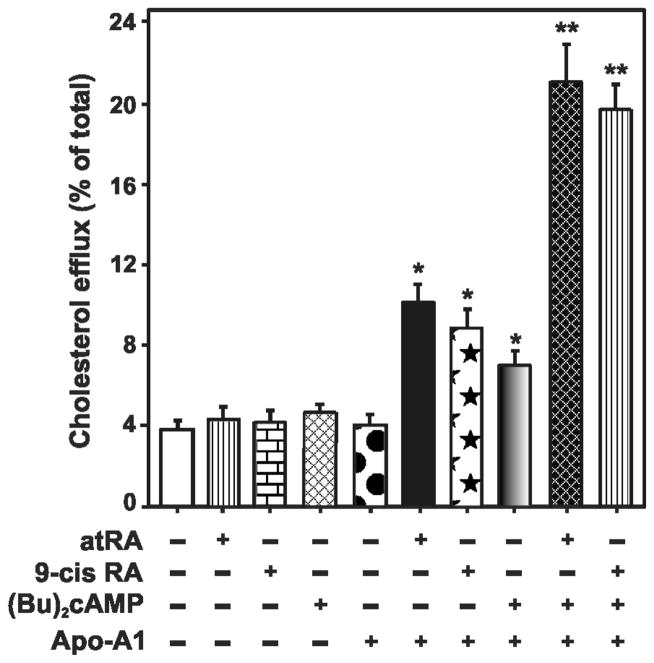
Effects of atRA and 9-cis RA on (Bu)2cAMP stimulated macrophage cholesterol efflux. Mouse RAW 264.7 macrophages were labeled with 3H-cholesterol for 24h. Macrophages were then treated without or with atRA (10 μM), 9-cis RA (10 μM), (Bu)2cAMP (0.1 mM), or their combination, for 12h, in the absence or presence of Apo-A1 (20 mg/ml), as indicated. Following treatments, media and cells from different groups were collected separately and counted in a liquid scintillation counter, and cholesterol efflux was calculated as the percentage of radioactivity recovered in the media over total (cells plus media) radioactivity. Data represent the mean ± SE of 4 independent experiments. *, p < 0.05; **, p <0.01; vs. control. Revised and represented with permission from Biochemical Biophysical Research Communication (153).

References

    1. Azhar S, Reaven E. Scavenger receptor class BI and selective cholesteryl ester uptake: partners in the regulation of steroidogenesis. Mol Cell Endocrinol. 2002;195:1–26. - PubMed
    1. Kraemer FB, Shen WJ, Harada K, Patel S, Osuga J, Ishibashi S, Azhar S. Hormone-sensitive lipase is required for high-density lipoprotein cholesteryl ester-supported adrenal steroidogenesis. Mol Endocrinol. 2004;18:549–557. - PubMed
    1. Manna PR, Dyson MT, Stocco DM. Regulation of the steroidogenic acute regulatory protein gene expression: present and future perspectives. Mol Hum Reprod. 2009;15:321–333. - PMC - PubMed
    1. Manna PR, Stocco DM. Regulation of the steroidogenic acute regulatory protein expression: functional and physiological consequences. Curr Drug Targets Immune Endocr Metabol Disord. 2005;5:93–108. - PubMed
    1. Stocco DM, Wang X, Jo Y, Manna PR. Multiple signaling pathways regulating steroidogenesis and steroidogenic acute regulatory protein expression: more complicated than we thought. Mol Endocrinol. 2005;19:2647–2659. - PubMed

Publication types

LinkOut - more resources