


Can adaptive treatment improve outcomes in family-based therapy for adolescents with anorexia nervosa? Feasibility and treatment effects of a multi-site treatment study
- PMID: 26276704
- PMCID: PMC4573312
- DOI: 10.1016/j.brat.2015.07.015
Can adaptive treatment improve outcomes in family-based therapy for adolescents with anorexia nervosa? Feasibility and treatment effects of a multi-site treatment study
Abstract
Objective: Adolescents with Anorexia Nervosa (AN), treated with family-based treatment (FBT) who fail to gain 2.3 kg by the fourth week of treatment have a 40-50% lower chance of recovery than those who do. Because of the high risk of developing enduring AN, improving outcomes in this group of poor responders is essential. This study examines the feasibility and effects of a novel adaptive treatment (i.e., Intensive Parental Coaching-IPC) aimed at enhancing parental self-efficacy related to re-feeding skills in poor early responders to FBT.
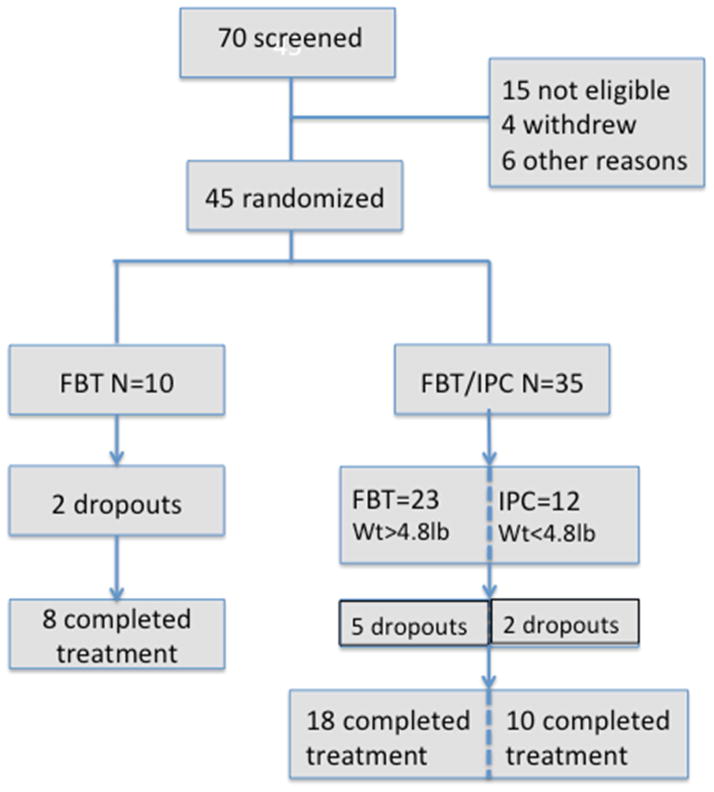
Method: 45 adolescents (12-18 years of age) meeting DSM TR IV criteria for AN were randomized in an unbalanced design (10 to standard FBT; 35 to the adaptive arm). Attrition, suitability, expectancy rates, weight change, and psychopathology were compared between groups.
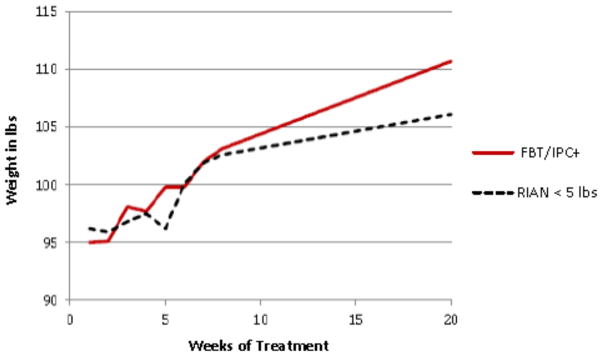
Outcomes: There were no differences in rates of attrition, suitability, expectancy ratings, or most clinical outcomes between randomized groups. However, the group of poor early responders that received IPC achieved full weight restoration (>95% of expected mean BMI) by EOT at similar rates as those who had responded early.
Conclusions: The results of this study suggest that it is feasible to use an adaptive design to study the treatment effect of IPC for those who do not gain adequate weight by session 4 of FBT. The results also suggest that using IPC for poor early responders significantly improves weight recovery rates to levels comparable to those who respond early. A sufficiently powered study is needed to confirm these promising findings.
Keywords: Adolescents; Anorexia nervosa; Family therapy.
Copyright © 2015 Elsevier Ltd. All rights reserved.
Figures
References
-
- Beck A, Steer R, Garbin M. Psychometric properties of the Beck Depression Inventory: twenty-five years of evaluation. Clin Psycho Rev. 1988;8:77–100.
-
- Beck AT. Beck Depression Inventory. San Antonio, TX: The Psychological Corporation; 1987.
