Review
. 2015 Aug;27(8):2095-118.
doi: 10.1105/tpc.15.00440. Epub 2015 Aug 14.

The Plant Peptidome: An Expanding Repertoire of Structural Features and Biological Functions

Affiliations
Review

The Plant Peptidome: An Expanding Repertoire of Structural Features and Biological Functions

Patrizia Tavormina et al. Plant Cell. 2015 Aug.

Abstract

Peptides fulfill a plethora of functions in plant growth, development, and stress responses. They act as key components of cell-to-cell communication, interfere with signaling and response pathways, or display antimicrobial activity. Strikingly, both the diversity and amount of plant peptides have been largely underestimated. Most characterized plant peptides to date acting as small signaling peptides or antimicrobial peptides are derived from nonfunctional precursor proteins. However, evidence is emerging on peptides derived from a functional protein, directly translated from small open reading frames (without the involvement of a precursor) or even encoded by primary transcripts of microRNAs. These novel types of peptides further add to the complexity of the plant peptidome, even though their number is still limited and functional characterization as well as translational evidence are often controversial. Here, we provide a comprehensive overview of the reported types of plant peptides, including their described functional and structural properties. We propose a novel, unifying peptide classification system to emphasize the enormous diversity in peptide synthesis and consequent complexity of the still expanding knowledge on the plant peptidome.


Figures

Figure 1.
Figure 1.
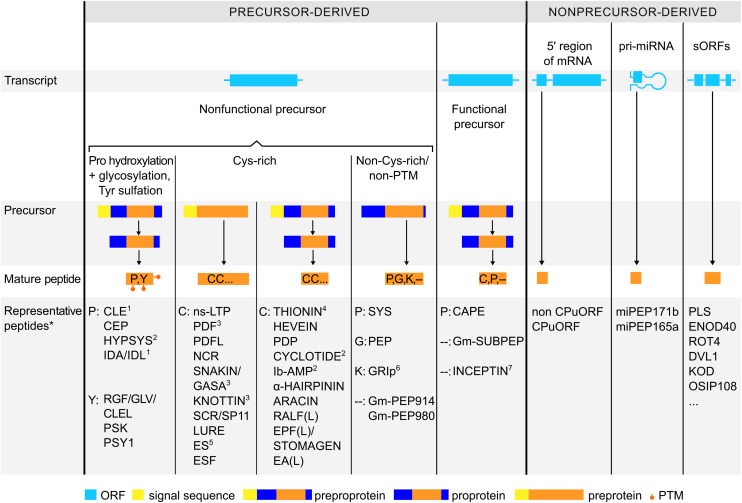
The Diversity of Plant Peptide Synthesis. Plant peptides are synthesized from precursor proteins or directly translated from sORFs embedded in transcripts. The former type of peptides is derived from nonfunctional precursors or functional precursors. Such a precursor can be a preprotein that results in the mature peptide upon removal of an NSS (yellow rectangle). Alternatively, such a precursor can be a proprotein that contains a prodomain (blue rectangle) and is enzymatically modified to the mature peptide (orange rectangle). If the proprotein also harbors an NSS, it is termed preproprotein. So far, peptides derived from nonfunctional precursors can be posttranslationally modified (PTM), Cys-rich, or non-Cys-rich and non-posttranslationally modified (non-Cys-rich/non-PTM). Representative peptides of these three subgroups are classified by their dominant residues where appropriate (*), though sometimes a single dominant amino acid cannot be identified (‐‐). Nonprecursor-derived peptides are encoded by sORFs (<100 amino acids) that are located (1) upstream of the main ORF in the 5′ leader sequence of a gene, (2) in primary transcripts of miRNA (pri-miRNAs), or (3) in other transcripts not encoding longer (>100 amino acids) proteins. Most peptides in this group follow the presented scheme, but some exceptions may arise, including 1some members do not contain an NSS, 2multiple mature peptides are released from one single precursor, 3some members can contain a prodomain, 4an unprocessed THIONIN of 15 kD was reported, 5an internal signal sequence is present instead of an NSS, 6an NSS is present and proteolytic cleavage is executed by a metacaspase, and 7proteolytic cleavage is executed by herbivorous insect processing machinery.
Figure 2.
Figure 2.
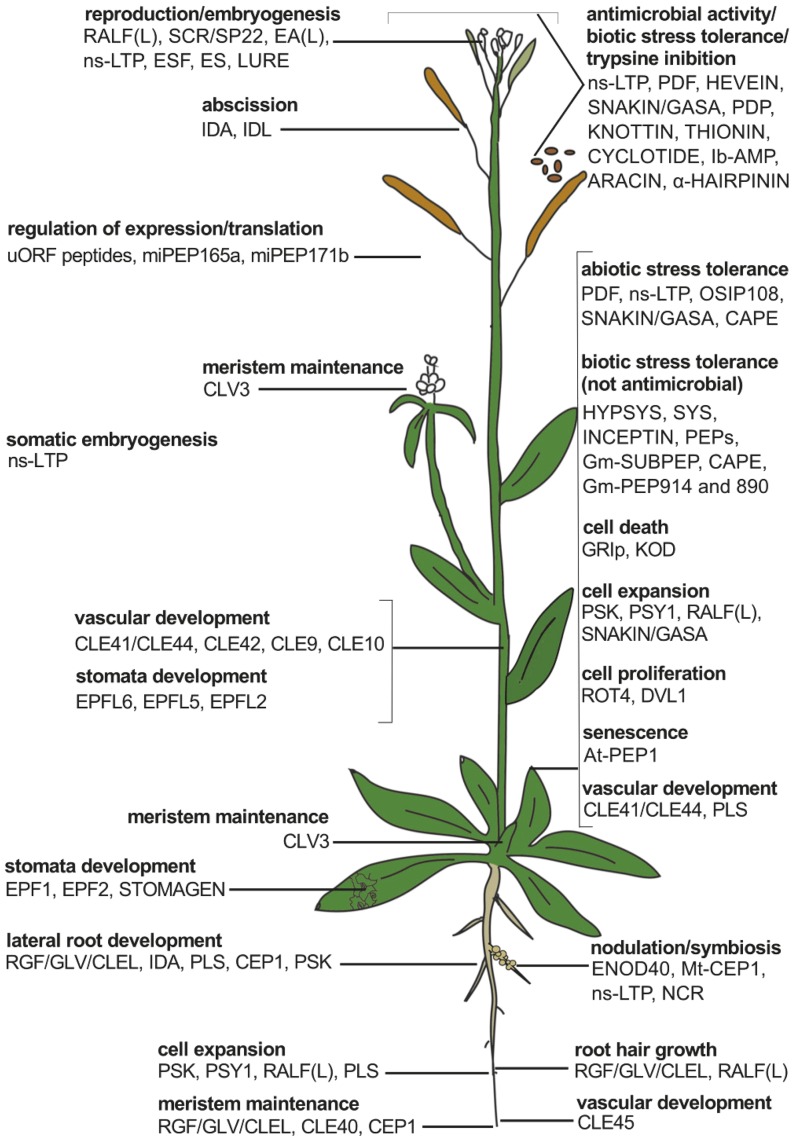
The Functional Diversity of Plant Peptides. Plant peptides have a wide range of biological roles and act in different plant parts, as indicated in an illustration of a simplified plant (adapted from Czyzewicz et al. [2013]).
Figure 3.
Figure 3.
Key Features of All Peptide Types Based on Representative Examples. Peptides derived from nonfunctional precursors can be classified in three subgroups: (1) PTM peptides, (2) Cys-rich peptides, and (3) non-Cys-rich/non-PTM peptides. PTM peptides are characterized by specific posttranslational modifications, such as Pro hydroxylation (orange), glycosylation (asterisk), and Tyr sulfation (blue). Cys-rich peptides carry at least two Cys residues to form stable disulfide bridges (square brackets). Non-Cys-rich/non-PTM peptides are not characterized by specific PTM or two or more Cys. Peptides can also be formed from functional precursors or directly translated from sORFs (<100 amino acids) in case no protein precursor is involved in the maturation process. To illustrate the features of all peptide types, the amino acid sequence of a representative mature peptide and the main characteristics of its 3D structure are shown. Additionally, dominant residues (bold), such as Pro, Gly, Lys, Cys, or Tyr, and conserved motifs (underlined) are indicated in the amino acid sequences of these representative peptides. Arabidopsis thaliana (At), Glycine max (Gm), Helianthus annuus (Ha), Hevea brasiliensis (Hb), Impatiens balsamina (Ib), Mirabilis jalapa (Mj), Medicago truncatula (Mt), Oryza sativa (Os); Petunia hybrida (phyb), SUCROSE CONTROL-peptide (SC-peptide); Solanum lycopersicum (Sl), Stellaria media (Sm), Solanum tuberosum (St), Torenia fournieri (Tf), Vigna unguiculata (Vu), Zea mays (Zm). nd, not determined.
Figure 4.
Figure 4.
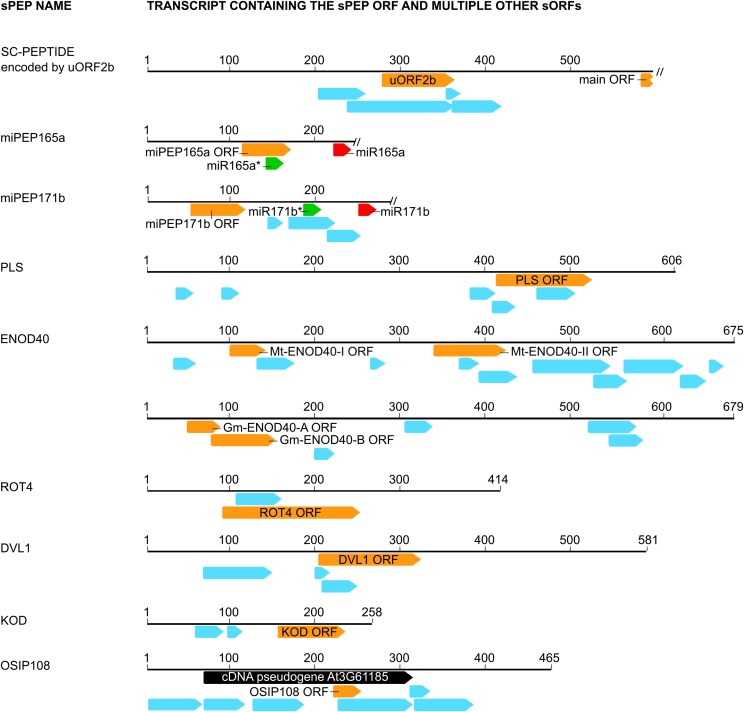
A Wide Variety of sPEP Transcripts. Transcripts of sPEPs harbor many sORFs (<100 amino acids; blue arrows), though only a few sORFs have been experimentally characterized (orange arrows). All sORFs starting with AUG and consisting of at least six codons in sense direction are displayed. Interior ORFs located within the same frame of a longer ORF are omitted, except for the SC-PEPTIDE. Only the 5′ part of the SC-PEPTIDE transcript and the miPEP transcripts is displayed (indicated by a double slash). A red arrow represents mature miRNA found from one arm of a hairpin; a green arrow represents mature miRNA (with asterisk) formed from the opposite arm of a hairpin.

References

    1. Aerts A.M., François I.E.J.A., Meert E.M.K., Li Q.T., Cammue B.P.A., Thevissen K. (2007). The antifungal activity of RsAFP2, a plant defensin from raphanus sativus, involves the induction of reactive oxygen species in Candida albicans. J. Mol. Microbiol. Biotechnol. 13: 243–247. - PubMed
    1. Albert M. (2013). Peptides as triggers of plant defence. J. Exp. Bot. 64: 5269–5279. - PubMed
    1. Almasia N.I., Bazzini A.A., Hopp H.E., Vazquez-Rovere C. (2008). Overexpression of snakin-1 gene enhances resistance to Rhizoctonia solani and Erwinia carotovora in transgenic potato plants. Mol. Plant Pathol. 9: 329–338. - PMC - PubMed
    1. Amano Y., Tsubouchi H., Shinohara H., Ogawa M., Matsubayashi Y. (2007). Tyrosine-sulfated glycopeptide involved in cellular proliferation and expansion in Arabidopsis. Proc. Natl. Acad. Sci. USA 104: 18333–18338. - PMC - PubMed
    1. Amien S., Kliwer I., Márton M.L., Debener T., Geiger D., Becker D., Dresselhaus T. (2010). Defensin-like ZmES4 mediates pollen tube burst in maize via opening of the potassium channel KZM1. PLoS Biol. 8: e1000388. - PMC - PubMed

Publication types

LinkOut - more resources