Review
. 2015 Jul:43:22-32.
doi: 10.1016/j.semcdb.2015.08.002. Epub 2015 Aug 12.

Amino acid management in cancer

Affiliations
Review

Amino acid management in cancer

Zhi-Yang Tsun et al. Semin Cell Dev Biol. 2015 Jul.

Abstract

Amino acids have a dual role in cellular metabolism, as they are both the building blocks for protein synthesis and intermediate metabolites which fuel other biosynthetic reactions. Recent work has demonstrated that deregulation of both arms of amino acid management are common alterations seen in cancer. Among the most highly consumed nutrients by cancer cells are the amino acids glutamine and serine, and the biosynthetic pathways that metabolize them are required in various cancer subtypes and the object of current efforts to target cancer metabolism. Also altered in cancer are components of the machinery which sense amino acid sufficiency, nucleated by the mechanistic target of rapamycin (mTOR), a key regulator of cell growth via modulation of key processes including protein synthesis and autophagy. The precise ways in which altered amino acid management supports cellular transformation remain mostly elusive, and a fuller mechanistic understanding of these processes will be important for efforts to exploit such alterations for cancer therapy.

Keywords: Amino acids; Cancer; Glutamine; Metabolism; Serine; mTOR.


Figures

Fig. 1
Fig. 1
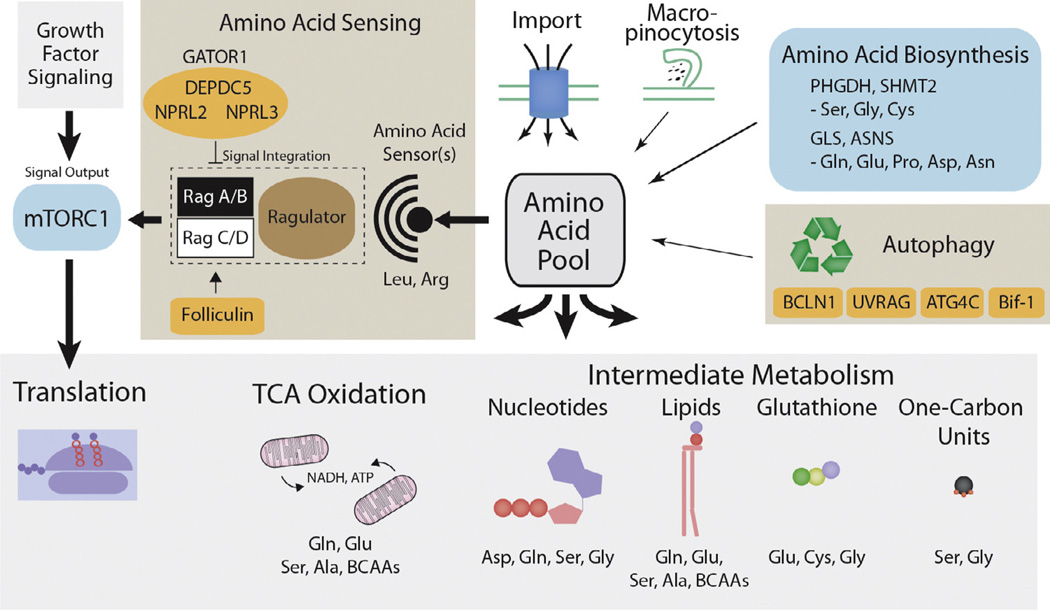
Amino acid sensing and biosynthesis are altered in cancer. Amino acid import and biosynthesis, as well as the processes of autophagy and macropinocytosis contribute to the pool of amino acids available to the cell for macromolecular biosynthesis. Amino acid biosynthetic pathways are activated in subsets of cancer and drive the production of specific amino acids and their utilization as intermediate metabolites for the production of important biomolecules such as nucleotides, lipids, glutathione, and one-carbon units. Amino acids are also oxidized in the TCA cycle as an alternative to glucose for the production of ATP and NADH. The specific amino acids which most directly contribute to these biomolecules and processes are listed. Unknown amino acids sensor(s) assess the availability of specific amino acids, likely including leucine and arginine. The Ras-like small GTPase Rag complex, modulated by the action of its GEF, Ragulator, and GAPs, tumor suppressive complexes GATOR1 and folliculin, integrate this amino acid signal and effect a change in localization of the mTORC1 complex, leading to its activation. The mTORC1 complex can then activate pathways promoting cell growth, including protein biosynthesis. Activating mutations in the mTORC1 core component mTOR, are recurrently observed in cancer. Processes exhibiting activation in cancer are colored green, tumor suppressive genes and complexes are colored orange.
Fig. 2
Fig. 2
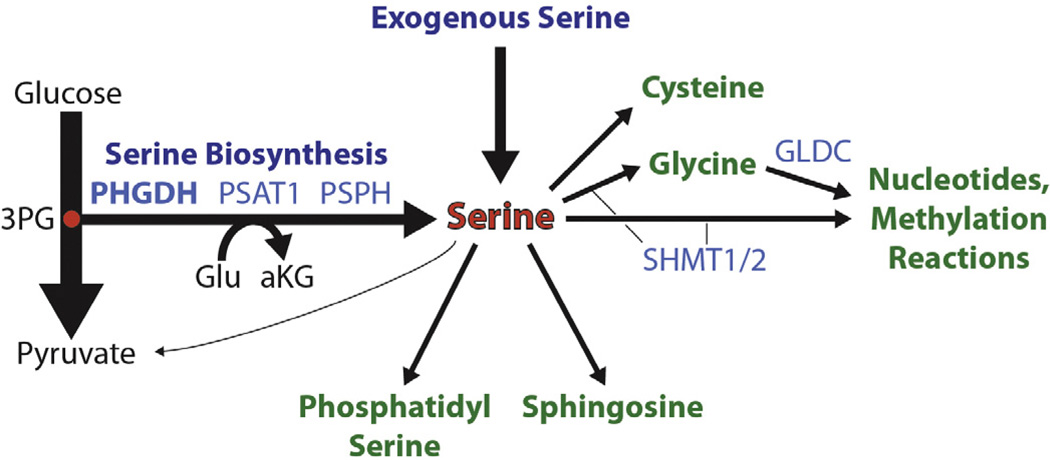
Serine biosynthesis and utilization. Serine can be imported into the cell or biosynthetically produced from the glycolytic intermediate 3-phosphoglycerate (3PG) in a three step pathway. Flux through serine biosynthesis additionally drives the production of cytosolic alpha-ketoglutarate (aKG). Serine is catabolized to generate phosphatidylserine, sphingosine, cysteine, glycine or pyruvate, the latter conversion being restricted to non-transformed liver cells. The conversion of serine to glycine or the subsequent catabolism of glycine in the mitochondria provides one-carbon units for nucleotide biosynthesis and the methylation reactions of the cell. Key enzymes are shown in light blue.
Fig. 3
Fig. 3
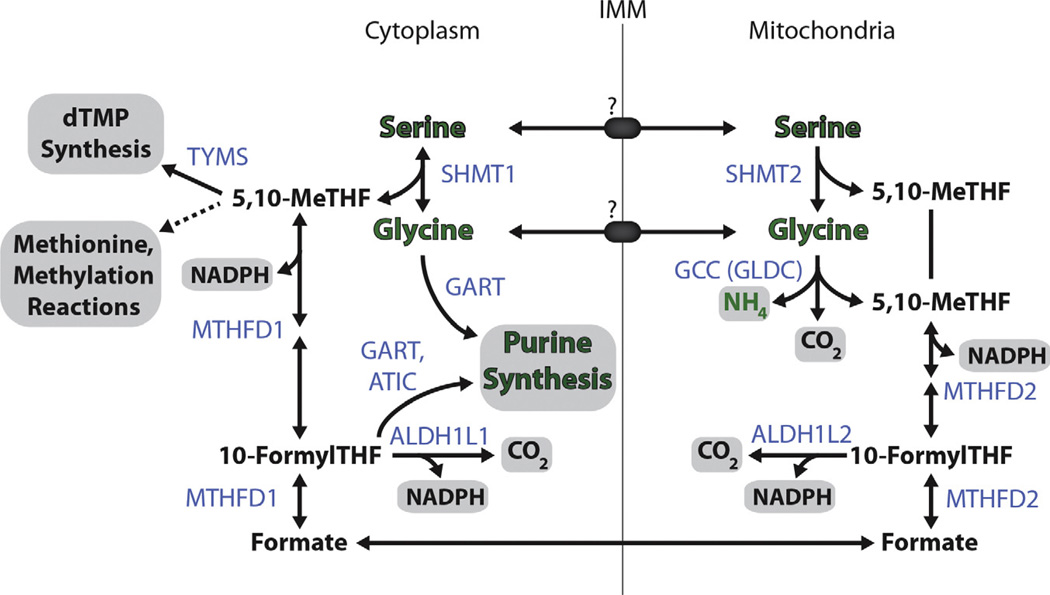
Cytosolic and Mitochondrial Compartmentalization of One-Carbon Metabolism. Serine and glycine contribute to one-carbon metabolism in largely parallel cytoplasmic and mitochondrial pathways. Serine hydroxymethyltransferate (SHMT1/2) catalyzes the contribution of the serine beta carbon into the one carbon pool by production of 5,10-methyl tetrahydrofolate (MeTHF). Cytoplasmic 5,10-MeTHF can then contribute to dTMP synthesis or to most major methylation reactions of the cell via production of S-Adenosyl methionine. In the mitochondria, glycine can be further cleaved to form another molecule of 5,10-MeTHF whilst in the cytoplasm, glycine instead can contribute en masse to purine biosynthesis. One-carbon units are managed by the methylenetetrahydrofolate dehydrogenases (MTHFD1/2), which can produce appropriate THF derivatives for nucleotide biosynthesis in the cytoplasm or for the production of NADPH in either compartment. Serine and glycine are thought to move across the inner mitochondrial membrane (IMM) via unknown transporters, whilst THF derivatives and NADPH are not thought to translocate between these two compartments. Green text denotes the fate of serine derived nitrogen, gray boxes indicate major endpoint metabolites produced from serine. Key enzymes are shown in light blue.
Fig. 4
Fig. 4
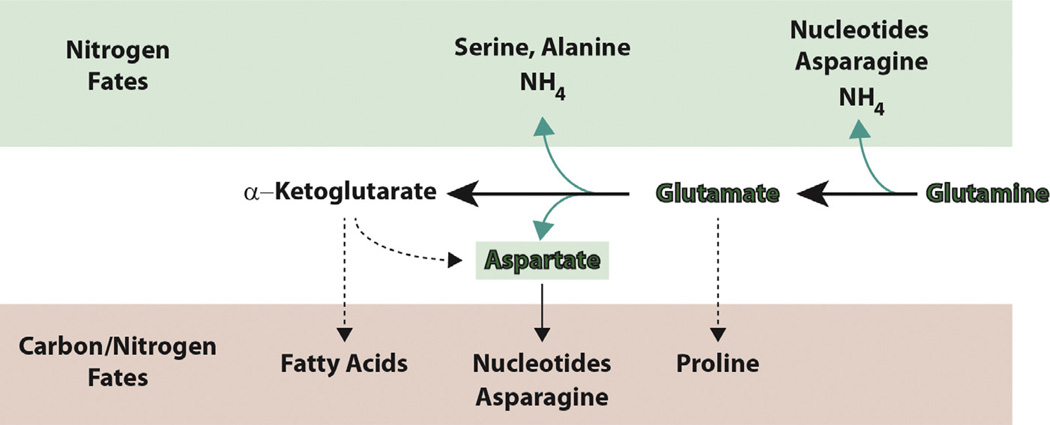
Major fates of glutamine. Glutamine and its major metabolite, glutamate, are used as nitrogen donors to contribute to the production of amino acids, via transamination reactions, or to nucleotide biosynthesis (green box). The amino groups of glutamine and glutamate can also be hydrolyzed to form ammonia, thereby balancing nitrogen assimilation and release. Glutamate and alpha-ketoglutarate produced by these deamination reactions can be further utilized for biosynthesis (pink box). Glutamate can be converted to proline or, via the TCA cycle, to aspartate, which is incorporated en masse in nucleotide biosynthesis or converted to asparagine. Alpha-ketoglutarate can be metabolized via various routes to acetyl CoA for use in de novo fatty acid biosynthesis.

References

    1. Cantor JR, Sabatini DM. Cancer cell metabolism: one hallmark, many faces. Cancer Discov. 2012;2(10):881–898. PMCID: 3491070. - PMC - PubMed
    1. Ward PS, Thompson CB. Metabolic reprogramming: a cancer hallmark even warburg did not anticipate. Cancer Cell. 2012;21(3):297–308. PMCID: 3311998. - PMC - PubMed
    1. Hanahan D, Weinberg RA. Hallmarks of cancer: the next generation. Cell. 2011;144(5):646–674. - PubMed
    1. Mayers JR, Vander Heiden MG. Famine versus feast: understanding the metabolism of tumors in vivo. Trends Biochem Sci. 2015 - PMC - PubMed
    1. Efeyan A, Comb WC, Sabatini DM. Nutrient-sensing mechanisms and pathways. Nature. 2015;517(7534):302–310. - PMC - PubMed

Publication types

MeSH terms