


White-Coat Effect Among Older Adults: Data From the Jackson Heart Study
- PMID: 26279070
- PMCID: PMC4742426
- DOI: 10.1111/jch.12644
White-Coat Effect Among Older Adults: Data From the Jackson Heart Study
Abstract
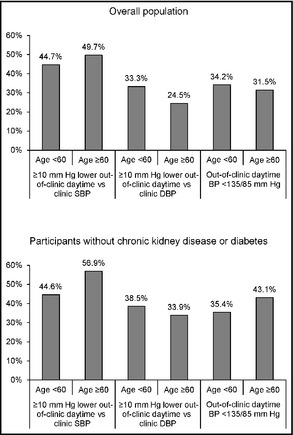
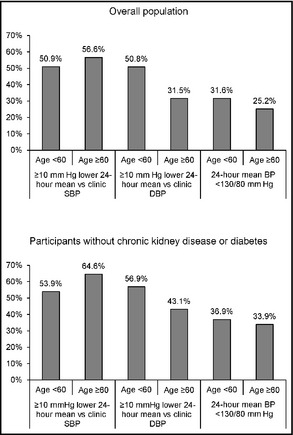
Many adults with elevated clinic blood pressure (BP) have lower BP when measured outside the clinic. This phenomenon, the "white-coat effect," may be larger among older adults, a population more susceptible to the adverse effects of low BP. The authors analyzed data from 257 participants in the Jackson Heart Study with elevated clinic BP (systolic/diastolic BP [SBP/DBP] ≥140/90 mm Hg) who underwent ambulatory BP monitoring (ABPM). The white-coat effect for SBP was larger for participants 60 years and older vs those younger than 60 years in the overall population (12.2 mm Hg, 95% confidence interval [CI], 9.2-15.1 mm Hg and 8.4 mm Hg, 95% CI, 5.7-11.1, respectively; P=.06) and among those without diabetes or chronic kidney disease (15.2 mm Hg, 95% CI, 10.1-20.2 and 8.6 mm Hg, 95% CI, 5.0-12.3, respectively; P=.04). After multivariable adjustment, clinic SBP ≥150 mm Hg vs <150 mm Hg was associated with a larger white-coat effect. Studies are needed to investigate the role of ABPM in guiding the initiation and titration of antihypertensive treatment, especially among older adults.
©2015 Wiley Periodicals, Inc.
Figures
Comment in
-
Blood Pressure Variability Provides Useful and Prognostic Information on the White-Coat Effect Among Older Patients.J Clin Hypertens (Greenwich). 2016 Aug;18(8):825. doi: 10.1111/jch.12796. Epub 2016 Feb 9. J Clin Hypertens (Greenwich). 2016. PMID: 26857208 Free PMC article. No abstract available.
References
-
- James PA, Oparil S, Carter BL, et al. 2014 evidence‐based guideline for the management of high blood pressure in adults: report from the panel members appointed to the Eighth Joint National Committee (JNC 8). JAMA. 2014;311:507–520. - PubMed
-
- O'Brien E, Parati G, Stergiou G, et al. European Society of Hypertension position paper on ambulatory blood pressure monitoring. J Hypertens. 2013;31:1731–1768. - PubMed
-
- Wright JT Jr, Fine LJ, Lackland DT, Ogedegbe G. Dennison Himmelfarb CR. Evidence supporting a systolic blood pressure goal of less than 150 mm Hg in patients aged 60 years or older: the minority view. Ann Intern Med. 2014;160:499–503. - PubMed
-
- Helvaci MR, Seyhanli M. What a high prevalence of white coat hypertension in society!. Intern Med. 2006;45:671–674. - PubMed
Publication types
MeSH terms
Grants and funding
- K24 HL111315/HL/NHLBI NIH HHS/United States
- P01 HL047540/HL/NHLBI NIH HHS/United States
- HHSN268201300048C/HL/NHLBI NIH HHS/United States
- HHSN268201300049C/HL/NHLBI NIH HHS/United States
- HHSN268201300047C/HL/NHLBI NIH HHS/United States
- HHSN268201300050C/HL/NHLBI NIH HHS/United States
- P01-HL047540/HL/NHLBI NIH HHS/United States
- R01 HL117323/HL/NHLBI NIH HHS/United States
- IK2 CX000856/CX/CSRD VA/United States
- HHSN268201300046C/HL/NHLBI NIH HHS/United States
- K24 HL125704/HL/NHLBI NIH HHS/United States
- K24HL111315/HL/NHLBI NIH HHS/United States
LinkOut - more resources
Full Text Sources
Other Literature Sources
