Review
. 2015 Aug 15;16(1):166.
doi: 10.1186/s13059-015-0733-y.

Xist localization and function: new insights from multiple levels

Affiliations
Review

Xist localization and function: new insights from multiple levels

Andrea Cerase et al. Genome Biol. .

Abstract

In female mammals, one of the two X chromosomes in each cell is transcriptionally silenced in order to achieve dosage compensation between the genders in a process called X chromosome inactivation. The master regulator of this process is the long non-coding RNA Xist. During X-inactivation, Xist accumulates in cis on the future inactive X chromosome, triggering a cascade of events that provoke the stable silencing of the entire chromosome, with relatively few genes remaining active. How Xist spreads, what are its binding sites, how it recruits silencing factors and how it induces a specific topological and nuclear organization of the chromatin all remain largely unanswered questions. Recent studies have improved our understanding of Xist localization and the proteins with which it interacts, allowing a reappraisal of ideas about Xist function. We discuss recent advances in our knowledge of Xist-mediated silencing, focusing on Xist spreading, the nuclear organization of the inactive X chromosome, recruitment of the polycomb complex and the role of the nuclear matrix in the process of X chromosome inactivation.


Figures
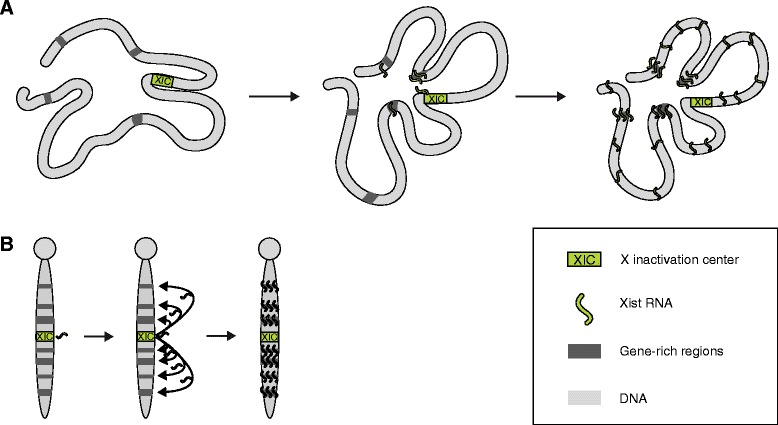
Fig. 1
Fig. 1
Models of the localization and spreading of Xist. a Three-dimensional spreading model of Xist localization. Xist might use close-proximity sites for its initial spreading (left and middle panels) before accumulating over the whole chromosome. At the final stages of spreading, Xist shows the highest enrichment at gene-rich regions (right panel). b Linear model of Xist spreading showing a classical representation of Xist decorating G-light bands on metaphase chromosomes
Fig. 2
Fig. 2
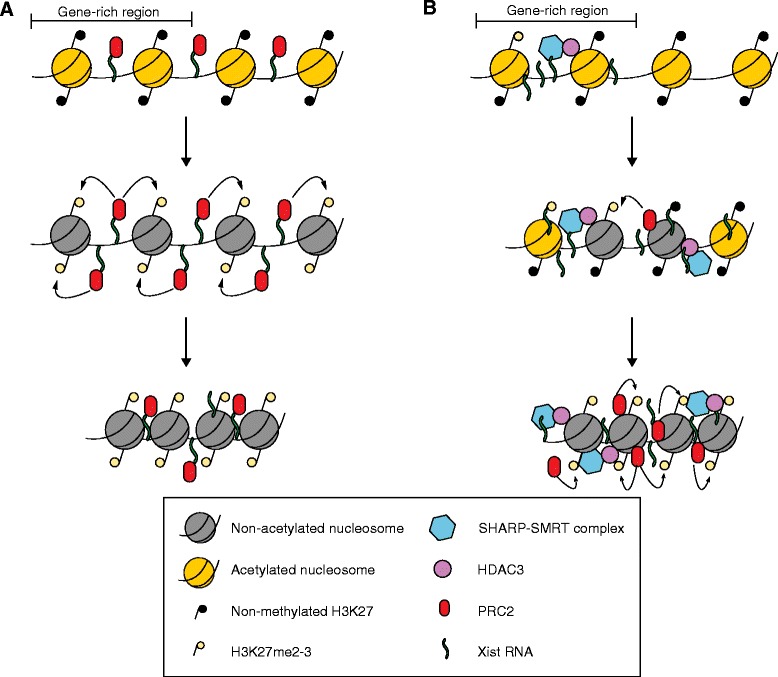
Direct and indirect models of recruitment of PRC2 by Xist RNA. a In the direct model, Xist localization brings PRC2 onto the chromatin by direct recruitment (upper panel). The PRC2 complex then places the H3K27me3 mark on the chromatin (middle panel), and this is followed by chromatin remodeler recruitment and chromatin compaction (lower panel). b In the indirect model, Xist interacts with gene-dense regions (upper panel) and induces chromatin changes (middle panel; i.e. histone deacetylation induced by Hdac3, chromatin compaction, eviction of RNA polymerase II). These changes might, in turn, recruit PRC1 or PRC2 and remodeler complexes (lower panel). H3K27me2-3 dimethylated or trimethylated histone 3 lysine 27, PRC1 polycomb repressive complex 1, PRC2 polycomb repressive complex 2
Fig. 3
Fig. 3
Possible role of scaffold proteins in X chromosome inactivation. a The binding of Xist to modified scaffold proteins induces the reorganization of the chromatin, as in (b), where Xist-mediated silencing is maintained by the nuclear scaffold. Genes to be silenced are dragged towards the nuclear matrix, preventing engagement of transcription factors at regulatory sites. CCCTC-binding factor (CTCF) might serve as a barrier to prevent Xist-induced chromatin reorganization. LINEs long interspersed nuclear elements
Fig. 4
Fig. 4
A speculative model of Xist function. The central part of the diagram shows a nucleus, with the active (Xa) and the inactive (Xi) chromosomal territories highlighted in green and yellow, respectively (gray indicates the chromosomal territories of other chromosomes). Magnified views of the Xi (right) and the Xa (left) territories are shown. The following model is based on the observations of Smeets and colleagues [25]. Coating with Xist RNA might cause a collapse of open chromatin channels, and this, in turn, might block the access of transcription factors and RNA polymerase II (RNA Pol II) to gene-regulatory elements. Alternatively, Xist might compete with C0t-1 RNA, and removal of this class of RNA could, in turn, lead to chromosome compaction [68]

References

    1. Penny GD, Kay GF, Sheardown SA, Rastan S, Brockdorff N. Requirement for Xist in X chromosome inactivation. Nature. 1996;379:131–7. doi: 10.1038/379131a0. - DOI - PubMed
    1. Augui S, Nora EP, Heard E. Regulation of X-chromosome inactivation by the X-inactivation centre. Nat Rev Genet. 2011;12:429–42. doi: 10.1038/nrg2987. - DOI - PubMed
    1. Lee JT, Bartolomei MS. X-inactivation, imprinting, and long noncoding RNAs in health and disease. Cell. 2013;152:1308–23. doi: 10.1016/j.cell.2013.02.016. - DOI - PubMed
    1. Morey C, Avner P. The demoiselle of X-inactivation: 50 years old and as trendy and mesmerising as ever. PLoS Genet. 2011;7 doi: 10.1371/journal.pgen.1002212. - DOI - PMC - PubMed
    1. Matarazzo MR, Cerase A, D'Esposito M. Building up the inactive X chromosome. Biol Cell. 2008;100:63–70. doi: 10.1042/BC20070073. - DOI - PubMed

Publication types