Review
. 2015 Oct;12(4):747-68.
doi: 10.1007/s13311-015-0375-5.

Cannabinoids and Epilepsy

Affiliations
Review

Cannabinoids and Epilepsy

Evan C Rosenberg et al. Neurotherapeutics. 2015 Oct.

Abstract

Cannabis has been used for centuries to treat seizures. Recent anecdotal reports, accumulating animal model data, and mechanistic insights have raised interest in cannabis-based antiepileptic therapies. In this study, we review current understanding of the endocannabinoid system, characterize the pro- and anticonvulsive effects of cannabinoids [e.g., Δ9-tetrahydrocannabinol and cannabidiol (CBD)], and highlight scientific evidence from pre-clinical and clinical trials of cannabinoids in epilepsy. These studies suggest that CBD avoids the psychoactive effects of the endocannabinoid system to provide a well-tolerated, promising therapeutic for the treatment of seizures, while whole-plant cannabis can both contribute to and reduce seizures. Finally, we discuss results from a new multicenter, open-label study using CBD in a population with treatment-resistant epilepsy. In all, we seek to evaluate our current understanding of cannabinoids in epilepsy and guide future basic science and clinical studies.

Keywords: Epilepsy; THC; cannabidiol; cannabinoids; cannabis; seizures.


Figures
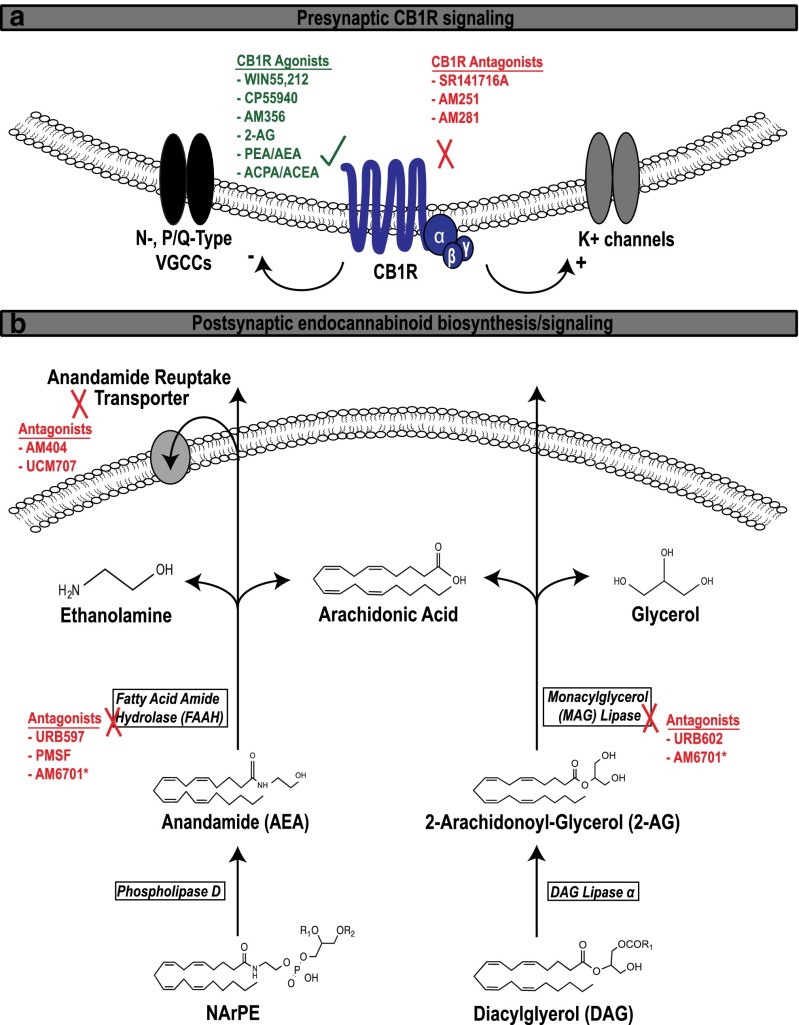
Fig. 1
Fig. 1
Biosynthesis, degradation, and signaling of endocannabinoids. (A) Presynaptic cannabinoid type 1 receptor (CB1R) signaling. (B) Postsynaptic endocannabinoid biosynthesis/signaling. NArPE = N-arachidonoyl phosphatidylethanolamine; DAG = 1-acyl, 2-arachidonoyl diacylglycerol; VGCC = voltage-gated calcium channels; PEA = palmitoylethanolamide; ACPA = arachidonylcyclopropylamide; ACEA = arachidonyl-2'-chloroethylamide; PMSF = phenylmethylsulfonyl fluoride
Fig. 2
Fig. 2
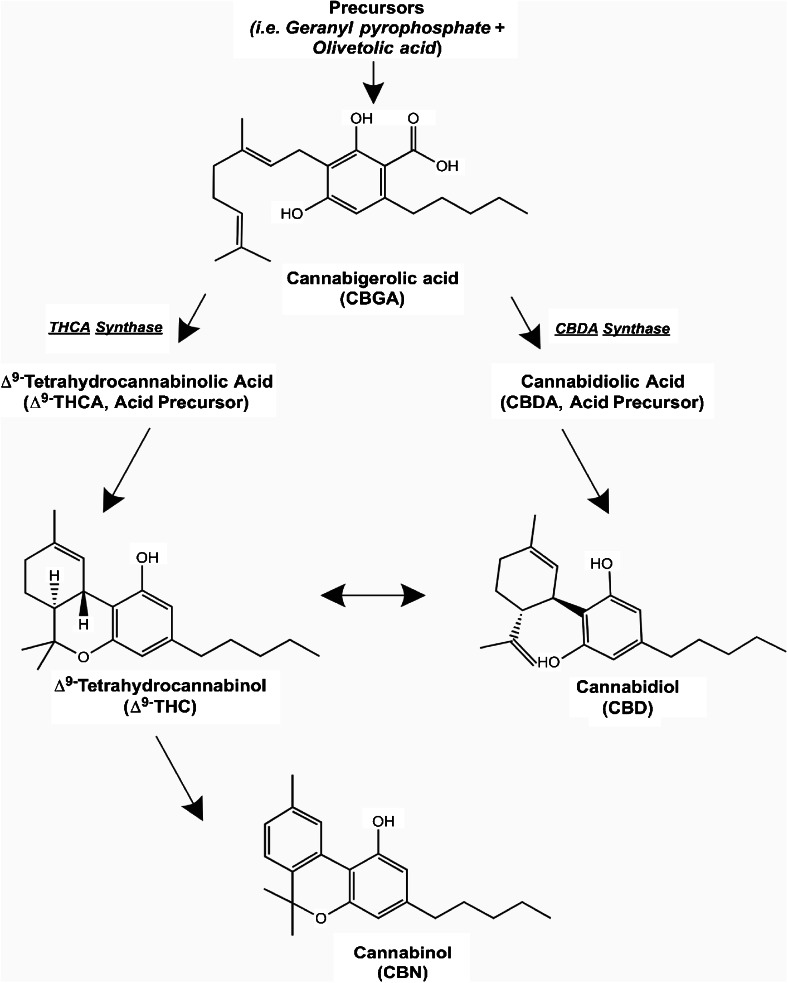
Biosynthesis of phytocannabinoids [73]
Fig. 3
Fig. 3
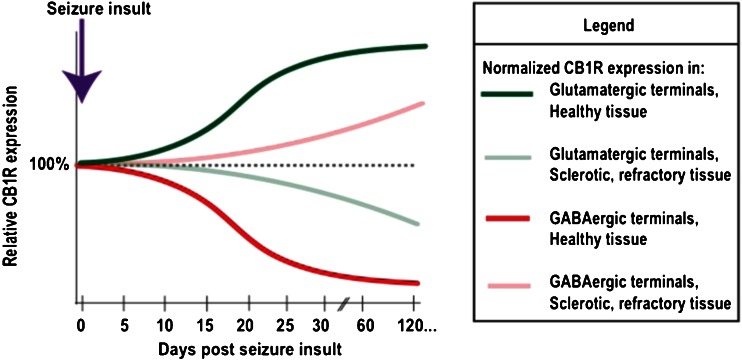
Homeostatic changes to hippocampal cannabinoid type 1 receptors (CB1Rs) in preclinical animal seizure models [, –166]. GABA = γ-aminobutryic acid
Fig. 4
Fig. 4
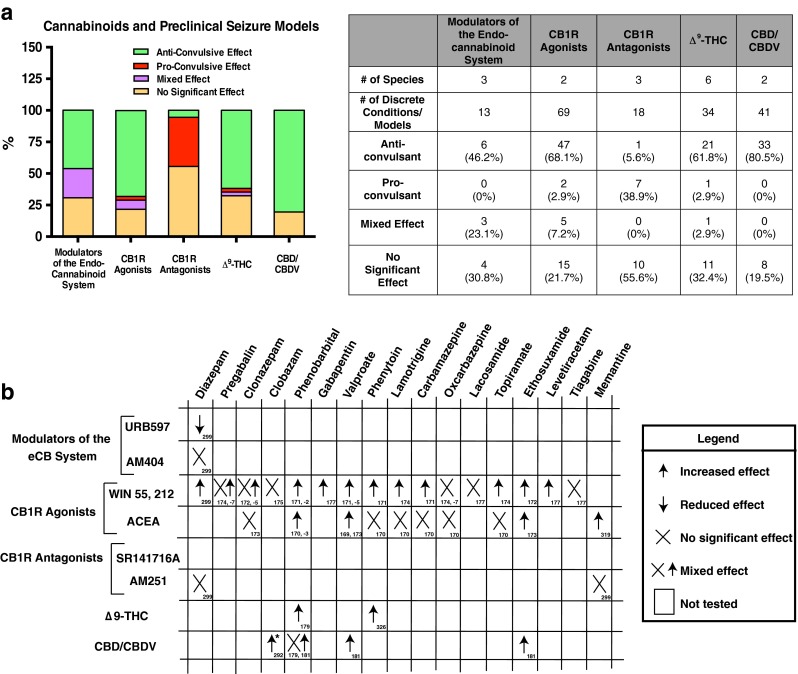
Summary of cannabinoids and preclinical seizure models. (A) Composite data from 175 preclinical seizure models (e.g., maximal electroshock, kainic acid) or discrete experimental designs (e.g., with combined antiseizure medications). Pro-/antiseizure effects are subclassified by given intervention: 1) modulators of the endocannabinoid (eCB) system (e.g., fatty acid amide hydrolase inhibitor URB597); 2) cannabinoid type 1 receptor (CB1R) agonists (e.g., WIN55212-2); 3) CB1R antagonists (e.g., SR141716A); 4) Δ9-tetrahydrocannabinol (Δ9-THC); and 5) cannabidiol (CBD)/cannabidivarin (CBDV). (See Supplementary Material for complete description of preclinical studies.) (B) Summary of preclinical data on cannabinoid interactions with antiseizure medications. Sources indicated in boxes. *Recent evidence from a phase I clinical trial suggests that CBD/CBDV elevates serum concentrations of clobazam and N-desmethylclobazam in human pediatric patients with treatment-resistant epilepsy [292]. ACEA = arachidonyl-2'-chloroethylamide

References

    1. Fisher RS, et al. Epileptic seizures and epilepsy: definitions proposed by the International League Against Epilepsy (ILAE) and the International Bureau for Epilepsy (IBE) Epilepsia. 2005;46:470–472. doi: 10.1111/j.0013-9580.2005.66104.x. - DOI - PubMed
    1. Kwan P, Brodie MJ. Early identification of refractory epilepsy. N Engl J Med. 2000;342:314–319. doi: 10.1056/NEJM200002033420503. - DOI - PubMed
    1. Kwan P, Brodie MJ. Refractory epilepsy: a progressive, intractable but preventable condition? Seizure. 2002;11:77–84. doi: 10.1053/seiz.2002.0593. - DOI - PubMed
    1. Kwan P, Schachter SC, Brodie MJ. Drug-resistant epilepsy. N Engl J Med. 2011;365:919–926. doi: 10.1056/NEJMra1004418. - DOI - PubMed
    1. Nilsson L, et al. Risk factors for sudden unexpected death in epilepsy: a case–control study. Lancet. 1999;353:888–893. doi: 10.1016/S0140-6736(98)05114-9. - DOI - PubMed

Publication types