Review
. 2016 Jan;41(1):219-31.
doi: 10.1038/npp.2015.249. Epub 2015 Aug 18.

Models of Intergenerational and Transgenerational Transmission of Risk for Psychopathology in Mice

Affiliations
Review

Models of Intergenerational and Transgenerational Transmission of Risk for Psychopathology in Mice

Torsten Klengel et al. Neuropsychopharmacology. 2016 Jan.

Abstract

Trajectories toward risk or resilience in psychiatric disorders are influenced by acquired and inherited factors. More recently, evidence from rodent studies suggest that acquired risk factors can be transmitted through non-genomic, epigenetic mechanisms to subsequent generations, potentially contributing to a cycle of disease and disease risk. Here, we review examples of transmission of environmental factors across generations and illustrate the difference between behavioral transmission and epigenetic inheritance. We highlight essential definitions of intergenerational and transgenerational transmission of disease risk with corresponding examples. We then explore how these phenomena may influence our understanding of psychiatric disorders leading toward new prevention and therapeutic approaches.


Figures
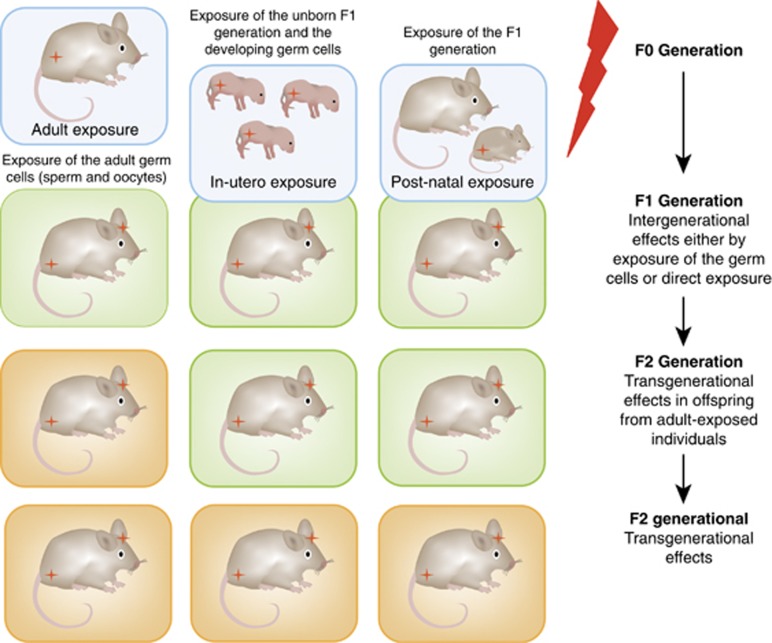
Figure 1
Figure 1
Environmental conditions can influence decent generations by distinct modes. The first column represents the exposure of an adult rodent to a stressful or aversive environment not only affecting the neural system of the exposed generation but also the germ cell through direct exposure. The germ cells give rise to the F1 generation representing an intergenerational transmission. The germ cells of the F1 generation are not exposed to the stressor and generate the subsequent F2 generation that represents a transgenerational transmission, which is not exposed to the stressor by means of a direct exposure or exposure of the germ cells. The second column represents the in utero exposure of a developing F1 generation to an environmental factor. This generation and the F2 generation, by means of the developing germ cells, are directly exposed, thus, representing an intergenerational transmission. The F3 generation represents the first generation that was not exposed to the stressor representing a transgenerational transmission. The third column represents the exposure of a F1 generation during postnatal development. Similar to the second example, this F1 as well as the F2 generation is directly exposed and therefore represent intergenerational transmission, with the following F3 generation representing a transgenerational transmission.
Figure 2
Figure 2
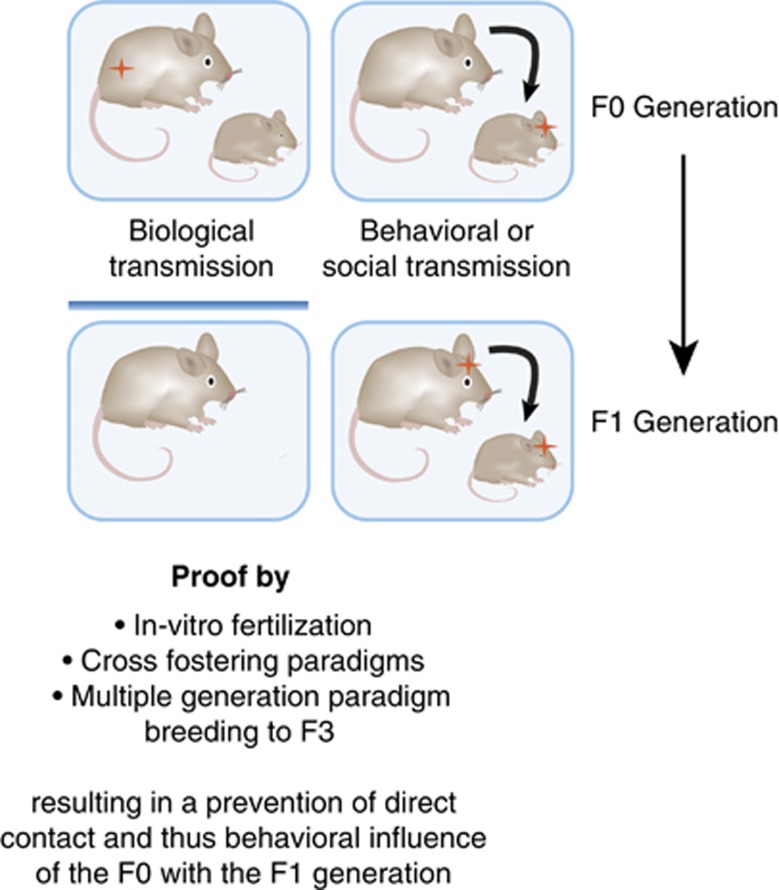
Transmission by behavioral or social cues is distinct from biological inheritance. The biological inheritance of acquired information through epigenetic mechanisms can be distinguished from the behavioral transmission in controlled experiments. Here, the contact of the stress-exposed father to the offspring can be excluded though in vitro fertilization (IVF) that also prevents effects on the female animal during mating potentially influencing maternal care. Other possibilities are cross-fostering paradigms and breeding schemes to the F3 generation that limit the potential of a behavioral transmission of information. This mode of information transfer is common and inevitable when parental generations interact with the offspring. Here, behavioral alterations can induce epigenetic modifications that are not present when animals are conceived through IVF, for example.
Figure 3
Figure 3
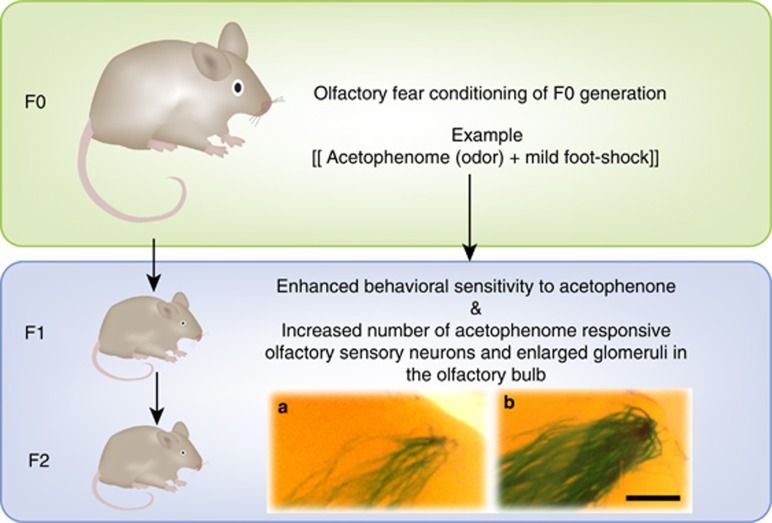
Transgenerational inheritance of enhanced olfactory sensitivity and its neuroanatomical representation. In this example, transgenerational inheritance is shown for Odor A (eg, acetophenone) in F1 and F2 generation of mice after the F0 generation was fear-conditioned to Odor A. Exposing an F0 generation of mice to an olfactory fear-conditioning paradigm, wherein presentations of a particular odor (eg, Odor A) are paired with mild foot-shocks, results in a sensitivity toward that odor in the F1 and F2 generations that have never previously been exposed to Odor A. When acetophenone, an odorant that activates M71-expressing odorant receptors in the nose, is used as the conditioning odor in the F0 generation, there are more M71-expressing olfactory sensory neurons in the nose of these animals. This enhanced neuroanatomical representation for M71 is also observed in the noses and olfactory bulbs of the F1 and F2 generation. DNA methylation is altered around the M71 receptor gene in sperm of the F0 and F1 generations, potentially associated with the greater number of M71 neurons in the F1 and F2 generations.

References

    1. Balhorn R (2007). The protamine family of sperm nuclear proteins. Genome Biol 8: 227. - PMC - PubMed
    1. Bell JT, Pai AA, Pickrell JK, Gaffney DJ, Pique-Regi R, Degner JF et al (2011). DNA methylation patterns associate with genetic and gene expression variation in HapMap cell lines. Genome Biol 12: 13. - PMC - PubMed
    1. Bierer LM, Bader HN, Daskalakis NP, Lehrner AL, Makotkine I, Seckl JR et al (2014). Elevation of 11β-hydroxysteroid dehydrogenase type 2 activity in Holocaust survivor offspring: evidence for an intergenerational effect of maternal trauma exposure. Psychoneuroendocrinology 48: 1–10. - PMC - PubMed
    1. Bird A (2007). Perceptions of epigenetics. Nature 447: 396–398. - PubMed
    1. Bonasio R, Tu S, Reinberg D (2010). Molecular signals of epigenetic states. Science 330: 612–616. - PMC - PubMed

Publication types