Risk Factors of Myopic Shift among Primary School Children in Beijing, China: A Prospective Study
- PMID: 26283882
- PMCID: PMC4532970
- DOI: 10.7150/ijms.12133
Risk Factors of Myopic Shift among Primary School Children in Beijing, China: A Prospective Study
Abstract
Objective: To evaluate factors associated with myopic shift among primary school children.
Methods: In a one-year prospective school-based study, 5052 children from ten schools were enrolled using a multi-stage random cluster approach. The baseline examination included non-cycloplegic auto-refractometry and questionnaire interview. Measurements were repeated at the follow-up.
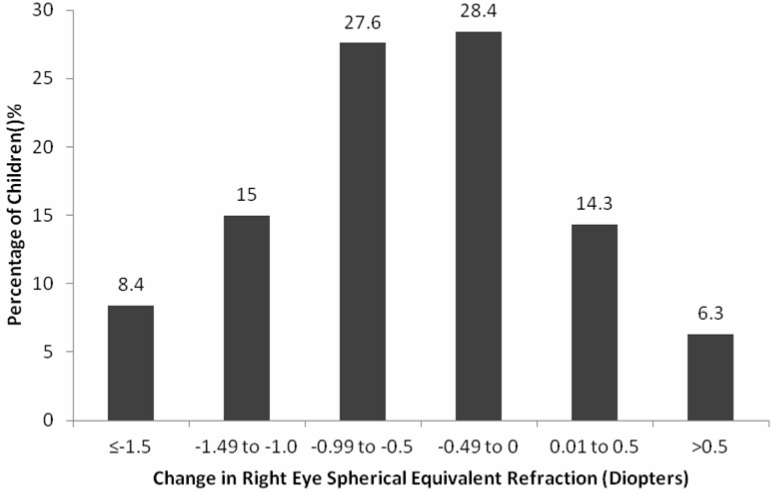
Results: Among 5052 students at baseline investigated, 4292 students (85.0%) returned for the follow-up examination. The mean refractive error (-1.13±1.57 diopters) had changed -0.52±0.73 diopters from the baseline to the follow-up examination. 2170 (51.0%) had a rate of significant myopic shift (significant myopic shift is defined as the change of spherical equivalent of the refraction ≤ -0.50D between the follow-up and baseline measures). We confirmed that common associated factors (older age, parental myopia, lower refractive status at baseline, shorter reading distance and lower frequency of outdoor activities during class recesses) were associated with greater shift towards myopia. After controlling for age, sex, region of habitation, parental myopia and refractive status at baseline, greater shift towards myopia was independently associated with distance from near-work (OR=1.48 , 95% CI=1.26-1.74, P<0.001) and longer time outdoors for leisure (OR=0.87, 95% CI=0.78-0.97, P<0.013).
Conclusion: Greater shift towards myopia was independently associated with modifiable factors (distance from near-work and longer time outdoors for leisure) might suggest that encouraging children to go outside for outdoor activities during class recess and after school may be a promising and feasible intervention against myopia development.
Keywords: Beijing China.; Myopia; Myopic shifts; Primary school children; Risk factors.
Conflict of interest statement
Competing interests: The authors declare there are not conflicts of interest.
Figures
References
-
- Morgan IG, Ohno-Matsui K. Saw SM. Myopia. Lancet. 2012;379:1739–1748. - PubMed
-
- Sun J, Zhou JB, Zhao PQ. et al. High prevalence of myopia and high myopia in 5060 chinese university students in Shanghai. Invest Ophthalmol Vis Sci. 2012;53:7504–7509. - PubMed
-
- Lin LL, Shin YF, Hsiao CK, Chen CJ. Prevalence of myopia in Taiwanese schoolchildren: 1983-2000. Ann Acad Med. 2004;33:27–33. - PubMed
-
- Jung SK, Lee JH, Kakizaki H, Jee D. Prevalence of myopia and its association with body stature and educational level in 19-year-old male conscripts in Seoul, South Korea. Invest Ophthalmol Vis Sci. 2012;53:5579–5583. - PubMed
-
- Lim MC, Gazzard G, Sim EL, Tong L, Saw SM. Direct costs of myopia in Singapore. Eye. 2009;23:1086–1089. - PubMed
Publication types
MeSH terms
LinkOut - more resources
Full Text Sources
Other Literature Sources